

B. Phase II Project (41# Operating Unit in Landfill Area II)
One set of percolate treatment facilities (2# lagoon treatment system, regulating
tank—anaerobic lagoon—facultative aerated lagoon—aerated lagoon), with a
processing capacity of 600 m
3 /d for each, has been built. For 2# aerated lagoon
treatment system, the following improvement measures have been taken: installation of cover on the regulating tank to enhance the effect of anaerobic process,
modification of the aeration system in aerobic tank to boost the effect of oxygenation, and introduction of the subsequent dosing-coagulation-sedimentation
process to raise the processing efficiency, realizing a design processing capacity of
600 m
3
/d.
Percolate treatment system II, covering an area of 158 mu (1 mu = 666.67 m
2 ),
is used to process the percolate from landfill area II and III. In both of the systems,
the “stabilization lagoon-reed wetland” treatment process is adopted. The percolate
treatment system is further restructured in phase-III reconstruction and expansion
project by provision of recharge unit, reed wetland water diverting and cut-off
separation levee, and chemical oxidation reaction tank. Additionally, the aeration
capacity in the facultative lagoon and aeration lagoon is enhanced. The processing
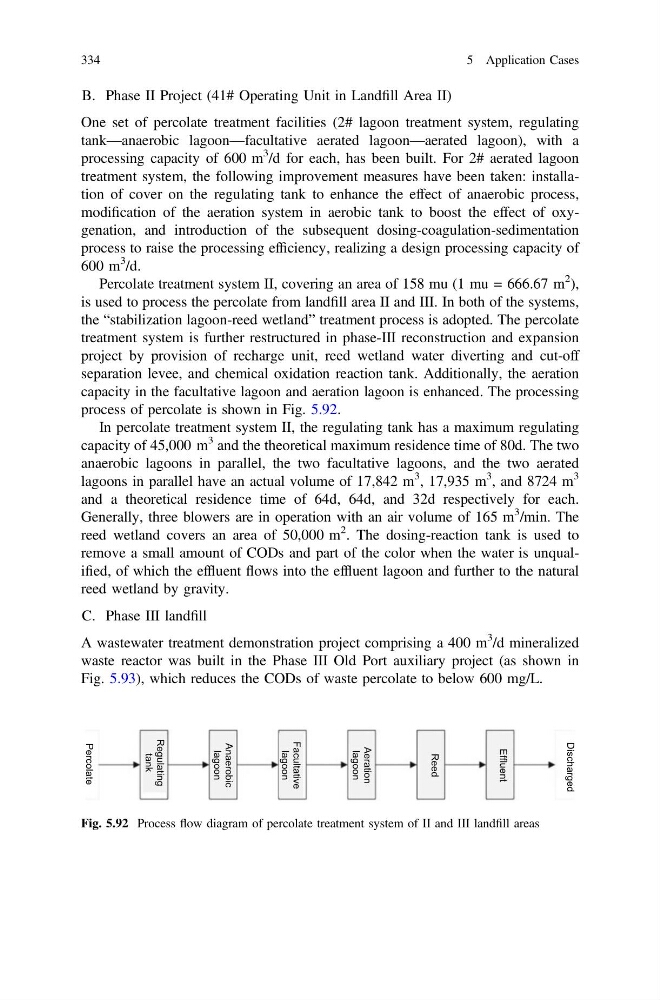
process of percolate is shown in Fig. 5.92.
In percolate treatment system II, the regulating tank has a maximum regulating
capacity of 45,000 m
3 and the theoretical maximum residence time of 80d. The two
anaerobic lagoons in parallel, the two facultative lagoons, and the two aerated
lagoons in parallel have an actual volume of 17,842 m
3 , 17,935 m
3 , and 8724 m
3
and a theoretical residence time of 64d, 64d, and 32d respectively for each.
Generally, three blowers are in operation with an air volume of 165 m
3 /min. The
reed wetland covers an area of 50,000 m
2 . The dosing-reaction tank is used to
remove a small amount of CODs and part of the color when the water is unqualified, of which the effluent flows into the effluent lagoon and further to the natural
reed wetland by gravity.
C. Phase III landfill
A wastewater treatment demonstration project comprising a 400 m
3 /d mineralized
waste reactor was built in the Phase III Old Port auxiliary project (as shown in
Fig. 5.93), which reduces the CODs of waste percolate to below 600 mg/L.
Percolate
Discharged
Regulating
tank
Anaerobic
lagoon
Facultative
lagoon
Aeration
lagoon
Reed
Effluent
Fig. 5.92 Process flow diagram of percolate treatment system of II and III landfill areas
334
5 Application Cases
One set of percolate treatment facilities (2# lagoon treatment system, regulating
tank—anaerobic lagoon—facultative aerated lagoon—aerated lagoon), with a
processing capacity of 600 m
3 /d for each, has been built. For 2# aerated lagoon
treatment system, the following improvement measures have been taken: installation of cover on the regulating tank to enhance the effect of anaerobic process,
modification of the aeration system in aerobic tank to boost the effect of oxygenation, and introduction of the subsequent dosing-coagulation-sedimentation
process to raise the processing efficiency, realizing a design processing capacity of
600 m
3
/d.
Percolate treatment system II, covering an area of 158 mu (1 mu = 666.67 m
2 ),
is used to process the percolate from landfill area II and III. In both of the systems,
the “stabilization lagoon-reed wetland” treatment process is adopted. The percolate
treatment system is further restructured in phase-III reconstruction and expansion
project by provision of recharge unit, reed wetland water diverting and cut-off
separation levee, and chemical oxidation reaction tank. Additionally, the aeration
capacity in the facultative lagoon and aeration lagoon is enhanced. The processing
process of percolate is shown in Fig. 5.92.
In percolate treatment system II, the regulating tank has a maximum regulating
capacity of 45,000 m
3 and the theoretical maximum residence time of 80d. The two
anaerobic lagoons in parallel, the two facultative lagoons, and the two aerated
lagoons in parallel have an actual volume of 17,842 m
3 , 17,935 m
3 , and 8724 m
3
and a theoretical residence time of 64d, 64d, and 32d respectively for each.
Generally, three blowers are in operation with an air volume of 165 m
3 /min. The
reed wetland covers an area of 50,000 m
2 . The dosing-reaction tank is used to
remove a small amount of CODs and part of the color when the water is unqualified, of which the effluent flows into the effluent lagoon and further to the natural
reed wetland by gravity.
C. Phase III landfill
A wastewater treatment demonstration project comprising a 400 m
3 /d mineralized
waste reactor was built in the Phase III Old Port auxiliary project (as shown in
Fig. 5.93), which reduces the CODs of waste percolate to below 600 mg/L.
Percolate
Discharged
Regulating
tank
Anaerobic
lagoon
Facultative
lagoon
Aeration
lagoon
Reed
Effluent
Fig. 5.92 Process flow diagram of percolate treatment system of II and III landfill areas
334
5 Application Cases