

② Existing percolate treatment facilities
I. Landfills of the first three phases
Percolate treatment facilities (constructed in 1994) with a capacity of 1160 m
3 /d
and a mineralized waste treatment facility with a capacity of 400 m
3 /d (and with the
wastewater treatment capacity of 1560 m
3 /d in total) were built in the first three
phases of the project.
A. Phase I Project (9# Operating Unit in Landfill Area I)
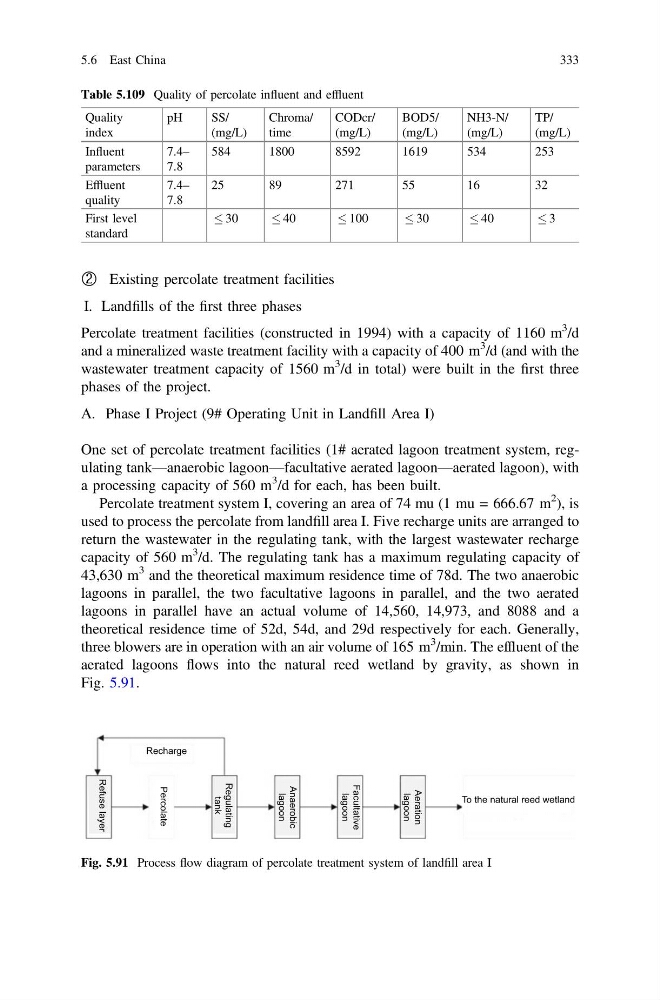
One set of percolate treatment facilities (1# aerated lagoon treatment system, regulating tank—anaerobic lagoon—facultative aerated lagoon—aerated lagoon), with
a processing capacity of 560 m
3 /d for each, has been built.
Percolate treatment system I, covering an area of 74 mu (1 mu = 666.67 m
2
), is
used to process the percolate from landfill area I. Five recharge units are arranged to
return the wastewater in the regulating tank, with the largest wastewater recharge
capacity of 560 m
3 /d. The regulating tank has a maximum regulating capacity of
43,630 m
3 and the theoretical maximum residence time of 78d. The two anaerobic
lagoons in parallel, the two facultative lagoons in parallel, and the two aerated
lagoons in parallel have an actual volume of 14,560, 14,973, and 8088 and a
theoretical residence time of 52d, 54d, and 29d respectively for each. Generally,
three blowers are in operation with an air volume of 165 m
3 /min. The effluent of the
aerated lagoons flows into the natural reed wetland by gravity, as shown in
Fig. 5.91.
Table 5.109 Quality of percolate influent and effluent
Quality
index
pH
SS/
(mg/L)
Chroma/
time
CODcr/
(mg/L)
BOD5/
(mg/L)
NH3-N/
(mg/L)
TP/
(mg/L)
Influent
parameters
7.4–
7.8
584
1800
8592
1619
534
253
Effluent
quality
7.4–
7.8
25
89
271
55
16
32
First level
standard
30
40
100
30
40
3
Refuse layer
Recharge
Percolate
Regulating
tank
Anaerobic
lagoon
Facultative
lagoon
Aeration
lagoon
To the natural reed wetland
Fig. 5.91 Process flow diagram of percolate treatment system of landfill area I
5.6 East China
333
I. Landfills of the first three phases
Percolate treatment facilities (constructed in 1994) with a capacity of 1160 m
3 /d
and a mineralized waste treatment facility with a capacity of 400 m
3 /d (and with the
wastewater treatment capacity of 1560 m
3 /d in total) were built in the first three
phases of the project.
A. Phase I Project (9# Operating Unit in Landfill Area I)
One set of percolate treatment facilities (1# aerated lagoon treatment system, regulating tank—anaerobic lagoon—facultative aerated lagoon—aerated lagoon), with
a processing capacity of 560 m
3 /d for each, has been built.
Percolate treatment system I, covering an area of 74 mu (1 mu = 666.67 m
2
), is
used to process the percolate from landfill area I. Five recharge units are arranged to
return the wastewater in the regulating tank, with the largest wastewater recharge
capacity of 560 m
3 /d. The regulating tank has a maximum regulating capacity of
43,630 m
3 and the theoretical maximum residence time of 78d. The two anaerobic
lagoons in parallel, the two facultative lagoons in parallel, and the two aerated
lagoons in parallel have an actual volume of 14,560, 14,973, and 8088 and a
theoretical residence time of 52d, 54d, and 29d respectively for each. Generally,
three blowers are in operation with an air volume of 165 m
3 /min. The effluent of the
aerated lagoons flows into the natural reed wetland by gravity, as shown in
Fig. 5.91.
Table 5.109 Quality of percolate influent and effluent
Quality
index
pH
SS/
(mg/L)
Chroma/
time
CODcr/
(mg/L)
BOD5/
(mg/L)
NH3-N/
(mg/L)
TP/
(mg/L)
Influent
parameters
7.4–
7.8
584
1800
8592
1619
534
253
Effluent
quality
7.4–
7.8
25
89
271
55
16
32
First level
standard
30
40
100
30
40
3
Refuse layer
Recharge
Percolate
Regulating
tank
Anaerobic
lagoon
Facultative
lagoon
Aeration
lagoon
To the natural reed wetland
Fig. 5.91 Process flow diagram of percolate treatment system of landfill area I
5.6 East China
333