

bottom and four sides of the landfill cells installed with the HDPE impermeable
membrane for seepage prevention, rain and polluted water separation unit, percolate
treatment unit and other measures.
Zoned landfills and separated sewage system of operating units and
non-operating units are adopted in the Old Port landfill, to reduce the amount of
rainfall in contact with the waste, thereby reducing the output of percolate and
protecting the surface water. The landfill percolate after collected, is treated by the
landfill sewage treatment plant, whose tail water is treated in a centralized manner
by Nanhui Wastewater Treatment Plant before being discharged into the East China
Sea.
① Compositions and characteristics of waste percolate
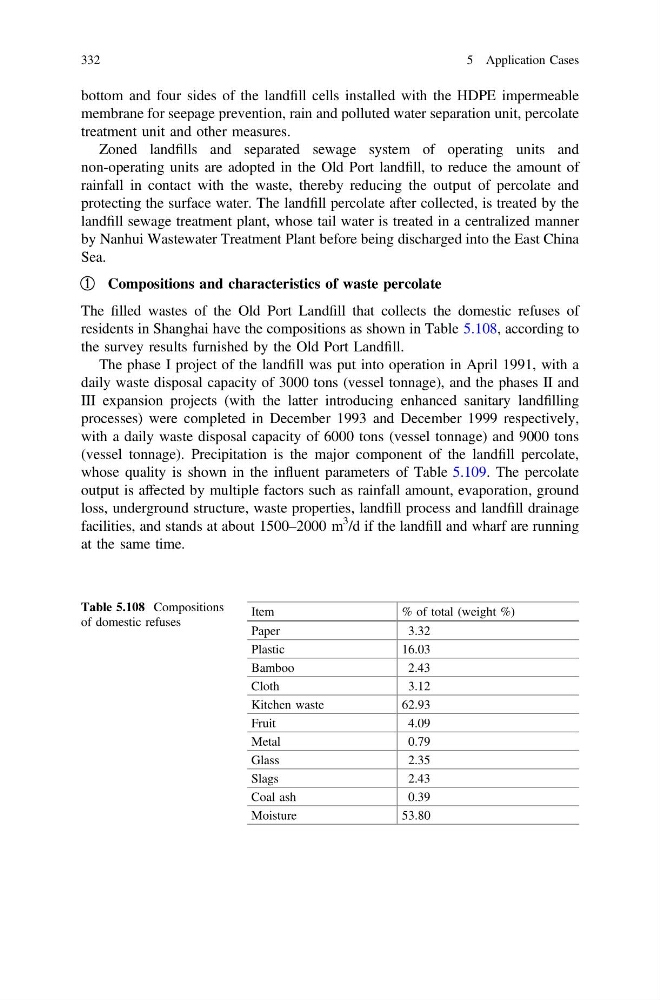
The filled wastes of the Old Port Landfill that collects the domestic refuses of
residents in Shanghai have the compositions as shown in Table 5.108, according to
the survey results furnished by the Old Port Landfill.
The phase I project of the landfill was put into operation in April 1991, with a
daily waste disposal capacity of 3000 tons (vessel tonnage), and the phases II and
III expansion projects (with the latter introducing enhanced sanitary landfilling
processes) were completed in December 1993 and December 1999 respectively,
with a daily waste disposal capacity of 6000 tons (vessel tonnage) and 9000 tons
(vessel tonnage). Precipitation is the major component of the landfill percolate,
whose quality is shown in the influent parameters of Table 5.109. The percolate
output is affected by multiple factors such as rainfall amount, evaporation, ground
loss, underground structure, waste properties, landfill process and landfill drainage
facilities, and stands at about 1500–2000 m
3 /d if the landfill and wharf are running
at the same time.
Table 5.108 Compositions
of domestic refuses
Item
% of total (weight %)
Paper
3.32
Plastic
16.03
Bamboo
2.43
Cloth
3.12
Kitchen waste
62.93
Fruit
4.09
Metal
0.79
Glass
2.35
Slags
2.43
Coal ash
0.39
Moisture
53.80
332
5 Application Cases
membrane for seepage prevention, rain and polluted water separation unit, percolate
treatment unit and other measures.
Zoned landfills and separated sewage system of operating units and
non-operating units are adopted in the Old Port landfill, to reduce the amount of
rainfall in contact with the waste, thereby reducing the output of percolate and
protecting the surface water. The landfill percolate after collected, is treated by the
landfill sewage treatment plant, whose tail water is treated in a centralized manner
by Nanhui Wastewater Treatment Plant before being discharged into the East China
Sea.
① Compositions and characteristics of waste percolate
The filled wastes of the Old Port Landfill that collects the domestic refuses of
residents in Shanghai have the compositions as shown in Table 5.108, according to
the survey results furnished by the Old Port Landfill.
The phase I project of the landfill was put into operation in April 1991, with a
daily waste disposal capacity of 3000 tons (vessel tonnage), and the phases II and
III expansion projects (with the latter introducing enhanced sanitary landfilling
processes) were completed in December 1993 and December 1999 respectively,
with a daily waste disposal capacity of 6000 tons (vessel tonnage) and 9000 tons
(vessel tonnage). Precipitation is the major component of the landfill percolate,
whose quality is shown in the influent parameters of Table 5.109. The percolate
output is affected by multiple factors such as rainfall amount, evaporation, ground
loss, underground structure, waste properties, landfill process and landfill drainage
facilities, and stands at about 1500–2000 m
3 /d if the landfill and wharf are running
at the same time.
Table 5.108 Compositions
of domestic refuses
Item
% of total (weight %)
Paper
3.32
Plastic
16.03
Bamboo
2.43
Cloth
3.12
Kitchen waste
62.93
Fruit
4.09
Metal
0.79
Glass
2.35
Slags
2.43
Coal ash
0.39
Moisture
53.80
332
5 Application Cases