

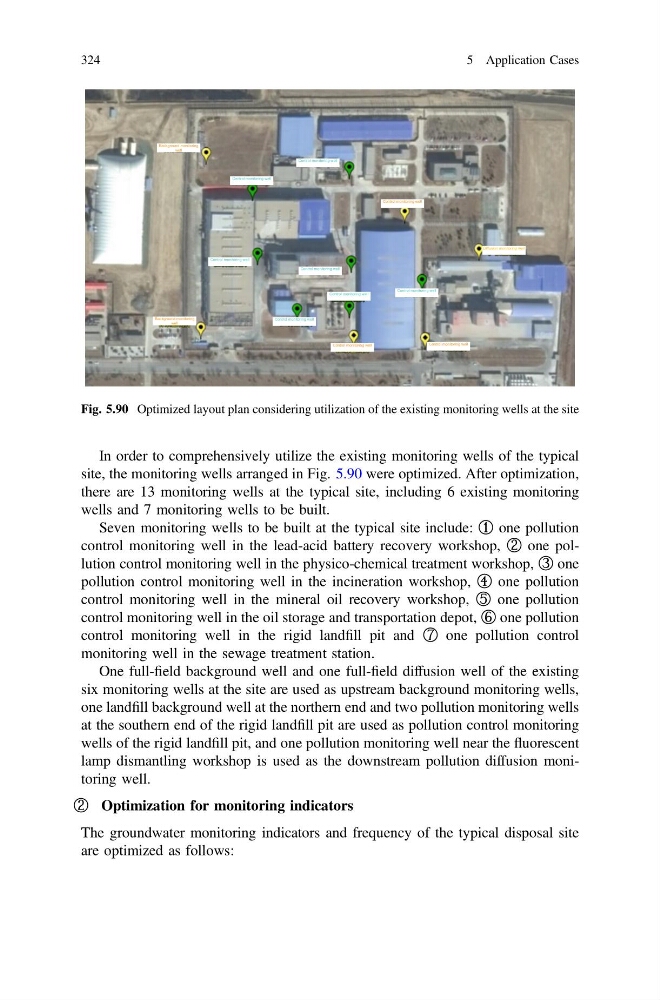
In order to comprehensively utilize the existing monitoring wells of the typical
site, the monitoring wells arranged in Fig. 5.90 were optimized. After optimization,
there are 13 monitoring wells at the typical site, including 6 existing monitoring
wells and 7 monitoring wells to be built.
Seven monitoring wells to be built at the typical site include: ① one pollution
control monitoring well in the lead-acid battery recovery workshop, ② one pollution control monitoring well in the physico-chemical treatment workshop, ③ one
pollution control monitoring well in the incineration workshop, ④ one pollution
control monitoring well in the mineral oil recovery workshop, ⑤ one pollution
control monitoring well in the oil storage and transportation depot, ⑥ one pollution
control monitoring well in the rigid landfill pit and ⑦ one pollution control
monitoring well in the sewage treatment station.
One full-field background well and one full-field diffusion well of the existing
six monitoring wells at the site are used as upstream background monitoring wells,
one landfill background well at the northern end and two pollution monitoring wells
at the southern end of the rigid landfill pit are used as pollution control monitoring
wells of the rigid landfill pit, and one pollution monitoring well near the fluorescent
lamp dismantling workshop is used as the downstream pollution diffusion monitoring well.
② Optimization for monitoring indicators
The groundwater monitoring indicators and frequency of the typical disposal site
are optimized as follows:
Control monitoring well
Control monitoring well
Control monitoring well
Background monitoring
well
Background monitoring
well
Control monitoring well
Control monitoring well
Control monitoring well
Control monitoring well
Control monitoring well
Control monitoring well
Control monitoring well
Diffusion monitoring well
Fig. 5.90 Optimized layout plan considering utilization of the existing monitoring wells at the site
324
5 Application Cases
site, the monitoring wells arranged in Fig. 5.90 were optimized. After optimization,
there are 13 monitoring wells at the typical site, including 6 existing monitoring
wells and 7 monitoring wells to be built.
Seven monitoring wells to be built at the typical site include: ① one pollution
control monitoring well in the lead-acid battery recovery workshop, ② one pollution control monitoring well in the physico-chemical treatment workshop, ③ one
pollution control monitoring well in the incineration workshop, ④ one pollution
control monitoring well in the mineral oil recovery workshop, ⑤ one pollution
control monitoring well in the oil storage and transportation depot, ⑥ one pollution
control monitoring well in the rigid landfill pit and ⑦ one pollution control
monitoring well in the sewage treatment station.
One full-field background well and one full-field diffusion well of the existing
six monitoring wells at the site are used as upstream background monitoring wells,
one landfill background well at the northern end and two pollution monitoring wells
at the southern end of the rigid landfill pit are used as pollution control monitoring
wells of the rigid landfill pit, and one pollution monitoring well near the fluorescent
lamp dismantling workshop is used as the downstream pollution diffusion monitoring well.
② Optimization for monitoring indicators
The groundwater monitoring indicators and frequency of the typical disposal site
are optimized as follows:
Control monitoring well
Control monitoring well
Control monitoring well
Background monitoring
well
Background monitoring
well
Control monitoring well
Control monitoring well
Control monitoring well
Control monitoring well
Control monitoring well
Control monitoring well
Control monitoring well
Diffusion monitoring well
Fig. 5.90 Optimized layout plan considering utilization of the existing monitoring wells at the site
324
5 Application Cases