

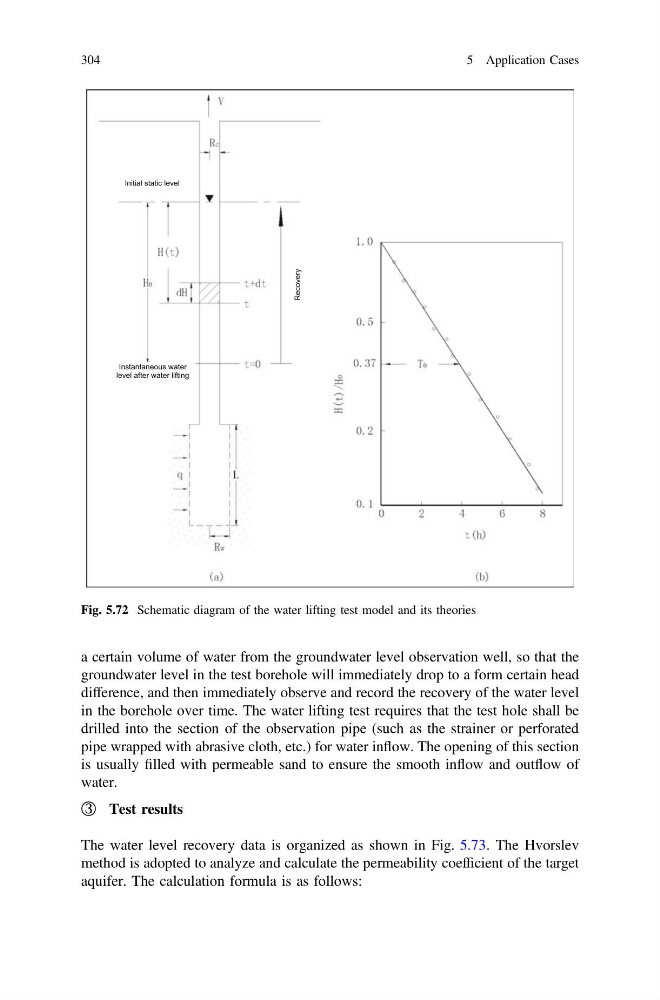
a certain volume of water from the groundwater level observation well, so that the
groundwater level in the test borehole will immediately drop to a form certain head
difference, and then immediately observe and record the recovery of the water level
in the borehole over time. The water lifting test requires that the test hole shall be
drilled into the section of the observation pipe (such as the strainer or perforated
pipe wrapped with abrasive cloth, etc.) for water inflow. The opening of this section
is usually filled with permeable sand to ensure the smooth inflow and outflow of
water.
③ Test results
The water level recovery data is organized as shown in Fig. 5.73. The Hvorslev
method is adopted to analyze and calculate the permeability coefficient of the target
aquifer. The calculation formula is as follows:
Initial static level
Instantaneous water
level after water lifting
Recovery
Fig. 5.72 Schematic diagram of the water lifting test model and its theories
304
5 Application Cases
groundwater level in the test borehole will immediately drop to a form certain head
difference, and then immediately observe and record the recovery of the water level
in the borehole over time. The water lifting test requires that the test hole shall be
drilled into the section of the observation pipe (such as the strainer or perforated
pipe wrapped with abrasive cloth, etc.) for water inflow. The opening of this section
is usually filled with permeable sand to ensure the smooth inflow and outflow of
water.
③ Test results
The water level recovery data is organized as shown in Fig. 5.73. The Hvorslev
method is adopted to analyze and calculate the permeability coefficient of the target
aquifer. The calculation formula is as follows:
Initial static level
Instantaneous water
level after water lifting
Recovery
Fig. 5.72 Schematic diagram of the water lifting test model and its theories
304
5 Application Cases