

when the permeability coefficient measured under different starting heads is within
the allowable difference range, end the test.
③ Test results
The permeability coefficient of variable head shall be calculated according to the
following formula:
K T ¼ 2:3
aL
Aðt 2 À t 1 Þ
log
H 1
H 2
where
a
Cross-sectional area of variable head pipe (cm
2 )
L
Seepage path, namely test height (cm)
t 1 , t 2
Starting time and end time for measuring and recording the head (s)
H 1 , H 2 Starting head and ending head.
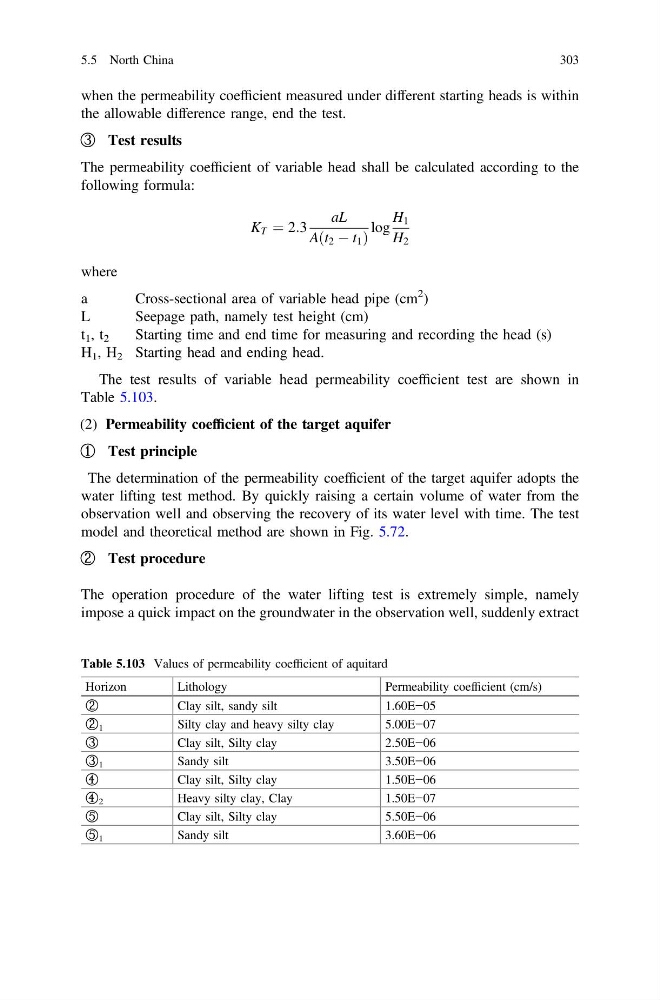
The test results of variable head permeability coefficient test are shown in
Table 5.103.
(2) Permeability coefficient of the target aquifer
① Test principle
The determination of the permeability coefficient of the target aquifer adopts the
water lifting test method. By quickly raising a certain volume of water from the
observation well and observing the recovery of its water level with time. The test
model and theoretical method are shown in Fig. 5.72.
② Test procedure
The operation procedure of the water lifting test is extremely simple, namely
impose a quick impact on the groundwater in the observation well, suddenly extract
Table 5.103 Values of permeability coefficient of aquitard
Horizon
Lithology
Permeability coefficient (cm/s)
②
Clay silt, sandy silt
1.60E−05
② 1
Silty clay and heavy silty clay
5.00E−07
③
Clay silt, Silty clay
2.50E−06
③ 1
Sandy silt
3.50E−06
④
Clay silt, Silty clay
1.50E−06
④ 2
Heavy silty clay, Clay
1.50E−07
⑤
Clay silt, Silty clay
5.50E−06
⑤ 1
Sandy silt
3.60E−06
5.5 North China
303
the allowable difference range, end the test.
③ Test results
The permeability coefficient of variable head shall be calculated according to the
following formula:
K T ¼ 2:3
aL
Aðt 2 À t 1 Þ
log
H 1
H 2
where
a
Cross-sectional area of variable head pipe (cm
2 )
L
Seepage path, namely test height (cm)
t 1 , t 2
Starting time and end time for measuring and recording the head (s)
H 1 , H 2 Starting head and ending head.
The test results of variable head permeability coefficient test are shown in
Table 5.103.
(2) Permeability coefficient of the target aquifer
① Test principle
The determination of the permeability coefficient of the target aquifer adopts the
water lifting test method. By quickly raising a certain volume of water from the
observation well and observing the recovery of its water level with time. The test
model and theoretical method are shown in Fig. 5.72.
② Test procedure
The operation procedure of the water lifting test is extremely simple, namely
impose a quick impact on the groundwater in the observation well, suddenly extract
Table 5.103 Values of permeability coefficient of aquitard
Horizon
Lithology
Permeability coefficient (cm/s)
②
Clay silt, sandy silt
1.60E−05
② 1
Silty clay and heavy silty clay
5.00E−07
③
Clay silt, Silty clay
2.50E−06
③ 1
Sandy silt
3.50E−06
④
Clay silt, Silty clay
1.50E−06
④ 2
Heavy silty clay, Clay
1.50E−07
⑤
Clay silt, Silty clay
5.50E−06
⑤ 1
Sandy silt
3.60E−06
5.5 North China
303