

522
M. Matsumoto et al.
labour wage increases in these countries, these processes become less economically
feasible. This is the reason why component restoration is less done today.
HDOR is another sector in which remanufacturing is actively conducted. Typical
examples of HDOR equipment include excavators, bulldozers, backhoes, asphalt
pavers, and trucks. Remanufactured components in the sector include engines,
starters, alternators, turbochargers, transmission axles, hydraulic cylinders, hydraulic
pumps, reduction gear equipment, and so on. Of these components, material surface
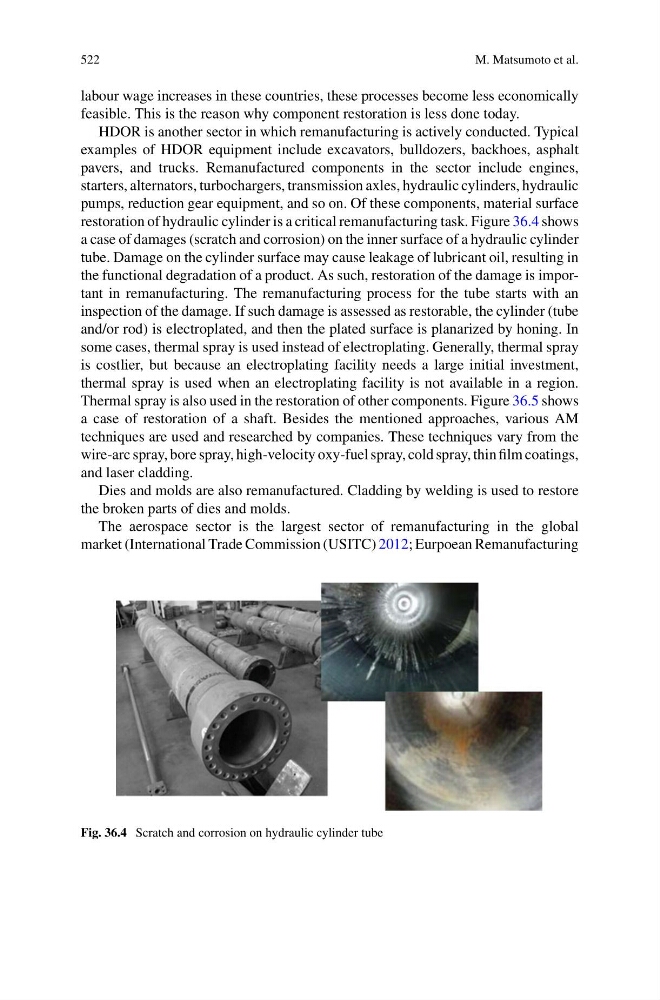
restoration of hydraulic cylinder is a critical remanufacturing task. Figure 36.4 shows
a case of damages (scratch and corrosion) on the inner surface of a hydraulic cylinder
tube. Damage on the cylinder surface may cause leakage of lubricant oil, resulting in
the functional degradation of a product. As such, restoration of the damage is important in remanufacturing. The remanufacturing process for the tube starts with an
inspection of the damage. If such damage is assessed as restorable, the cylinder (tube
and/or rod) is electroplated, and then the plated surface is planarized by honing. In
some cases, thermal spray is used instead of electroplating. Generally, thermal spray
is costlier, but because an electroplating facility needs a large initial investment,
thermal spray is used when an electroplating facility is not available in a region.
Thermal spray is also used in the restoration of other components. Figure 36.5 shows
a case of restoration of a shaft. Besides the mentioned approaches, various AM
techniques are used and researched by companies. These techniques vary from the
wire-arc spray, bore spray, high-velocity oxy-fuel spray, cold spray, thin film coatings,
and laser cladding.
Dies and molds are also remanufactured. Cladding by welding is used to restore
the broken parts of dies and molds.
The aerospace sector is the largest sector of remanufacturing in the global
market (International Trade Commission (USITC) 2012; Eurpoean Remanufacturing
Fig. 36.4 Scratch and corrosion on hydraulic cylinder tube
M. Matsumoto et al.
labour wage increases in these countries, these processes become less economically
feasible. This is the reason why component restoration is less done today.
HDOR is another sector in which remanufacturing is actively conducted. Typical
examples of HDOR equipment include excavators, bulldozers, backhoes, asphalt
pavers, and trucks. Remanufactured components in the sector include engines,
starters, alternators, turbochargers, transmission axles, hydraulic cylinders, hydraulic
pumps, reduction gear equipment, and so on. Of these components, material surface
restoration of hydraulic cylinder is a critical remanufacturing task. Figure 36.4 shows
a case of damages (scratch and corrosion) on the inner surface of a hydraulic cylinder
tube. Damage on the cylinder surface may cause leakage of lubricant oil, resulting in
the functional degradation of a product. As such, restoration of the damage is important in remanufacturing. The remanufacturing process for the tube starts with an
inspection of the damage. If such damage is assessed as restorable, the cylinder (tube
and/or rod) is electroplated, and then the plated surface is planarized by honing. In
some cases, thermal spray is used instead of electroplating. Generally, thermal spray
is costlier, but because an electroplating facility needs a large initial investment,
thermal spray is used when an electroplating facility is not available in a region.
Thermal spray is also used in the restoration of other components. Figure 36.5 shows
a case of restoration of a shaft. Besides the mentioned approaches, various AM
techniques are used and researched by companies. These techniques vary from the
wire-arc spray, bore spray, high-velocity oxy-fuel spray, cold spray, thin film coatings,
and laser cladding.
Dies and molds are also remanufactured. Cladding by welding is used to restore
the broken parts of dies and molds.
The aerospace sector is the largest sector of remanufacturing in the global
market (International Trade Commission (USITC) 2012; Eurpoean Remanufacturing
Fig. 36.4 Scratch and corrosion on hydraulic cylinder tube