

36 Additive Manufacturing for Circular Manufacturing: Trends …
521
when the depth of the layers to scrape off is within the range of tolerance. In other
cases, the damages are restored by making up the part, under what is known as AM.
AM techniques used in present-day remanufacturing include welding, cladding, and
thermal spray.
The automobile parts sector is one of the sectors in which remanufacturing is
observed actively. AM is used in the sector. The sector, however, is oftentimes associated with a relatively strong cost constraint, originating from the principle that the
price of the original products in this sector is relatively lower than those of other
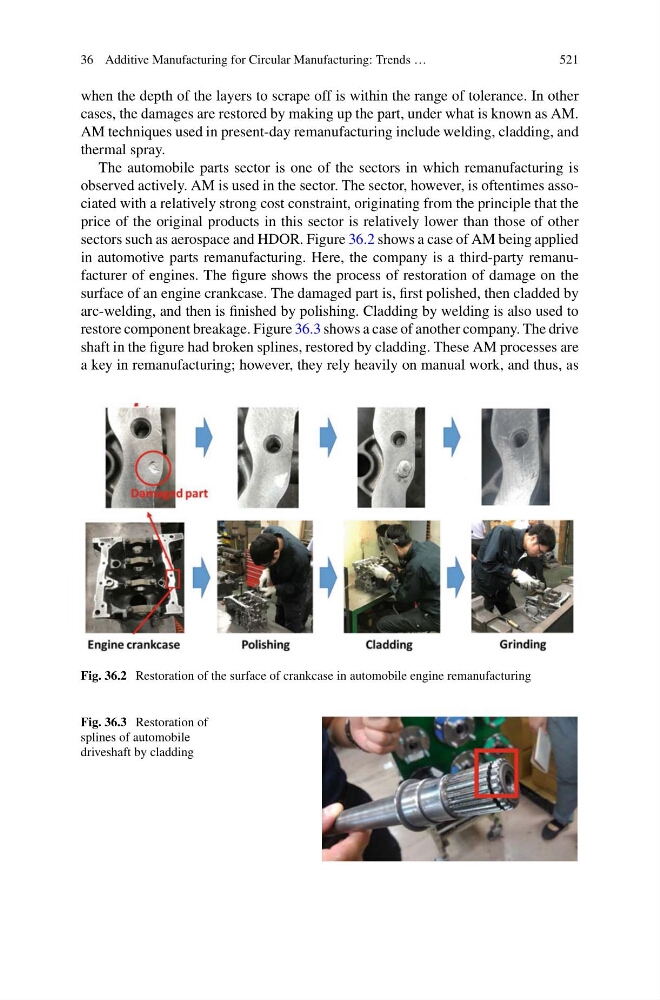
sectors such as aerospace and HDOR. Figure 36.2 shows a case of AM being applied
in automotive parts remanufacturing. Here, the company is a third-party remanufacturer of engines. The figure shows the process of restoration of damage on the
surface of an engine crankcase. The damaged part is, first polished, then cladded by
arc-welding, and then is finished by polishing. Cladding by welding is also used to
restore component breakage. Figure 36.3 shows a case of another company. The drive
shaft in the figure had broken splines, restored by cladding. These AM processes are
a key in remanufacturing; however, they rely heavily on manual work, and thus, as
Fig. 36.2 Restoration of the surface of crankcase in automobile engine remanufacturing
Fig. 36.3 Restoration of
splines of automobile
driveshaft by cladding
521
when the depth of the layers to scrape off is within the range of tolerance. In other
cases, the damages are restored by making up the part, under what is known as AM.
AM techniques used in present-day remanufacturing include welding, cladding, and
thermal spray.
The automobile parts sector is one of the sectors in which remanufacturing is
observed actively. AM is used in the sector. The sector, however, is oftentimes associated with a relatively strong cost constraint, originating from the principle that the
price of the original products in this sector is relatively lower than those of other
sectors such as aerospace and HDOR. Figure 36.2 shows a case of AM being applied
in automotive parts remanufacturing. Here, the company is a third-party remanufacturer of engines. The figure shows the process of restoration of damage on the
surface of an engine crankcase. The damaged part is, first polished, then cladded by
arc-welding, and then is finished by polishing. Cladding by welding is also used to
restore component breakage. Figure 36.3 shows a case of another company. The drive
shaft in the figure had broken splines, restored by cladding. These AM processes are
a key in remanufacturing; however, they rely heavily on manual work, and thus, as
Fig. 36.2 Restoration of the surface of crankcase in automobile engine remanufacturing
Fig. 36.3 Restoration of
splines of automobile
driveshaft by cladding