

36 Additive Manufacturing for Circular Manufacturing: Trends …
523
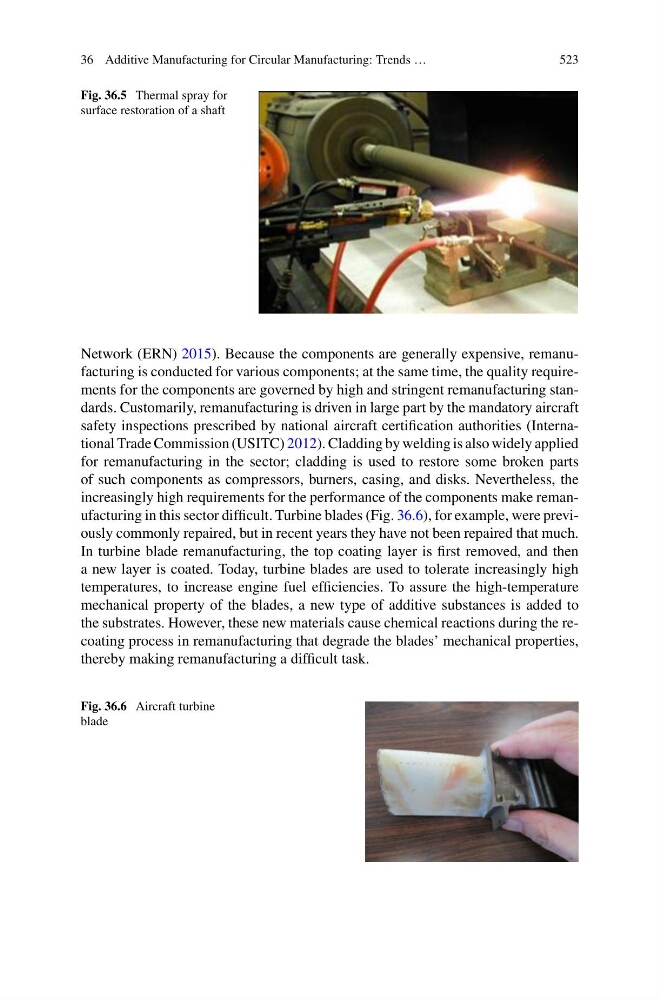
Fig. 36.5 Thermal spray for
surface restoration of a shaft
Network (ERN) 2015). Because the components are generally expensive, remanufacturing is conducted for various components; at the same time, the quality requirements for the components are governed by high and stringent remanufacturing standards. Customarily, remanufacturing is driven in large part by the mandatory aircraft
safety inspections prescribed by national aircraft certification authorities (International Trade Commission (USITC) 2012). Cladding by welding is also widely applied
for remanufacturing in the sector; cladding is used to restore some broken parts
of such components as compressors, burners, casing, and disks. Nevertheless, the
increasingly high requirements for the performance of the components make remanufacturing in this sector difficult. Turbine blades (Fig. 36.6), for example, were previously commonly repaired, but in recent years they have not been repaired that much.
In turbine blade remanufacturing, the top coating layer is first removed, and then
a new layer is coated. Today, turbine blades are used to tolerate increasingly high
temperatures, to increase engine fuel efficiencies. To assure the high-temperature
mechanical property of the blades, a new type of additive substances is added to
the substrates. However, these new materials cause chemical reactions during the recoating process in remanufacturing that degrade the blades’ mechanical properties,
thereby making remanufacturing a difficult task.
Fig. 36.6 Aircraft turbine
blade
523
Fig. 36.5 Thermal spray for
surface restoration of a shaft
Network (ERN) 2015). Because the components are generally expensive, remanufacturing is conducted for various components; at the same time, the quality requirements for the components are governed by high and stringent remanufacturing standards. Customarily, remanufacturing is driven in large part by the mandatory aircraft
safety inspections prescribed by national aircraft certification authorities (International Trade Commission (USITC) 2012). Cladding by welding is also widely applied
for remanufacturing in the sector; cladding is used to restore some broken parts
of such components as compressors, burners, casing, and disks. Nevertheless, the
increasingly high requirements for the performance of the components make remanufacturing in this sector difficult. Turbine blades (Fig. 36.6), for example, were previously commonly repaired, but in recent years they have not been repaired that much.
In turbine blade remanufacturing, the top coating layer is first removed, and then
a new layer is coated. Today, turbine blades are used to tolerate increasingly high
temperatures, to increase engine fuel efficiencies. To assure the high-temperature
mechanical property of the blades, a new type of additive substances is added to
the substrates. However, these new materials cause chemical reactions during the recoating process in remanufacturing that degrade the blades’ mechanical properties,
thereby making remanufacturing a difficult task.
Fig. 36.6 Aircraft turbine
blade