

33 Analysis of Manufacturing Costs for Powder Metallurgy (PM) …
481
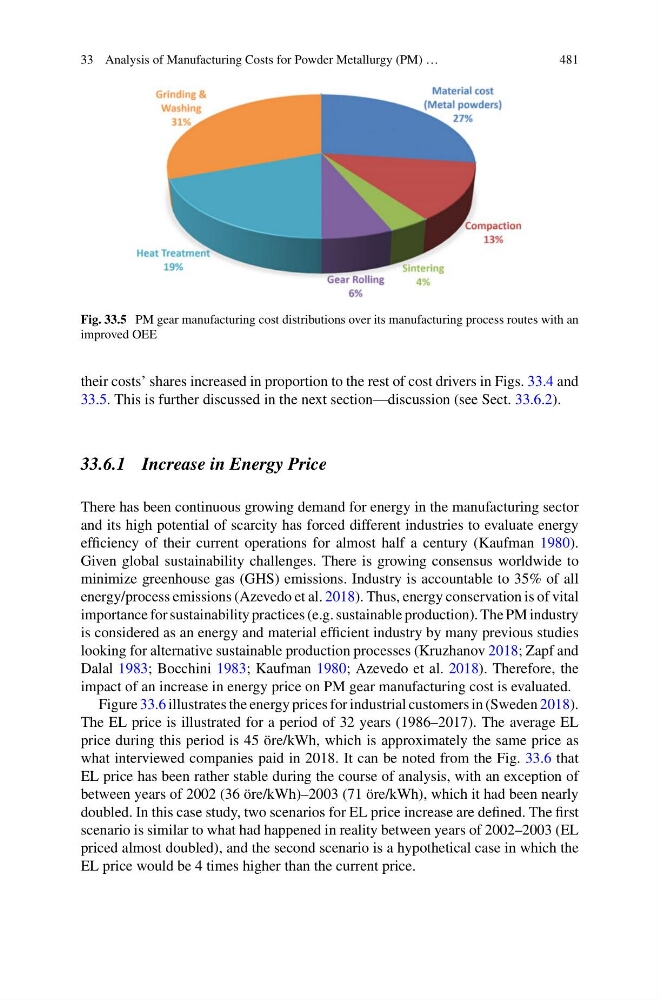
Fig. 33.5 PM gear manufacturing cost distributions over its manufacturing process routes with an
improved OEE
their costs’ shares increased in proportion to the rest of cost drivers in Figs. 33.4 and
33.5. This is further discussed in the next section—discussion (see Sect. 33.6.2).
33.6.1 Increase in Energy Price
There has been continuous growing demand for energy in the manufacturing sector
and its high potential of scarcity has forced different industries to evaluate energy
efficiency of their current operations for almost half a century (Kaufman 1980).
Given global sustainability challenges. There is growing consensus worldwide to
minimize greenhouse gas (GHS) emissions. Industry is accountable to 35% of all
energy/process emissions (Azevedo et al. 2018). Thus, energy conservation is of vital
importance for sustainability practices (e.g. sustainable production). The PM industry
is considered as an energy and material efficient industry by many previous studies
looking for alternative sustainable production processes (Kruzhanov 2018; Zapf and
Dalal 1983; Bocchini 1983; Kaufman 1980; Azevedo et al. 2018). Therefore, the
impact of an increase in energy price on PM gear manufacturing cost is evaluated.
Figure 33.6 illustrates the energy prices for industrial customers in (Sweden 2018).
The EL price is illustrated for a period of 32 years (1986–2017). The average EL
price during this period is 45 öre/kWh, which is approximately the same price as
what interviewed companies paid in 2018. It can be noted from the Fig. 33.6 that
EL price has been rather stable during the course of analysis, with an exception of
between years of 2002 (36 öre/kWh)–2003 (71 öre/kWh), which it had been nearly
doubled. In this case study, two scenarios for EL price increase are defined. The first
scenario is similar to what had happened in reality between years of 2002–2003 (EL
priced almost doubled), and the second scenario is a hypothetical case in which the
EL price would be 4 times higher than the current price.
481
Fig. 33.5 PM gear manufacturing cost distributions over its manufacturing process routes with an
improved OEE
their costs’ shares increased in proportion to the rest of cost drivers in Figs. 33.4 and
33.5. This is further discussed in the next section—discussion (see Sect. 33.6.2).
33.6.1 Increase in Energy Price
There has been continuous growing demand for energy in the manufacturing sector
and its high potential of scarcity has forced different industries to evaluate energy
efficiency of their current operations for almost half a century (Kaufman 1980).
Given global sustainability challenges. There is growing consensus worldwide to
minimize greenhouse gas (GHS) emissions. Industry is accountable to 35% of all
energy/process emissions (Azevedo et al. 2018). Thus, energy conservation is of vital
importance for sustainability practices (e.g. sustainable production). The PM industry
is considered as an energy and material efficient industry by many previous studies
looking for alternative sustainable production processes (Kruzhanov 2018; Zapf and
Dalal 1983; Bocchini 1983; Kaufman 1980; Azevedo et al. 2018). Therefore, the
impact of an increase in energy price on PM gear manufacturing cost is evaluated.
Figure 33.6 illustrates the energy prices for industrial customers in (Sweden 2018).
The EL price is illustrated for a period of 32 years (1986–2017). The average EL
price during this period is 45 öre/kWh, which is approximately the same price as
what interviewed companies paid in 2018. It can be noted from the Fig. 33.6 that
EL price has been rather stable during the course of analysis, with an exception of
between years of 2002 (36 öre/kWh)–2003 (71 öre/kWh), which it had been nearly
doubled. In this case study, two scenarios for EL price increase are defined. The first
scenario is similar to what had happened in reality between years of 2002–2003 (EL
priced almost doubled), and the second scenario is a hypothetical case in which the
EL price would be 4 times higher than the current price.