

38
H.-Y. Kang et al.
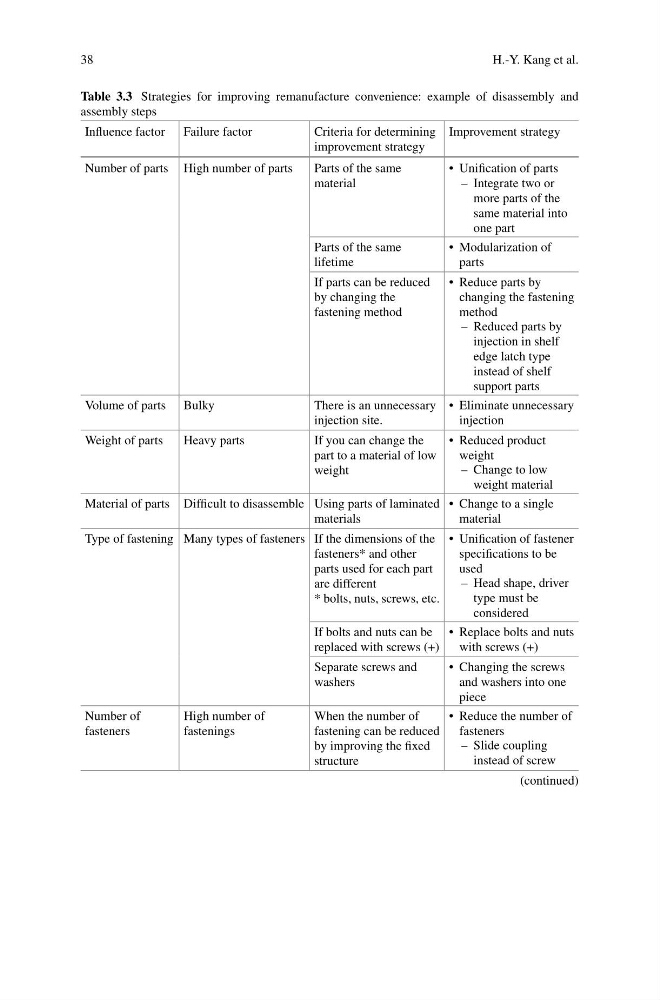
Table 3.3 Strategies for improving remanufacture convenience: example of disassembly and
assembly steps
Influence factor Failure factor
Criteria for determining
improvement strategy
Improvement strategy
Number of parts High number of parts
Parts of the same
material
• Unification of parts
– Integrate two or
more parts of the
same material into
one part
Parts of the same
lifetime
• Modularization of
parts
If parts can be reduced
by changing the
fastening method
• Reduce parts by
changing the fastening
method
– Reduced parts by
injection in shelf
edge latch type
instead of shelf
support parts
Volume of parts Bulky
There is an unnecessary
injection site.
• Eliminate unnecessary
injection
Weight of parts
Heavy parts
If you can change the
part to a material of low
weight
• Reduced product
weight
– Change to low
weight material
Material of parts Difficult to disassemble Using parts of laminated
materials
• Change to a single
material
Type of fastening Many types of fasteners If the dimensions of the
fasteners* and other
parts used for each part
are different
* bolts, nuts, screws, etc.
• Unification of fastener
specifications to be
used
– Head shape, driver
type must be
considered
If bolts and nuts can be
replaced with screws (+)
• Replace bolts and nuts
with screws (+)
Separate screws and
washers
• Changing the screws
and washers into one
piece
Number of
fasteners
High number of
fastenings
When the number of
fastening can be reduced
by improving the fixed
structure
• Reduce the number of
fasteners
– Slide coupling
instead of screw
(continued)
H.-Y. Kang et al.
Table 3.3 Strategies for improving remanufacture convenience: example of disassembly and
assembly steps
Influence factor Failure factor
Criteria for determining
improvement strategy
Improvement strategy
Number of parts High number of parts
Parts of the same
material
• Unification of parts
– Integrate two or
more parts of the
same material into
one part
Parts of the same
lifetime
• Modularization of
parts
If parts can be reduced
by changing the
fastening method
• Reduce parts by
changing the fastening
method
– Reduced parts by
injection in shelf
edge latch type
instead of shelf
support parts
Volume of parts Bulky
There is an unnecessary
injection site.
• Eliminate unnecessary
injection
Weight of parts
Heavy parts
If you can change the
part to a material of low
weight
• Reduced product
weight
– Change to low
weight material
Material of parts Difficult to disassemble Using parts of laminated
materials
• Change to a single
material
Type of fastening Many types of fasteners If the dimensions of the
fasteners* and other
parts used for each part
are different
* bolts, nuts, screws, etc.
• Unification of fastener
specifications to be
used
– Head shape, driver
type must be
considered
If bolts and nuts can be
replaced with screws (+)
• Replace bolts and nuts
with screws (+)
Separate screws and
washers
• Changing the screws
and washers into one
piece
Number of
fasteners
High number of
fastenings
When the number of
fastening can be reduced
by improving the fixed
structure
• Reduce the number of
fasteners
– Slide coupling
instead of screw
(continued)