

29 A Novel Approach to Artificial Energy-Loss Free Field Emitters …
419
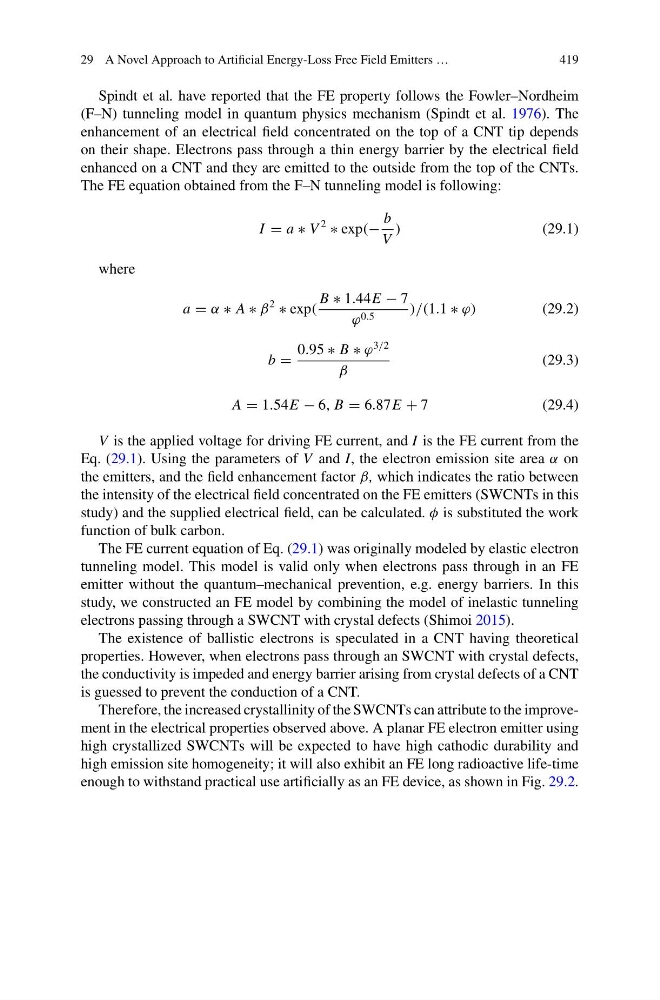
Spindt et al. have reported that the FE property follows the Fowler–Nordheim
(F–N) tunneling model in quantum physics mechanism (Spindt et al. 1976). The
enhancement of an electrical field concentrated on the top of a CNT tip depends
on their shape. Electrons pass through a thin energy barrier by the electrical field
enhanced on a CNT and they are emitted to the outside from the top of the CNTs.
The FE equation obtained from the F–N tunneling model is following:
I = a ∗ V
2
∗ exp(−
b
V
)
(29.1)
where
a = α ∗ A ∗ β
2
∗ exp(
B ∗ 1.44E − 7
ϕ 0.5
)/(1.1 ∗ ϕ)
(29.2)
b =
0.95 ∗ B ∗ ϕ
3/2
β
(29.3)
A = 1.54E − 6, B = 6.87E + 7
(29.4)
V is the applied voltage for driving FE current, and I is the FE current from the
Eq. (29.1). Using the parameters of V and I, the electron emission site area α on
the emitters, and the field enhancement factor β, which indicates the ratio between
the intensity of the electrical field concentrated on the FE emitters (SWCNTs in this
study) and the supplied electrical field, can be calculated. φ is substituted the work
function of bulk carbon.
The FE current equation of Eq. (29.1) was originally modeled by elastic electron
tunneling model. This model is valid only when electrons pass through in an FE
emitter without the quantum–mechanical prevention, e.g. energy barriers. In this
study, we constructed an FE model by combining the model of inelastic tunneling
electrons passing through a SWCNT with crystal defects (Shimoi 2015).
The existence of ballistic electrons is speculated in a CNT having theoretical
properties. However, when electrons pass through an SWCNT with crystal defects,
the conductivity is impeded and energy barrier arising from crystal defects of a CNT
is guessed to prevent the conduction of a CNT.
Therefore, the increased crystallinity of the SWCNTs can attribute to the improvement in the electrical properties observed above. A planar FE electron emitter using
high crystallized SWCNTs will be expected to have high cathodic durability and
high emission site homogeneity; it will also exhibit an FE long radioactive life-time
enough to withstand practical use artificially as an FE device, as shown in Fig. 29.2.
419
Spindt et al. have reported that the FE property follows the Fowler–Nordheim
(F–N) tunneling model in quantum physics mechanism (Spindt et al. 1976). The
enhancement of an electrical field concentrated on the top of a CNT tip depends
on their shape. Electrons pass through a thin energy barrier by the electrical field
enhanced on a CNT and they are emitted to the outside from the top of the CNTs.
The FE equation obtained from the F–N tunneling model is following:
I = a ∗ V
2
∗ exp(−
b
V
)
(29.1)
where
a = α ∗ A ∗ β
2
∗ exp(
B ∗ 1.44E − 7
ϕ 0.5
)/(1.1 ∗ ϕ)
(29.2)
b =
0.95 ∗ B ∗ ϕ
3/2
β
(29.3)
A = 1.54E − 6, B = 6.87E + 7
(29.4)
V is the applied voltage for driving FE current, and I is the FE current from the
Eq. (29.1). Using the parameters of V and I, the electron emission site area α on
the emitters, and the field enhancement factor β, which indicates the ratio between
the intensity of the electrical field concentrated on the FE emitters (SWCNTs in this
study) and the supplied electrical field, can be calculated. φ is substituted the work
function of bulk carbon.
The FE current equation of Eq. (29.1) was originally modeled by elastic electron
tunneling model. This model is valid only when electrons pass through in an FE
emitter without the quantum–mechanical prevention, e.g. energy barriers. In this
study, we constructed an FE model by combining the model of inelastic tunneling
electrons passing through a SWCNT with crystal defects (Shimoi 2015).
The existence of ballistic electrons is speculated in a CNT having theoretical
properties. However, when electrons pass through an SWCNT with crystal defects,
the conductivity is impeded and energy barrier arising from crystal defects of a CNT
is guessed to prevent the conduction of a CNT.
Therefore, the increased crystallinity of the SWCNTs can attribute to the improvement in the electrical properties observed above. A planar FE electron emitter using
high crystallized SWCNTs will be expected to have high cathodic durability and
high emission site homogeneity; it will also exhibit an FE long radioactive life-time
enough to withstand practical use artificially as an FE device, as shown in Fig. 29.2.