

28 Green Power Generations and Environmental Monitoring Systems …
399
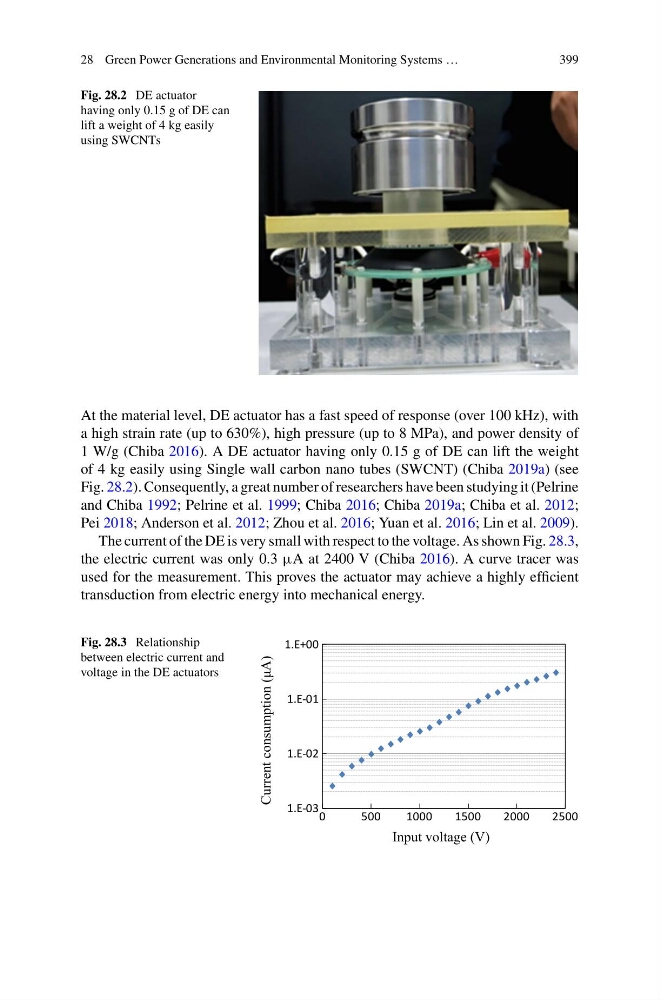
Fig. 28.2 DE actuator
having only 0.15 g of DE can
lift a weight of 4 kg easily
using SWCNTs
At the material level, DE actuator has a fast speed of response (over 100 kHz), with
a high strain rate (up to 630%), high pressure (up to 8 MPa), and power density of
1 W/g (Chiba 2016). A DE actuator having only 0.15 g of DE can lift the weight
of 4 kg easily using Single wall carbon nano tubes (SWCNT) (Chiba 2019a) (see
Fig. 28.2). Consequently, a great number of researchers have been studying it (Pelrine
and Chiba 1992; Pelrine et al. 1999; Chiba 2016; Chiba 2019a; Chiba et al. 2012;
Pei 2018; Anderson et al. 2012; Zhou et al. 2016; Yuan et al. 2016; Lin et al. 2009).
The current of the DE is very small with respect to the voltage. As shown Fig. 28.3,
the electric current was only 0.3 µA at 2400 V (Chiba 2016). A curve tracer was
used for the measurement. This proves the actuator may achieve a highly efficient
transduction from electric energy into mechanical energy.
Fig. 28.3 Relationship
between electric current and
voltage in the DE actuators
1.E-03
1.E-02
1.E-01
1.E+00
0
500
1000
1500
2000
2500
Input voltage (V)
Current consumption (μA)
399
Fig. 28.2 DE actuator
having only 0.15 g of DE can
lift a weight of 4 kg easily
using SWCNTs
At the material level, DE actuator has a fast speed of response (over 100 kHz), with
a high strain rate (up to 630%), high pressure (up to 8 MPa), and power density of
1 W/g (Chiba 2016). A DE actuator having only 0.15 g of DE can lift the weight
of 4 kg easily using Single wall carbon nano tubes (SWCNT) (Chiba 2019a) (see
Fig. 28.2). Consequently, a great number of researchers have been studying it (Pelrine
and Chiba 1992; Pelrine et al. 1999; Chiba 2016; Chiba 2019a; Chiba et al. 2012;
Pei 2018; Anderson et al. 2012; Zhou et al. 2016; Yuan et al. 2016; Lin et al. 2009).
The current of the DE is very small with respect to the voltage. As shown Fig. 28.3,
the electric current was only 0.3 µA at 2400 V (Chiba 2016). A curve tracer was
used for the measurement. This proves the actuator may achieve a highly efficient
transduction from electric energy into mechanical energy.
Fig. 28.3 Relationship
between electric current and
voltage in the DE actuators
1.E-03
1.E-02
1.E-01
1.E+00
0
500
1000
1500
2000
2500
Input voltage (V)
Current consumption (μA)