

398
S. Chiba et al.
2018). Furthermore, due to problems such as the exhaustion of resources and global
warming, it is necessary to rapidly expand the proportional use of renewable energy.
Currently, its proportion of the world’s total electricity generation is only 22%.
In the very near future, the population of the earth will reach 10 billion and the
power consumption will be massive. If, for example, a population of 10 billion
attempts to maintain the plentiful lifestyle that many enjoy today with frequent
consumption of beef, the number of cattle required to sustain that will cause a huge
spike in greenhouse gases with their exhalations. We could solve this by lab-grown
cultured meat, but that necessitates a great deal of energy. Other advancements such
as the growing use of electronic currency will incur greater energy demands and
more currency networks link up to monitor one another. In short, humanity is in dire
need of highly efficient and renewable power sources.
Renewable energy comes in a myriad of possible forms: photovoltaic power generation, solar thermal utilization, wind power generation, biomass utilization power
generation, geothermal power generation, snow and ice thermal power generation,
and wave power generation. However, since the power generation cost of common
systems remains very high, research and development of more effective materials
and those of peripheral equipment continues (Liu et al. 2011; Krajacˇic´ et al. 2011;
Rourke et al. 2009; Khan et al. 2009; Segurado et al. 2011).
The dielectric elastomers (DEs) are very efficient as actuators and can be used
as accurate sensors and also capable of high efficiency power generation. They
have received a lot of attention as a means to help address the growing dangers
our world faces. This paper discusses how to construct global smart cities, efficient
transportation, environmental monitoring systems, etc., using the DE transducer.
28.2 Back Ground of DE
DEs are a relatively new transducer technology that was first investigated by Pelrine,
Chiba et al. in SRI in 1991(Pelrine and Chiba 1992). DEs use rubberlike polymers
(elastomers) as actuator materials (Pelrine and Chiba 1992; Pelrine et al. 1999).
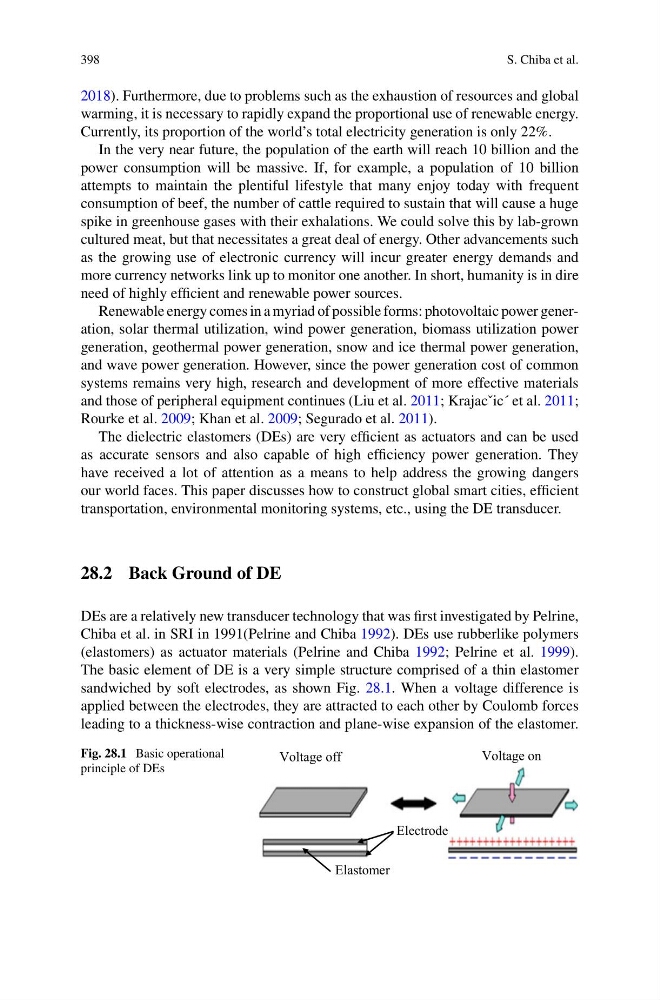
The basic element of DE is a very simple structure comprised of a thin elastomer
sandwiched by soft electrodes, as shown Fig. 28.1. When a voltage difference is
applied between the electrodes, they are attracted to each other by Coulomb forces
leading to a thickness-wise contraction and plane-wise expansion of the elastomer.
Fig. 28.1 Basic operational
principle of DEs
Voltage off
Voltage on
Electrode
Elastomer
S. Chiba et al.
2018). Furthermore, due to problems such as the exhaustion of resources and global
warming, it is necessary to rapidly expand the proportional use of renewable energy.
Currently, its proportion of the world’s total electricity generation is only 22%.
In the very near future, the population of the earth will reach 10 billion and the
power consumption will be massive. If, for example, a population of 10 billion
attempts to maintain the plentiful lifestyle that many enjoy today with frequent
consumption of beef, the number of cattle required to sustain that will cause a huge
spike in greenhouse gases with their exhalations. We could solve this by lab-grown
cultured meat, but that necessitates a great deal of energy. Other advancements such
as the growing use of electronic currency will incur greater energy demands and
more currency networks link up to monitor one another. In short, humanity is in dire
need of highly efficient and renewable power sources.
Renewable energy comes in a myriad of possible forms: photovoltaic power generation, solar thermal utilization, wind power generation, biomass utilization power
generation, geothermal power generation, snow and ice thermal power generation,
and wave power generation. However, since the power generation cost of common
systems remains very high, research and development of more effective materials
and those of peripheral equipment continues (Liu et al. 2011; Krajacˇic´ et al. 2011;
Rourke et al. 2009; Khan et al. 2009; Segurado et al. 2011).
The dielectric elastomers (DEs) are very efficient as actuators and can be used
as accurate sensors and also capable of high efficiency power generation. They
have received a lot of attention as a means to help address the growing dangers
our world faces. This paper discusses how to construct global smart cities, efficient
transportation, environmental monitoring systems, etc., using the DE transducer.
28.2 Back Ground of DE
DEs are a relatively new transducer technology that was first investigated by Pelrine,
Chiba et al. in SRI in 1991(Pelrine and Chiba 1992). DEs use rubberlike polymers
(elastomers) as actuator materials (Pelrine and Chiba 1992; Pelrine et al. 1999).
The basic element of DE is a very simple structure comprised of a thin elastomer
sandwiched by soft electrodes, as shown Fig. 28.1. When a voltage difference is
applied between the electrodes, they are attracted to each other by Coulomb forces
leading to a thickness-wise contraction and plane-wise expansion of the elastomer.
Fig. 28.1 Basic operational
principle of DEs
Voltage off
Voltage on
Electrode
Elastomer