

27 An Economic Evaluation of Recycling System in Next-Generation …
389
speed of the truck(km/h); time shows a movable time(hour);profit is the selling price
of REE(JPY/car).
Equation (27.2) maximizes the revenue consisting of sales profit, transportation
cost, equipment cost, and labor cost using discount rate. Constraint (3) shows to
ensure that each car dismantling facility belongs to exactly one recycling facility
in t. Constraint (4) shows that when the equipment is introduced to the recycling
facility in the first term, the equipment is introduced continuously from the next
year. Constraint (5) is used to restrict the car dismantling facilities that should be
assigned to a recycling facility. Constraint (6) limits the time that the driver can work
on the track. Constraint (7) specifies the binary variables.
The future annual waste of an NdFeB-sintered magnet was estimated using the
parameters of Weibull distribution and was assigned to m areas according to the
population and car ownership at a particular prefecture in Japan based on the considered regional characteristics. The transportation cost of an HEV motor was estimated
based on the distance from a car dismantling facility to a recycling facility. Each car
dismantling facility was installed in each J area, and the recycling facilities were
constructed at a particular I. The location of the recycling facilities and the allocation of car dismantling facilities were estimated using the previous model formula.
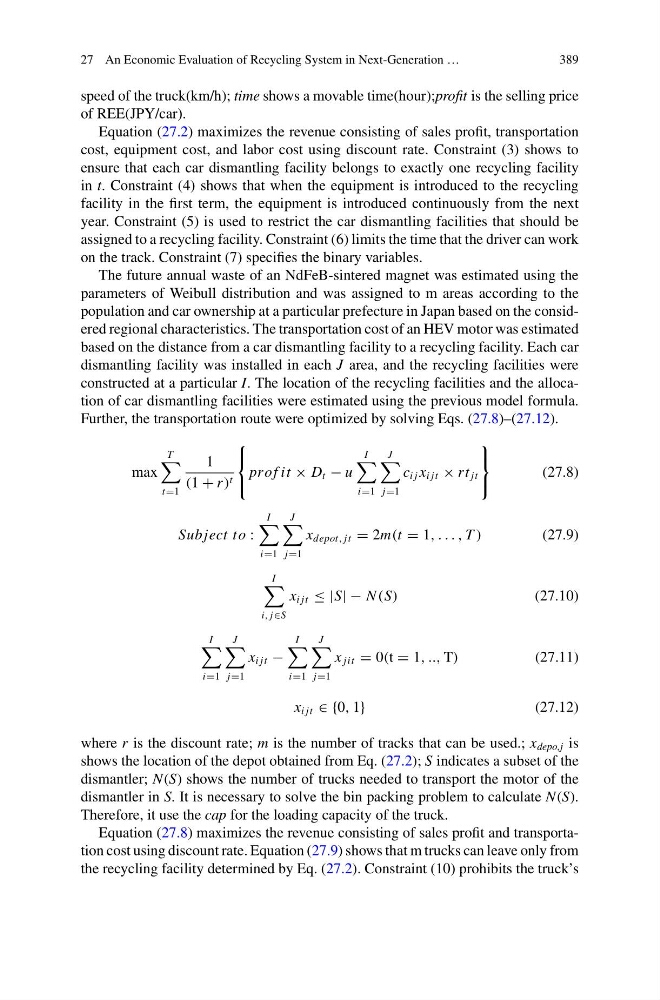
Further, the transportation route were optimized by solving Eqs. (27.8)–(27.12).
max
T
t=1
1
(1 + r ) t
⎧
⎨
⎩
pr o f it × D t − u
I
i=1
J
j=1
c i j x i jt × rt jt
⎫
⎬
⎭
(27.8)
Subject to :
I
i=1
J
j=1
x depot, jt = 2m(t = 1, . . . , T )
(27.9)
I
i, j∈S
x i jt ≤ |S| − N (S)
(27.10)
I
i=1
J
j=1
x i jt −
I
i=1
J
j=1
x jit = 0(t = 1, .., T)
(27.11)
x i jt ∈ {0, 1}
(27.12)
where r is the discount rate; m is the number of tracks that can be used.; x depo,j is
shows the location of the depot obtained from Eq. (27.2); S indicates a subset of the
dismantler; N(S) shows the number of trucks needed to transport the motor of the
dismantler in S. It is necessary to solve the bin packing problem to calculate N(S).
Therefore, it use the cap for the loading capacity of the truck.
Equation (27.8) maximizes the revenue consisting of sales profit and transportation cost using discount rate. Equation (27.9) shows that m trucks can leave only from
the recycling facility determined by Eq. (27.2). Constraint (10) prohibits the truck’s
389
speed of the truck(km/h); time shows a movable time(hour);profit is the selling price
of REE(JPY/car).
Equation (27.2) maximizes the revenue consisting of sales profit, transportation
cost, equipment cost, and labor cost using discount rate. Constraint (3) shows to
ensure that each car dismantling facility belongs to exactly one recycling facility
in t. Constraint (4) shows that when the equipment is introduced to the recycling
facility in the first term, the equipment is introduced continuously from the next
year. Constraint (5) is used to restrict the car dismantling facilities that should be
assigned to a recycling facility. Constraint (6) limits the time that the driver can work
on the track. Constraint (7) specifies the binary variables.
The future annual waste of an NdFeB-sintered magnet was estimated using the
parameters of Weibull distribution and was assigned to m areas according to the
population and car ownership at a particular prefecture in Japan based on the considered regional characteristics. The transportation cost of an HEV motor was estimated
based on the distance from a car dismantling facility to a recycling facility. Each car
dismantling facility was installed in each J area, and the recycling facilities were
constructed at a particular I. The location of the recycling facilities and the allocation of car dismantling facilities were estimated using the previous model formula.
Further, the transportation route were optimized by solving Eqs. (27.8)–(27.12).
max
T
t=1
1
(1 + r ) t
⎧
⎨
⎩
pr o f it × D t − u
I
i=1
J
j=1
c i j x i jt × rt jt
⎫
⎬
⎭
(27.8)
Subject to :
I
i=1
J
j=1
x depot, jt = 2m(t = 1, . . . , T )
(27.9)
I
i, j∈S
x i jt ≤ |S| − N (S)
(27.10)
I
i=1
J
j=1
x i jt −
I
i=1
J
j=1
x jit = 0(t = 1, .., T)
(27.11)
x i jt ∈ {0, 1}
(27.12)
where r is the discount rate; m is the number of tracks that can be used.; x depo,j is
shows the location of the depot obtained from Eq. (27.2); S indicates a subset of the
dismantler; N(S) shows the number of trucks needed to transport the motor of the
dismantler in S. It is necessary to solve the bin packing problem to calculate N(S).
Therefore, it use the cap for the loading capacity of the truck.
Equation (27.8) maximizes the revenue consisting of sales profit and transportation cost using discount rate. Equation (27.9) shows that m trucks can leave only from
the recycling facility determined by Eq. (27.2). Constraint (10) prohibits the truck’s