

388
H. Kuroki et al.
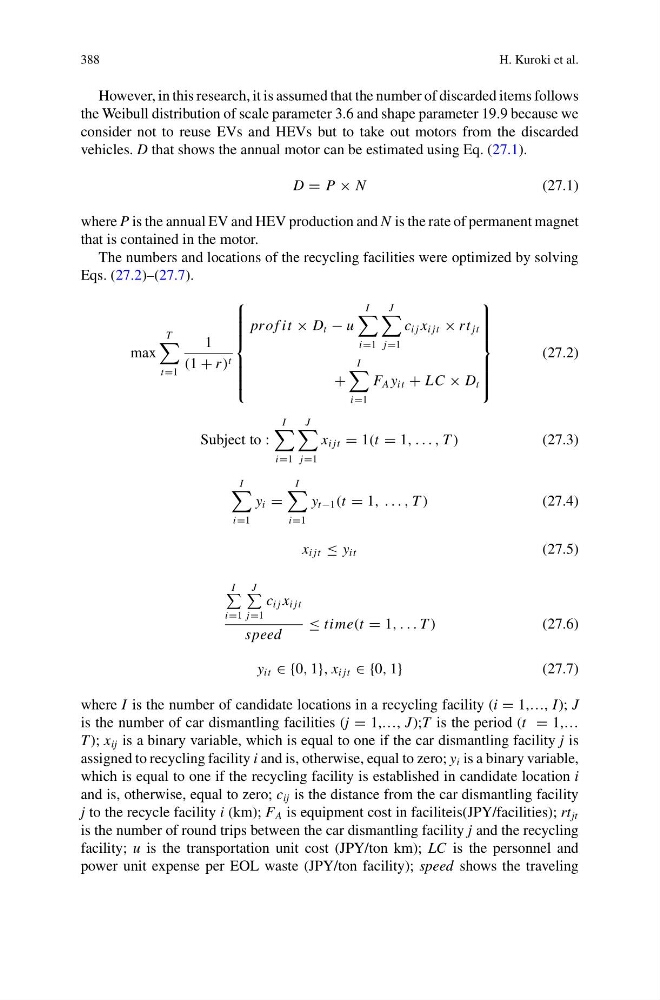
However, in this research, it is assumed that the number of discarded items follows
the Weibull distribution of scale parameter 3.6 and shape parameter 19.9 because we
consider not to reuse EVs and HEVs but to take out motors from the discarded
vehicles. D that shows the annual motor can be estimated using Eq. (27.1).
D = P × N
(27.1)
where P is the annual EV and HEV production and N is the rate of permanent magnet
that is contained in the motor.
The numbers and locations of the recycling facilities were optimized by solving
Eqs. (27.2)–(27.7).
max
T
t=1
1
(1 + r ) t
⎧
⎪ ⎪ ⎪ ⎪ ⎪ ⎨
⎪ ⎪ ⎪ ⎪ ⎪ ⎩
pr o f it × D t − u
I
i=1
J
j=1
c i j x i jt × rt jt
+
I
i=1
F A y it + LC × D t
⎫
⎪ ⎪ ⎪ ⎪ ⎪ ⎬
⎪ ⎪ ⎪ ⎪ ⎪ ⎭
(27.2)
Subject to :
I
i=1
J
j=1
x i jt = 1(t = 1, . . . , T )
(27.3)
I
i=1
y i =
I
i=1
y t−1 (t = 1, . . . , T )
(27.4)
x i jt ≤ y it
(27.5)
I
i=1
J
j=1
c i j x i jt
speed
≤ time(t = 1, . . . T )
(27.6)
y it ∈ {0, 1}, x i jt ∈ {0, 1}
(27.7)
where I is the number of candidate locations in a recycling facility (i = 1,…, I); J
is the number of car dismantling facilities (j = 1,…, J);T is the period (t = 1,…
T ); x ij is a binary variable, which is equal to one if the car dismantling facility j is
assigned to recycling facility i and is, otherwise, equal to zero; y i is a binary variable,
which is equal to one if the recycling facility is established in candidate location i
and is, otherwise, equal to zero; c ij is the distance from the car dismantling facility
j to the recycle facility i (km); F A is equipment cost in faciliteis(JPY/facilities); rt jt
is the number of round trips between the car dismantling facility j and the recycling
facility; u is the transportation unit cost (JPY/ton km); LC is the personnel and
power unit expense per EOL waste (JPY/ton facility); speed shows the traveling
H. Kuroki et al.
However, in this research, it is assumed that the number of discarded items follows
the Weibull distribution of scale parameter 3.6 and shape parameter 19.9 because we
consider not to reuse EVs and HEVs but to take out motors from the discarded
vehicles. D that shows the annual motor can be estimated using Eq. (27.1).
D = P × N
(27.1)
where P is the annual EV and HEV production and N is the rate of permanent magnet
that is contained in the motor.
The numbers and locations of the recycling facilities were optimized by solving
Eqs. (27.2)–(27.7).
max
T
t=1
1
(1 + r ) t
⎧
⎪ ⎪ ⎪ ⎪ ⎪ ⎨
⎪ ⎪ ⎪ ⎪ ⎪ ⎩
pr o f it × D t − u
I
i=1
J
j=1
c i j x i jt × rt jt
+
I
i=1
F A y it + LC × D t
⎫
⎪ ⎪ ⎪ ⎪ ⎪ ⎬
⎪ ⎪ ⎪ ⎪ ⎪ ⎭
(27.2)
Subject to :
I
i=1
J
j=1
x i jt = 1(t = 1, . . . , T )
(27.3)
I
i=1
y i =
I
i=1
y t−1 (t = 1, . . . , T )
(27.4)
x i jt ≤ y it
(27.5)
I
i=1
J
j=1
c i j x i jt
speed
≤ time(t = 1, . . . T )
(27.6)
y it ∈ {0, 1}, x i jt ∈ {0, 1}
(27.7)
where I is the number of candidate locations in a recycling facility (i = 1,…, I); J
is the number of car dismantling facilities (j = 1,…, J);T is the period (t = 1,…
T ); x ij is a binary variable, which is equal to one if the car dismantling facility j is
assigned to recycling facility i and is, otherwise, equal to zero; y i is a binary variable,
which is equal to one if the recycling facility is established in candidate location i
and is, otherwise, equal to zero; c ij is the distance from the car dismantling facility
j to the recycle facility i (km); F A is equipment cost in faciliteis(JPY/facilities); rt jt
is the number of round trips between the car dismantling facility j and the recycling
facility; u is the transportation unit cost (JPY/ton km); LC is the personnel and
power unit expense per EOL waste (JPY/ton facility); speed shows the traveling