

370
N. F. Nissen et al.
and there are also some indications that already today also printed circuit boards
with a larger number of tantalum capacitors are separated for dedicated tantalum
recovery.
26.2.3 Neodymium
Neodymium belongs to the rare earth elements (REE) and possesses high magnetism
with a low density (7.003 g/cm
3 ) and a melting point at 1024 °C. REE occur in the
earth’s crust in various minerals. Large amounts of energy, water and toxic chemicals are used for the extraction of rare earths and the subsequent elemental separation, which is associated with high environmental pollution (Ökoinstitut 2011).
Neodymium is utilized in various technical applications such as electric motors,
batteries, catalytic converters, wind turbines and hybrid cars. The largest application is the production of NdFeB magnets, which are used in many information
and communication technology devices: Permanent magnets from hard-disk-drives,
miniaturized loudspeakers, headphones, smartphones and microphones. Neodymium
magnets appear in products where low mass, small volume, or strong magnetic fields
are required. With concentrations ranging up to 23–29%, neodymium is an important component of high performance permanent magnets, which may additionally
contain the heavy rare earth elements praseodymium and dysprosium (Böni et al.
2015).
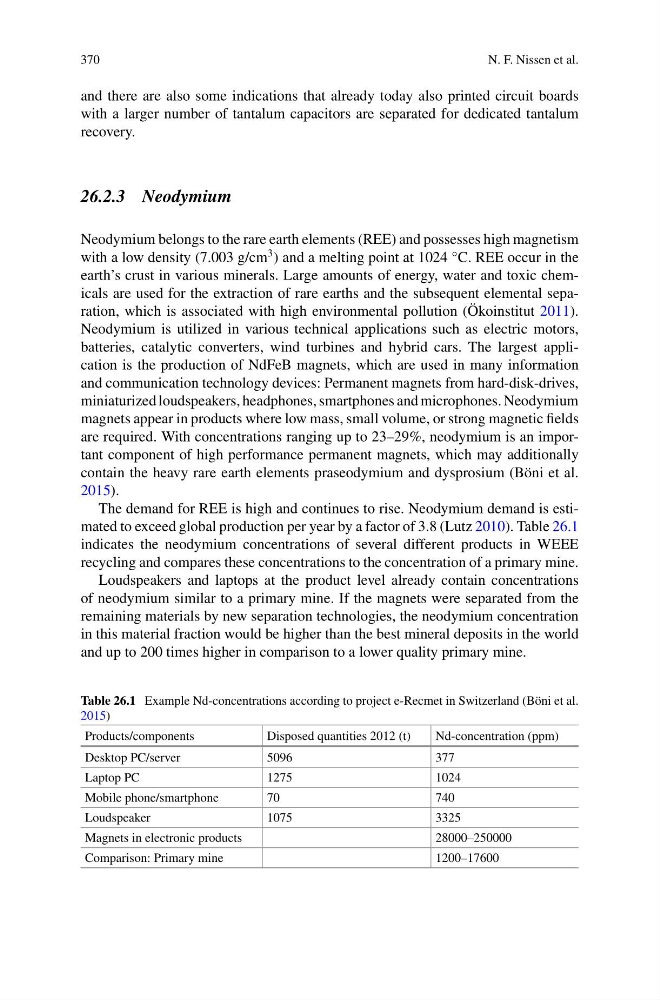
The demand for REE is high and continues to rise. Neodymium demand is estimated to exceed global production per year by a factor of 3.8 (Lutz 2010). Table 26.1
indicates the neodymium concentrations of several different products in WEEE
recycling and compares these concentrations to the concentration of a primary mine.
Loudspeakers and laptops at the product level already contain concentrations
of neodymium similar to a primary mine. If the magnets were separated from the
remaining materials by new separation technologies, the neodymium concentration
in this material fraction would be higher than the best mineral deposits in the world
and up to 200 times higher in comparison to a lower quality primary mine.
Table 26.1 Example Nd-concentrations according to project e-Recmet in Switzerland (Böni et al.
2015)
Products/components
Disposed quantities 2012 (t)
Nd-concentration (ppm)
Desktop PC/server
5096
377
Laptop PC
1275
1024
Mobile phone/smartphone
70
740
Loudspeaker
1075
3325
Magnets in electronic products
28000–250000
Comparison: Primary mine
1200–17600
N. F. Nissen et al.
and there are also some indications that already today also printed circuit boards
with a larger number of tantalum capacitors are separated for dedicated tantalum
recovery.
26.2.3 Neodymium
Neodymium belongs to the rare earth elements (REE) and possesses high magnetism
with a low density (7.003 g/cm
3 ) and a melting point at 1024 °C. REE occur in the
earth’s crust in various minerals. Large amounts of energy, water and toxic chemicals are used for the extraction of rare earths and the subsequent elemental separation, which is associated with high environmental pollution (Ökoinstitut 2011).
Neodymium is utilized in various technical applications such as electric motors,
batteries, catalytic converters, wind turbines and hybrid cars. The largest application is the production of NdFeB magnets, which are used in many information
and communication technology devices: Permanent magnets from hard-disk-drives,
miniaturized loudspeakers, headphones, smartphones and microphones. Neodymium
magnets appear in products where low mass, small volume, or strong magnetic fields
are required. With concentrations ranging up to 23–29%, neodymium is an important component of high performance permanent magnets, which may additionally
contain the heavy rare earth elements praseodymium and dysprosium (Böni et al.
2015).
The demand for REE is high and continues to rise. Neodymium demand is estimated to exceed global production per year by a factor of 3.8 (Lutz 2010). Table 26.1
indicates the neodymium concentrations of several different products in WEEE
recycling and compares these concentrations to the concentration of a primary mine.
Loudspeakers and laptops at the product level already contain concentrations
of neodymium similar to a primary mine. If the magnets were separated from the
remaining materials by new separation technologies, the neodymium concentration
in this material fraction would be higher than the best mineral deposits in the world
and up to 200 times higher in comparison to a lower quality primary mine.
Table 26.1 Example Nd-concentrations according to project e-Recmet in Switzerland (Böni et al.
2015)
Products/components
Disposed quantities 2012 (t)
Nd-concentration (ppm)
Desktop PC/server
5096
377
Laptop PC
1275
1024
Mobile phone/smartphone
70
740
Loudspeaker
1075
3325
Magnets in electronic products
28000–250000
Comparison: Primary mine
1200–17600