

26 Recyclability of Tungsten, Tantalum and Neodymium …
369
26.2.2 Tantalum
Tantalum is another element of the group of refractory metals, which are characterized
by a high resistance against wear and which typically have a very high melting
point—in the case of tantalum 3017 °C—which also determines, how tantalum can
be processed metallurgically. Tantalum is one of the T3G conflict minerals, which
are mined in civil war affected regions of D.R. Congo. This fact and that for a certain
period of time the mining worldwide was limited to only a few regions made tantalum
a critical raw material. The related ore coltan is typically mined in open pit mines by
artisanal miners. Environmental impacts—besides the social and direct human health
impacts—are related to landscape impacts, and potential waste water emissions from
mining processes, but at least the character of open pit mining means a rather low
energy consumption for mining operations.
Tantalum is used as a material for capacitors in mobile IT devices as it allows
to realize a high capacitance in a small volume, thus is crucial for miniaturization:
Tantalum forms very thin protective oxide layers, which serve as dielectric layer in
between the metallic tantalum and the cathode material. The global production of
tantalum yielded 1300 t in 2013, according to DERA thereof 10% for capacitors
in the electronics industry (Marscheider-Weidemann et al. 2016). A significantly
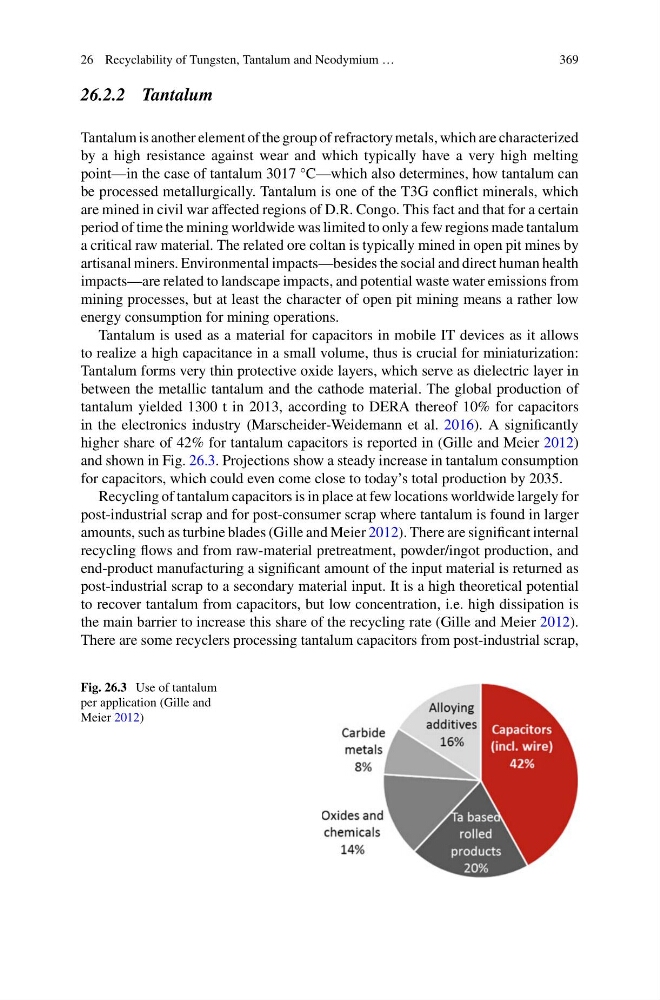
higher share of 42% for tantalum capacitors is reported in (Gille and Meier 2012)
and shown in Fig. 26.3. Projections show a steady increase in tantalum consumption
for capacitors, which could even come close to today’s total production by 2035.
Recycling of tantalum capacitors is in place at few locations worldwide largely for
post-industrial scrap and for post-consumer scrap where tantalum is found in larger
amounts, such as turbine blades (Gille and Meier 2012). There are significant internal
recycling flows and from raw-material pretreatment, powder/ingot production, and
end-product manufacturing a significant amount of the input material is returned as
post-industrial scrap to a secondary material input. It is a high theoretical potential
to recover tantalum from capacitors, but low concentration, i.e. high dissipation is
the main barrier to increase this share of the recycling rate (Gille and Meier 2012).
There are some recyclers processing tantalum capacitors from post-industrial scrap,
Fig. 26.3 Use of tantalum
per application (Gille and
Meier 2012)
369
26.2.2 Tantalum
Tantalum is another element of the group of refractory metals, which are characterized
by a high resistance against wear and which typically have a very high melting
point—in the case of tantalum 3017 °C—which also determines, how tantalum can
be processed metallurgically. Tantalum is one of the T3G conflict minerals, which
are mined in civil war affected regions of D.R. Congo. This fact and that for a certain
period of time the mining worldwide was limited to only a few regions made tantalum
a critical raw material. The related ore coltan is typically mined in open pit mines by
artisanal miners. Environmental impacts—besides the social and direct human health
impacts—are related to landscape impacts, and potential waste water emissions from
mining processes, but at least the character of open pit mining means a rather low
energy consumption for mining operations.
Tantalum is used as a material for capacitors in mobile IT devices as it allows
to realize a high capacitance in a small volume, thus is crucial for miniaturization:
Tantalum forms very thin protective oxide layers, which serve as dielectric layer in
between the metallic tantalum and the cathode material. The global production of
tantalum yielded 1300 t in 2013, according to DERA thereof 10% for capacitors
in the electronics industry (Marscheider-Weidemann et al. 2016). A significantly
higher share of 42% for tantalum capacitors is reported in (Gille and Meier 2012)
and shown in Fig. 26.3. Projections show a steady increase in tantalum consumption
for capacitors, which could even come close to today’s total production by 2035.
Recycling of tantalum capacitors is in place at few locations worldwide largely for
post-industrial scrap and for post-consumer scrap where tantalum is found in larger
amounts, such as turbine blades (Gille and Meier 2012). There are significant internal
recycling flows and from raw-material pretreatment, powder/ingot production, and
end-product manufacturing a significant amount of the input material is returned as
post-industrial scrap to a secondary material input. It is a high theoretical potential
to recover tantalum from capacitors, but low concentration, i.e. high dissipation is
the main barrier to increase this share of the recycling rate (Gille and Meier 2012).
There are some recyclers processing tantalum capacitors from post-industrial scrap,
Fig. 26.3 Use of tantalum
per application (Gille and
Meier 2012)