

25 Model-Based Design of Product-Related Information …
359
25.3.3 Life Cycle Simulation
Life cycle simulation (LCS) is based on discrete event simulation with several characteristics suitable to design and analysis of products, processes, and life cycles
(Umeda et al. 2000; Komoto and Tomiyama 2008; Fukushige et al. 2017). Products, modules, parts, and components are regarded as inputs and outputs of life cycle
processes. The structure of these elements is dynamically reconfigured during their
life cycles (e.g. through assembly and disassembly processes).
In LCS, individual stakeholders assigned to specific life cycle processes perform
actions. These actions are triggered by receiving of a product or information, or by its
own state transition. These actions can cause state transition of the received product,
delivery of the received product to a specific stakeholder, and generation of new
information to specific stakeholders.
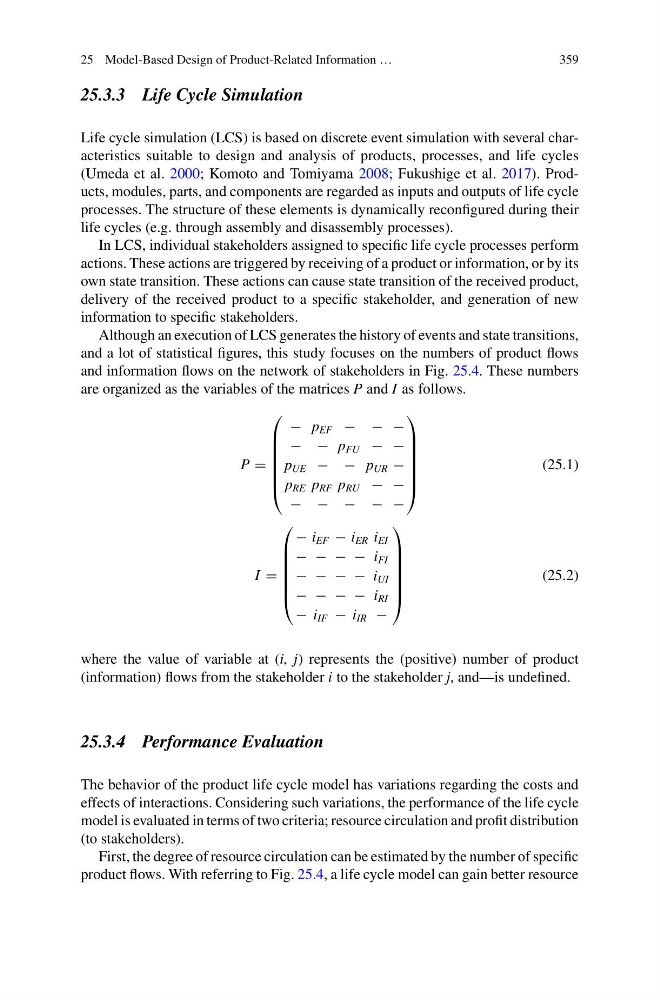
Although an execution of LCS generates the history of events and state transitions,
and a lot of statistical figures, this study focuses on the numbers of product flows
and information flows on the network of stakeholders in Fig. 25.4. These numbers
are organized as the variables of the matrices P and I as follows.
P =
⎛
⎜
⎜
⎜
⎜
⎜
⎝
− p EF − − −
− − p FU − −
p UE − − p UR −
p RE p RF p RU − −
− − − − −
⎞
⎟
⎟
⎟
⎟
⎟
⎠
(25.1)
I =
⎛
⎜
⎜
⎜
⎜
⎜
⎝
− i EF − i ER i EI
− − − − i FI
− − − − i UI
− − − − i RI
− i IF − i IR −
⎞
⎟
⎟
⎟
⎟
⎟
⎠
(25.2)
where the value of variable at (i, j) represents the (positive) number of product
(information) flows from the stakeholder i to the stakeholder j, and—is undefined.
25.3.4 Performance Evaluation
The behavior of the product life cycle model has variations regarding the costs and
effects of interactions. Considering such variations, the performance of the life cycle
model is evaluated in terms of two criteria; resource circulation and profit distribution
(to stakeholders).
First, the degree of resource circulation can be estimated by the number of specific
product flows. With referring to Fig. 25.4, a life cycle model can gain better resource
359
25.3.3 Life Cycle Simulation
Life cycle simulation (LCS) is based on discrete event simulation with several characteristics suitable to design and analysis of products, processes, and life cycles
(Umeda et al. 2000; Komoto and Tomiyama 2008; Fukushige et al. 2017). Products, modules, parts, and components are regarded as inputs and outputs of life cycle
processes. The structure of these elements is dynamically reconfigured during their
life cycles (e.g. through assembly and disassembly processes).
In LCS, individual stakeholders assigned to specific life cycle processes perform
actions. These actions are triggered by receiving of a product or information, or by its
own state transition. These actions can cause state transition of the received product,
delivery of the received product to a specific stakeholder, and generation of new
information to specific stakeholders.
Although an execution of LCS generates the history of events and state transitions,
and a lot of statistical figures, this study focuses on the numbers of product flows
and information flows on the network of stakeholders in Fig. 25.4. These numbers
are organized as the variables of the matrices P and I as follows.
P =
⎛
⎜
⎜
⎜
⎜
⎜
⎝
− p EF − − −
− − p FU − −
p UE − − p UR −
p RE p RF p RU − −
− − − − −
⎞
⎟
⎟
⎟
⎟
⎟
⎠
(25.1)
I =
⎛
⎜
⎜
⎜
⎜
⎜
⎝
− i EF − i ER i EI
− − − − i FI
− − − − i UI
− − − − i RI
− i IF − i IR −
⎞
⎟
⎟
⎟
⎟
⎟
⎠
(25.2)
where the value of variable at (i, j) represents the (positive) number of product
(information) flows from the stakeholder i to the stakeholder j, and—is undefined.
25.3.4 Performance Evaluation
The behavior of the product life cycle model has variations regarding the costs and
effects of interactions. Considering such variations, the performance of the life cycle
model is evaluated in terms of two criteria; resource circulation and profit distribution
(to stakeholders).
First, the degree of resource circulation can be estimated by the number of specific
product flows. With referring to Fig. 25.4, a life cycle model can gain better resource