

360
H. Komoto et al.
circulation by increasing p RU (repair) p RF (reuse, remanufacturing, or recycle) and
decreasing p EF (material extraction) p UE (disposal by users) and p RE (disposal by
recyclers) in P. The value of these variables mainly depends on decision makings
performed by U and R. Thus, design of information flows that cause desired product
flows with better resource circulation is crucial.
Second, profit distribution can be quantified by analyzing disparity in monetary
flows derived from product and information flows shown in Fig. 25.4. The monetary
flows are defined in (3).
M = P ◦ V + I ◦ W
(25.3)
where, ◦ is the pointwise product of two matrices with the same size (it is also called
Hadamard product). For instance, the amount of monetary flows from the stakeholder
i to the stakeholder j is an element of M as defined as follows.
m ij = p ij v ij + i ij w ij
(25.4)
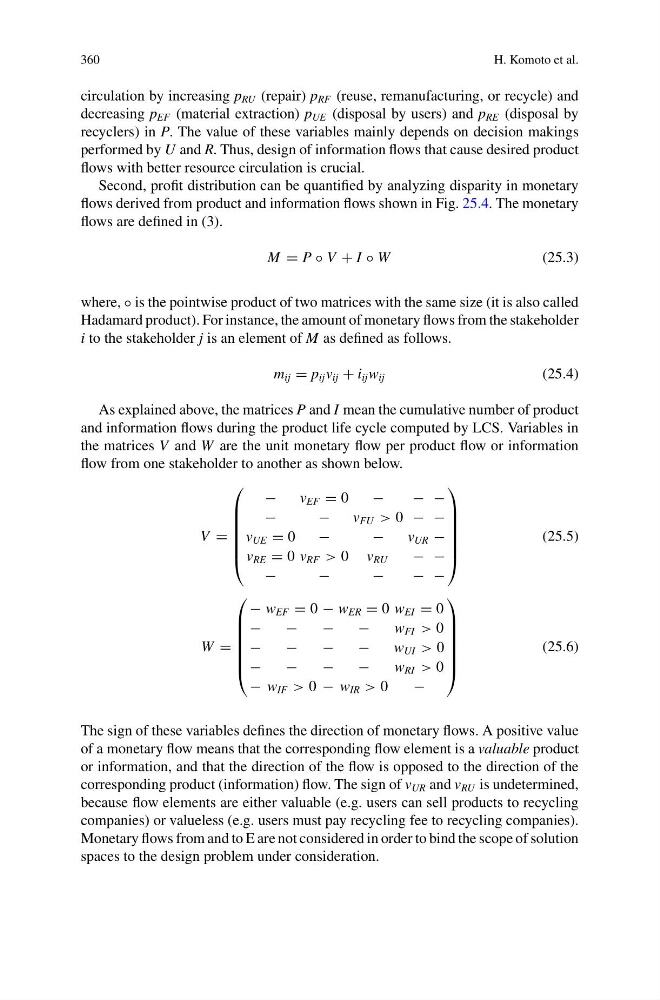
As explained above, the matrices P and I mean the cumulative number of product
and information flows during the product life cycle computed by LCS. Variables in
the matrices V and W are the unit monetary flow per product flow or information
flow from one stakeholder to another as shown below.
V =
⎛
⎜
⎜
⎜
⎜
⎜
⎝
−
v EF = 0
−
− −
−
−
v FU > 0 − −
v UE = 0
−
−
v UR −
v RE = 0 v RF > 0 v RU
− −
−
−
−
− −
⎞
⎟
⎟
⎟
⎟
⎟
⎠
(25.5)
W =
⎛
⎜
⎜
⎜
⎜
⎜
⎝
− w EF = 0 − w ER = 0 w EI = 0
−
−
−
−
w FI > 0
−
−
−
−
w UI > 0
−
−
−
−
w RI > 0
− w IF > 0 − w IR > 0
−
⎞
⎟
⎟
⎟
⎟
⎟
⎠
(25.6)
The sign of these variables defines the direction of monetary flows. A positive value
of a monetary flow means that the corresponding flow element is a valuable product
or information, and that the direction of the flow is opposed to the direction of the
corresponding product (information) flow. The sign of v UR and v RU is undetermined,
because flow elements are either valuable (e.g. users can sell products to recycling
companies) or valueless (e.g. users must pay recycling fee to recycling companies).
Monetary flows from and to E are not considered in order to bind the scope of solution
spaces to the design problem under consideration.
H. Komoto et al.
circulation by increasing p RU (repair) p RF (reuse, remanufacturing, or recycle) and
decreasing p EF (material extraction) p UE (disposal by users) and p RE (disposal by
recyclers) in P. The value of these variables mainly depends on decision makings
performed by U and R. Thus, design of information flows that cause desired product
flows with better resource circulation is crucial.
Second, profit distribution can be quantified by analyzing disparity in monetary
flows derived from product and information flows shown in Fig. 25.4. The monetary
flows are defined in (3).
M = P ◦ V + I ◦ W
(25.3)
where, ◦ is the pointwise product of two matrices with the same size (it is also called
Hadamard product). For instance, the amount of monetary flows from the stakeholder
i to the stakeholder j is an element of M as defined as follows.
m ij = p ij v ij + i ij w ij
(25.4)
As explained above, the matrices P and I mean the cumulative number of product
and information flows during the product life cycle computed by LCS. Variables in
the matrices V and W are the unit monetary flow per product flow or information
flow from one stakeholder to another as shown below.
V =
⎛
⎜
⎜
⎜
⎜
⎜
⎝
−
v EF = 0
−
− −
−
−
v FU > 0 − −
v UE = 0
−
−
v UR −
v RE = 0 v RF > 0 v RU
− −
−
−
−
− −
⎞
⎟
⎟
⎟
⎟
⎟
⎠
(25.5)
W =
⎛
⎜
⎜
⎜
⎜
⎜
⎝
− w EF = 0 − w ER = 0 w EI = 0
−
−
−
−
w FI > 0
−
−
−
−
w UI > 0
−
−
−
−
w RI > 0
− w IF > 0 − w IR > 0
−
⎞
⎟
⎟
⎟
⎟
⎟
⎠
(25.6)
The sign of these variables defines the direction of monetary flows. A positive value
of a monetary flow means that the corresponding flow element is a valuable product
or information, and that the direction of the flow is opposed to the direction of the
corresponding product (information) flow. The sign of v UR and v RU is undetermined,
because flow elements are either valuable (e.g. users can sell products to recycling
companies) or valueless (e.g. users must pay recycling fee to recycling companies).
Monetary flows from and to E are not considered in order to bind the scope of solution
spaces to the design problem under consideration.