

358
H. Komoto et al.
25.3.2 Life Cycle Modeling
In the design process to deal with the external requirements, first, a life cycle model,
where the system is situated, should be defined. The product life cycle model consists
of five types of stakeholders interacting one another. The role of each stakeholder and
the inputs and outputs of the information management system is described below.
• E (1): External environment represents sources and targets of products (materials)
and information other than the stakeholders listed below.
• F (2): A set of the stakeholders that manufacture and deliver products to users (i.e.
Forward supply chain). They include manufacturer, carrier, and retailer introduced
in Sect. 25.2. They occasionally send DesignData the system I, when new products
are manufactured.
• U (3): Users of products. They periodically (and automatically) send UsageData
to the system I upon agreement of users.
• R (4): A set of the stakeholders that perform maintenance, repair, and end-of-life
operations for products (i.e. Reverse supply chain). They include repairer, local
municipality, collector, recycler, and refiner introduced in Sect. 25.2. They send
RepairData and ReuseData to the system I. They also send DesignDataRequest
when reusing and recycling products efficiently.
• I (5): The information management system that collects, analyzes, and publishes
product-related data. In this context, the system collects the data from the stakeholders F, U, and R. The system only handles with information flows but not
with product flows. It sends UsageDataSummary to F when a certain amount of
UsageData is collected. In responding DesignDataRequest from R, the system
searches the corresponding DesignData and replies to R.
The integer in the bracket following each symbol of the stakeholder types indicate the
common index of the row and column of the matrices shown in the formulations 1–2
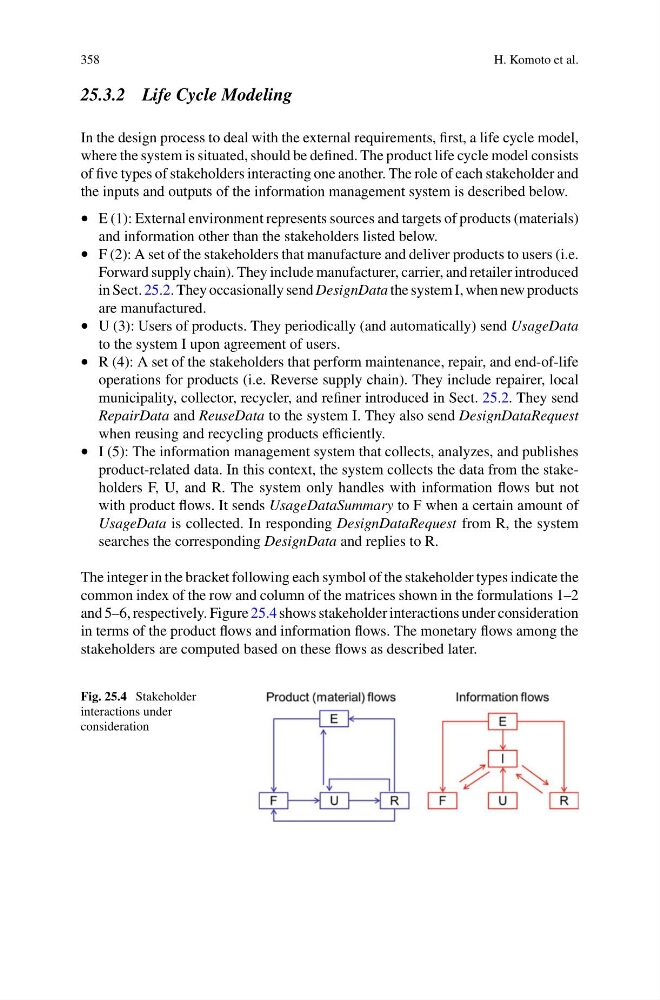
and 5–6, respectively. Figure 25.4 shows stakeholder interactions under consideration
in terms of the product flows and information flows. The monetary flows among the
stakeholders are computed based on these flows as described later.
Fig. 25.4 Stakeholder
interactions under
consideration
H. Komoto et al.
25.3.2 Life Cycle Modeling
In the design process to deal with the external requirements, first, a life cycle model,
where the system is situated, should be defined. The product life cycle model consists
of five types of stakeholders interacting one another. The role of each stakeholder and
the inputs and outputs of the information management system is described below.
• E (1): External environment represents sources and targets of products (materials)
and information other than the stakeholders listed below.
• F (2): A set of the stakeholders that manufacture and deliver products to users (i.e.
Forward supply chain). They include manufacturer, carrier, and retailer introduced
in Sect. 25.2. They occasionally send DesignData the system I, when new products
are manufactured.
• U (3): Users of products. They periodically (and automatically) send UsageData
to the system I upon agreement of users.
• R (4): A set of the stakeholders that perform maintenance, repair, and end-of-life
operations for products (i.e. Reverse supply chain). They include repairer, local
municipality, collector, recycler, and refiner introduced in Sect. 25.2. They send
RepairData and ReuseData to the system I. They also send DesignDataRequest
when reusing and recycling products efficiently.
• I (5): The information management system that collects, analyzes, and publishes
product-related data. In this context, the system collects the data from the stakeholders F, U, and R. The system only handles with information flows but not
with product flows. It sends UsageDataSummary to F when a certain amount of
UsageData is collected. In responding DesignDataRequest from R, the system
searches the corresponding DesignData and replies to R.
The integer in the bracket following each symbol of the stakeholder types indicate the
common index of the row and column of the matrices shown in the formulations 1–2
and 5–6, respectively. Figure 25.4 shows stakeholder interactions under consideration
in terms of the product flows and information flows. The monetary flows among the
stakeholders are computed based on these flows as described later.
Fig. 25.4 Stakeholder
interactions under
consideration