

354
H. Komoto et al.
defined in the design stage is a key design variable of end-of-life alternatives that
increases recycling rate of products like LCD TV (Umeda et al. 2013).
However, product-related information is not effectively shared and used by the
potential stakeholders involved in the life cycle of products. Unless legislative obligation (such as the WEEE directive), the owners of product-related information is not
willing to collaborate one another and share product-related information (Aschehoug
et al. 2012). Moreover, standards for information models to deal with product-related
information across product life cycles are crucial for effective information sharing
(Rachuri et al. 2008).
The value of information sharing among stakeholders in a supply chain has
been intensively studied with various analytical techniques (e.g. game theory-based
(Raweewan and Jr Ferrell 2018) and equation-based (Teunter et al. 2018)). However,
these models do not sufficiently express the complex behavior of stakeholders in the
various life cycle stages and interactions among them.
The objective of the study is to analyze the value of information sharing among
the stakeholders involved in various stages of a product life cycle. To do so, this
study proposes a simulation-based approach to specify the external and internal
requirements of such a system and evaluate the impact of the system on resource
circulation and profitability of the stakeholders.
The content of this paper is divided into two parts.
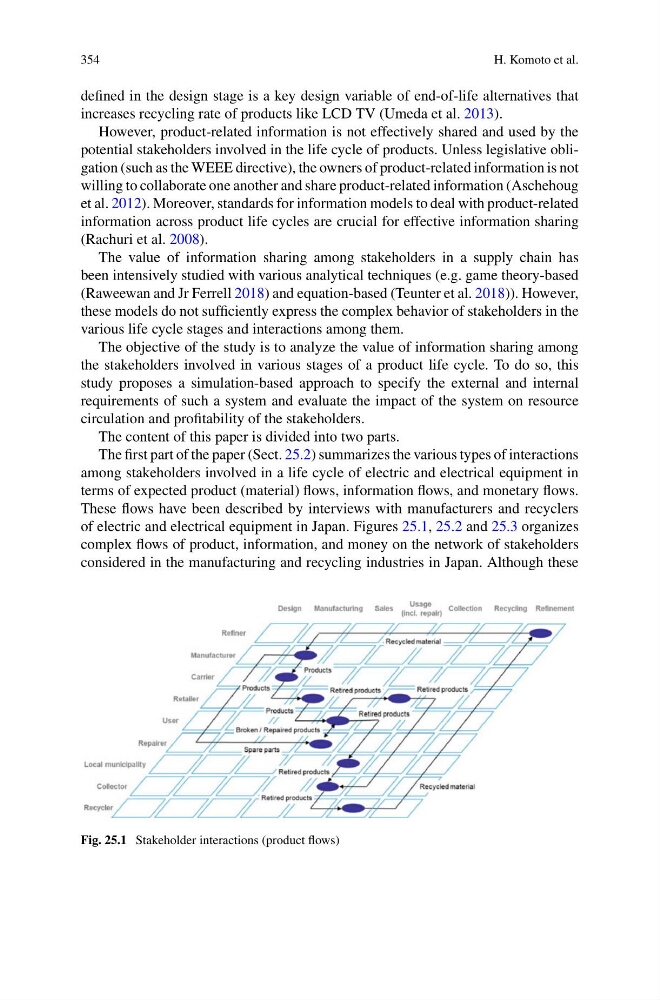
The first part of the paper (Sect. 25.2) summarizes the various types of interactions
among stakeholders involved in a life cycle of electric and electrical equipment in
terms of expected product (material) flows, information flows, and monetary flows.
These flows have been described by interviews with manufacturers and recyclers
of electric and electrical equipment in Japan. Figures 25.1, 25.2 and 25.3 organizes
complex flows of product, information, and money on the network of stakeholders
considered in the manufacturing and recycling industries in Japan. Although these
Fig. 25.1 Stakeholder interactions (product flows)
H. Komoto et al.
defined in the design stage is a key design variable of end-of-life alternatives that
increases recycling rate of products like LCD TV (Umeda et al. 2013).
However, product-related information is not effectively shared and used by the
potential stakeholders involved in the life cycle of products. Unless legislative obligation (such as the WEEE directive), the owners of product-related information is not
willing to collaborate one another and share product-related information (Aschehoug
et al. 2012). Moreover, standards for information models to deal with product-related
information across product life cycles are crucial for effective information sharing
(Rachuri et al. 2008).
The value of information sharing among stakeholders in a supply chain has
been intensively studied with various analytical techniques (e.g. game theory-based
(Raweewan and Jr Ferrell 2018) and equation-based (Teunter et al. 2018)). However,
these models do not sufficiently express the complex behavior of stakeholders in the
various life cycle stages and interactions among them.
The objective of the study is to analyze the value of information sharing among
the stakeholders involved in various stages of a product life cycle. To do so, this
study proposes a simulation-based approach to specify the external and internal
requirements of such a system and evaluate the impact of the system on resource
circulation and profitability of the stakeholders.
The content of this paper is divided into two parts.
The first part of the paper (Sect. 25.2) summarizes the various types of interactions
among stakeholders involved in a life cycle of electric and electrical equipment in
terms of expected product (material) flows, information flows, and monetary flows.
These flows have been described by interviews with manufacturers and recyclers
of electric and electrical equipment in Japan. Figures 25.1, 25.2 and 25.3 organizes
complex flows of product, information, and money on the network of stakeholders
considered in the manufacturing and recycling industries in Japan. Although these
Fig. 25.1 Stakeholder interactions (product flows)