

302
K. Martinsen et al.
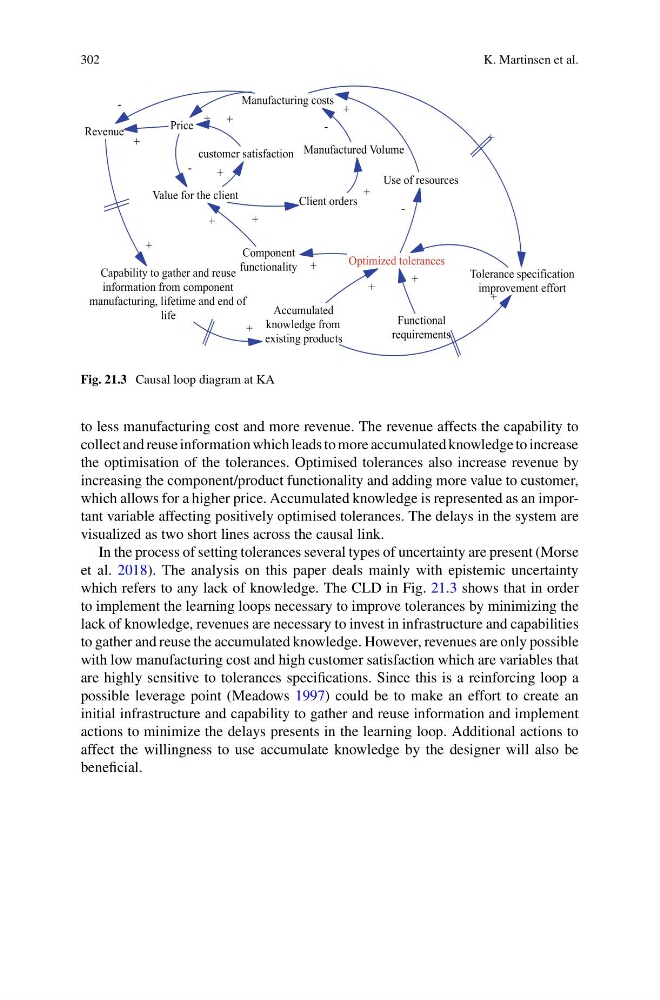
Fig. 21.3 Causal loop diagram at KA
to less manufacturing cost and more revenue. The revenue affects the capability to
collect and reuse information which leads to more accumulated knowledge to increase
the optimisation of the tolerances. Optimised tolerances also increase revenue by
increasing the component/product functionality and adding more value to customer,
which allows for a higher price. Accumulated knowledge is represented as an important variable affecting positively optimised tolerances. The delays in the system are
visualized as two short lines across the causal link.
In the process of setting tolerances several types of uncertainty are present (Morse
et al. 2018). The analysis on this paper deals mainly with epistemic uncertainty
which refers to any lack of knowledge. The CLD in Fig. 21.3 shows that in order
to implement the learning loops necessary to improve tolerances by minimizing the
lack of knowledge, revenues are necessary to invest in infrastructure and capabilities
to gather and reuse the accumulated knowledge. However, revenues are only possible
with low manufacturing cost and high customer satisfaction which are variables that
are highly sensitive to tolerances specifications. Since this is a reinforcing loop a
possible leverage point (Meadows 1997) could be to make an effort to create an
initial infrastructure and capability to gather and reuse information and implement
actions to minimize the delays presents in the learning loop. Additional actions to
affect the willingness to use accumulate knowledge by the designer will also be
beneficial.
K. Martinsen et al.
Fig. 21.3 Causal loop diagram at KA
to less manufacturing cost and more revenue. The revenue affects the capability to
collect and reuse information which leads to more accumulated knowledge to increase
the optimisation of the tolerances. Optimised tolerances also increase revenue by
increasing the component/product functionality and adding more value to customer,
which allows for a higher price. Accumulated knowledge is represented as an important variable affecting positively optimised tolerances. The delays in the system are
visualized as two short lines across the causal link.
In the process of setting tolerances several types of uncertainty are present (Morse
et al. 2018). The analysis on this paper deals mainly with epistemic uncertainty
which refers to any lack of knowledge. The CLD in Fig. 21.3 shows that in order
to implement the learning loops necessary to improve tolerances by minimizing the
lack of knowledge, revenues are necessary to invest in infrastructure and capabilities
to gather and reuse the accumulated knowledge. However, revenues are only possible
with low manufacturing cost and high customer satisfaction which are variables that
are highly sensitive to tolerances specifications. Since this is a reinforcing loop a
possible leverage point (Meadows 1997) could be to make an effort to create an
initial infrastructure and capability to gather and reuse information and implement
actions to minimize the delays presents in the learning loop. Additional actions to
affect the willingness to use accumulate knowledge by the designer will also be
beneficial.