

290
Y. Fukazawa et al.
20.5 Module Exchange Experiment
20.5.1 Outline of the Experiment
We plan an experiment to exchange modules of 10 manipulators performing a task
to carry loads in order to verify the function of the part agent system. By creating
differences in the contents of work to be done by the robot, differences are created
in the degrees of progress of deterioration of each robot. A part agent detects the
deterioration of the module and expands the life cycle model at fixed time intervals to
calculate the EV. Modules are replaced or discarded based on the calculated values. If
there is a module on the manipulator that has been marked for discard, the operation
of the manipulator is stopped.
This experiment is carried out until all 10 manipulators stop. The part agent
system is evaluated by comparing the actual deterioration of the equipment. In this
experiment, the stages that a part agent can select are use, replace, and dispose.
20.5.2 Module Exchange Manipulator
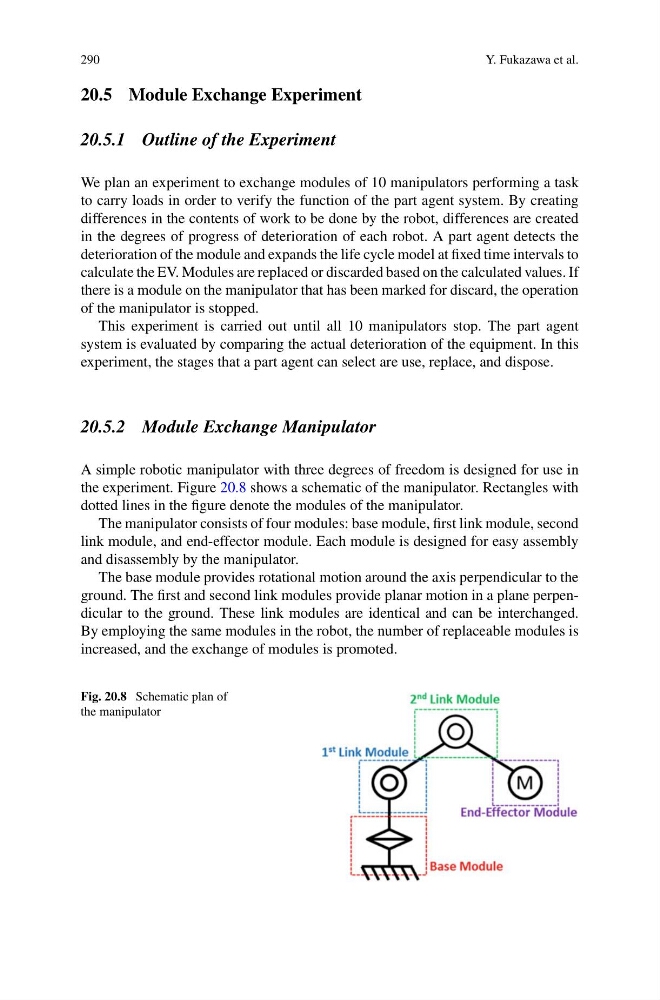
A simple robotic manipulator with three degrees of freedom is designed for use in
the experiment. Figure 20.8 shows a schematic of the manipulator. Rectangles with
dotted lines in the figure denote the modules of the manipulator.
The manipulator consists of four modules: base module, first link module, second
link module, and end-effector module. Each module is designed for easy assembly
and disassembly by the manipulator.
The base module provides rotational motion around the axis perpendicular to the
ground. The first and second link modules provide planar motion in a plane perpendicular to the ground. These link modules are identical and can be interchanged.
By employing the same modules in the robot, the number of replaceable modules is
increased, and the exchange of modules is promoted.
Fig. 20.8 Schematic plan of
the manipulator
Y. Fukazawa et al.
20.5 Module Exchange Experiment
20.5.1 Outline of the Experiment
We plan an experiment to exchange modules of 10 manipulators performing a task
to carry loads in order to verify the function of the part agent system. By creating
differences in the contents of work to be done by the robot, differences are created
in the degrees of progress of deterioration of each robot. A part agent detects the
deterioration of the module and expands the life cycle model at fixed time intervals to
calculate the EV. Modules are replaced or discarded based on the calculated values. If
there is a module on the manipulator that has been marked for discard, the operation
of the manipulator is stopped.
This experiment is carried out until all 10 manipulators stop. The part agent
system is evaluated by comparing the actual deterioration of the equipment. In this
experiment, the stages that a part agent can select are use, replace, and dispose.
20.5.2 Module Exchange Manipulator
A simple robotic manipulator with three degrees of freedom is designed for use in
the experiment. Figure 20.8 shows a schematic of the manipulator. Rectangles with
dotted lines in the figure denote the modules of the manipulator.
The manipulator consists of four modules: base module, first link module, second
link module, and end-effector module. Each module is designed for easy assembly
and disassembly by the manipulator.
The base module provides rotational motion around the axis perpendicular to the
ground. The first and second link modules provide planar motion in a plane perpendicular to the ground. These link modules are identical and can be interchanged.
By employing the same modules in the robot, the number of replaceable modules is
increased, and the exchange of modules is promoted.
Fig. 20.8 Schematic plan of
the manipulator