

20 Part Agents for Exchanging Modules of Manipulators
289
or environmental load of the stage (such as V1, V2, and V3). A line denotes an
expanded life cycle path with its probability (such as p12, p13, and p14). To evaluate
each possible stage, the expected values of properties are calculated by considering
the series of paths in the future. We define a series of stages connected to the paths
as a route.
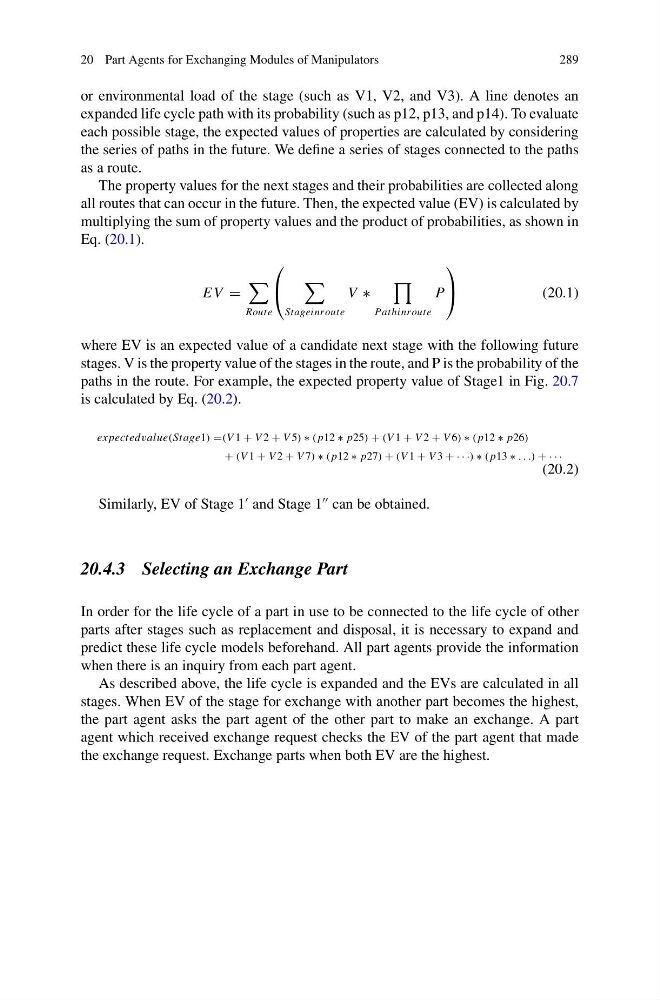
The property values for the next stages and their probabilities are collected along
all routes that can occur in the future. Then, the expected value (EV) is calculated by
multiplying the sum of property values and the product of probabilities, as shown in
Eq. (20.1).
E V =
Route
⎛
⎝
Stageinroute
V ∗
Pathinroute
P
⎞
⎠
(20.1)
where EV is an expected value of a candidate next stage with the following future
stages. V is the property value of the stages in the route, and P is the probability of the
paths in the route. For example, the expected property value of Stage1 in Fig. 20.7
is calculated by Eq. (20.2).
ex pectedvalue(Stage1) =(V 1 + V 2 + V 5) ∗ ( p12 ∗ p25) + (V 1 + V 2 + V 6) ∗ ( p12 ∗ p26)
+ (V 1 + V 2 + V 7) ∗ ( p12 ∗ p27) + (V 1 + V 3 + · · ·) ∗ ( p13 ∗ . . .) + · · ·
(20.2)
Similarly, EV of Stage 1
and Stage 1
can be obtained.
20.4.3 Selecting an Exchange Part
In order for the life cycle of a part in use to be connected to the life cycle of other
parts after stages such as replacement and disposal, it is necessary to expand and
predict these life cycle models beforehand. All part agents provide the information
when there is an inquiry from each part agent.
As described above, the life cycle is expanded and the EVs are calculated in all
stages. When EV of the stage for exchange with another part becomes the highest,
the part agent asks the part agent of the other part to make an exchange. A part
agent which received exchange request checks the EV of the part agent that made
the exchange request. Exchange parts when both EV are the highest.
289
or environmental load of the stage (such as V1, V2, and V3). A line denotes an
expanded life cycle path with its probability (such as p12, p13, and p14). To evaluate
each possible stage, the expected values of properties are calculated by considering
the series of paths in the future. We define a series of stages connected to the paths
as a route.
The property values for the next stages and their probabilities are collected along
all routes that can occur in the future. Then, the expected value (EV) is calculated by
multiplying the sum of property values and the product of probabilities, as shown in
Eq. (20.1).
E V =
Route
⎛
⎝
Stageinroute
V ∗
Pathinroute
P
⎞
⎠
(20.1)
where EV is an expected value of a candidate next stage with the following future
stages. V is the property value of the stages in the route, and P is the probability of the
paths in the route. For example, the expected property value of Stage1 in Fig. 20.7
is calculated by Eq. (20.2).
ex pectedvalue(Stage1) =(V 1 + V 2 + V 5) ∗ ( p12 ∗ p25) + (V 1 + V 2 + V 6) ∗ ( p12 ∗ p26)
+ (V 1 + V 2 + V 7) ∗ ( p12 ∗ p27) + (V 1 + V 3 + · · ·) ∗ ( p13 ∗ . . .) + · · ·
(20.2)
Similarly, EV of Stage 1
and Stage 1
can be obtained.
20.4.3 Selecting an Exchange Part
In order for the life cycle of a part in use to be connected to the life cycle of other
parts after stages such as replacement and disposal, it is necessary to expand and
predict these life cycle models beforehand. All part agents provide the information
when there is an inquiry from each part agent.
As described above, the life cycle is expanded and the EVs are calculated in all
stages. When EV of the stage for exchange with another part becomes the highest,
the part agent asks the part agent of the other part to make an exchange. A part
agent which received exchange request checks the EV of the part agent that made
the exchange request. Exchange parts when both EV are the highest.