

288
Y. Fukazawa et al.
Over the life cycle of a part, it is possible for the user to evaluate the life cycle
when the user replaces it by connecting the life cycle of another part in the market
or a part used by another user to the stage of replacement or disposal.
20.4.2 Prediction and Assessment
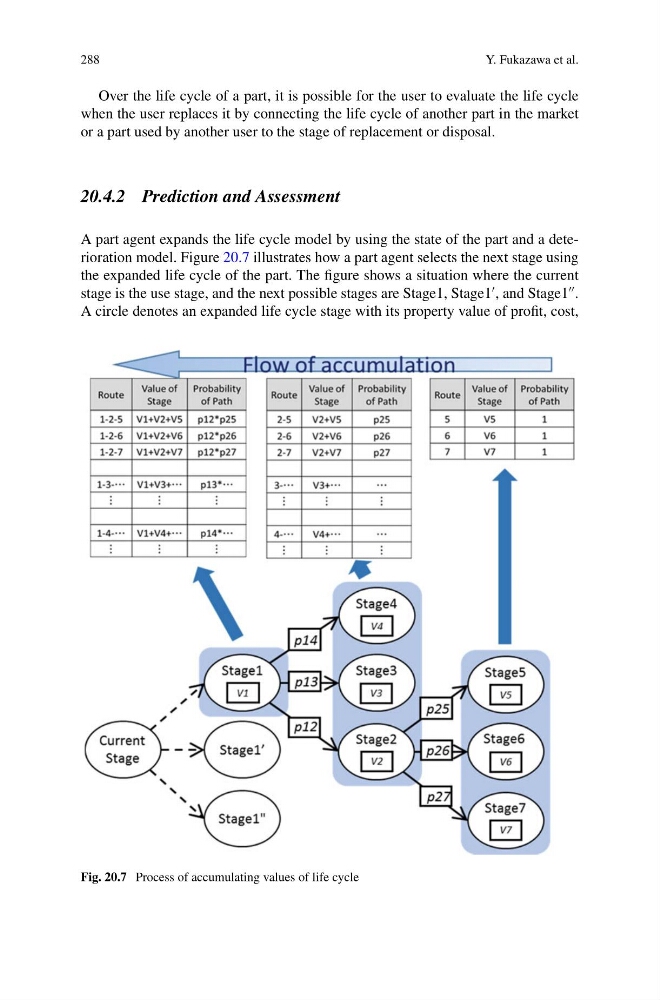
A part agent expands the life cycle model by using the state of the part and a deterioration model. Figure 20.7 illustrates how a part agent selects the next stage using
the expanded life cycle of the part. The figure shows a situation where the current
stage is the use stage, and the next possible stages are Stage1, Stage1
, and Stage1
.
A circle denotes an expanded life cycle stage with its property value of profit, cost,
Fig. 20.7 Process of accumulating values of life cycle
Y. Fukazawa et al.
Over the life cycle of a part, it is possible for the user to evaluate the life cycle
when the user replaces it by connecting the life cycle of another part in the market
or a part used by another user to the stage of replacement or disposal.
20.4.2 Prediction and Assessment
A part agent expands the life cycle model by using the state of the part and a deterioration model. Figure 20.7 illustrates how a part agent selects the next stage using
the expanded life cycle of the part. The figure shows a situation where the current
stage is the use stage, and the next possible stages are Stage1, Stage1
, and Stage1
.
A circle denotes an expanded life cycle stage with its property value of profit, cost,
Fig. 20.7 Process of accumulating values of life cycle