

20 Part Agents for Exchanging Modules of Manipulators
287
In previous research (Yokoki et al. 2015), to realize this function, a system was
developed that encourages the user to take appropriate action based on the information
of the life cycle model, deterioration of the part, and failure.
20.4.1 Life Cycle Model
Figure 20.5 shows a life cycle model of machine parts. This model is used as an
example in this paper. We define the life cycle of a part as consisting of stages
connected by paths. The circles represent the stages: produce, sell, use, repair, and
dispose, while the arrows represent the paths.
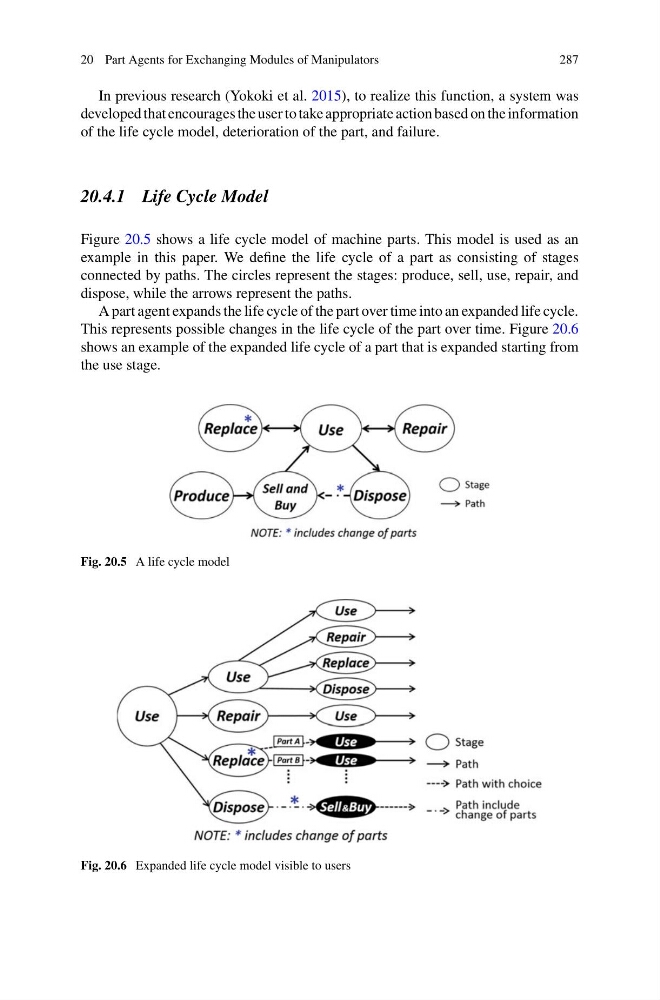
A part agent expands the life cycle of the part over time into an expanded life cycle.
This represents possible changes in the life cycle of the part over time. Figure 20.6
shows an example of the expanded life cycle of a part that is expanded starting from
the use stage.
Fig. 20.5 A life cycle model
Fig. 20.6 Expanded life cycle model visible to users
287
In previous research (Yokoki et al. 2015), to realize this function, a system was
developed that encourages the user to take appropriate action based on the information
of the life cycle model, deterioration of the part, and failure.
20.4.1 Life Cycle Model
Figure 20.5 shows a life cycle model of machine parts. This model is used as an
example in this paper. We define the life cycle of a part as consisting of stages
connected by paths. The circles represent the stages: produce, sell, use, repair, and
dispose, while the arrows represent the paths.
A part agent expands the life cycle of the part over time into an expanded life cycle.
This represents possible changes in the life cycle of the part over time. Figure 20.6
shows an example of the expanded life cycle of a part that is expanded starting from
the use stage.
Fig. 20.5 A life cycle model
Fig. 20.6 Expanded life cycle model visible to users