

178
J. Wang and N. Mishima
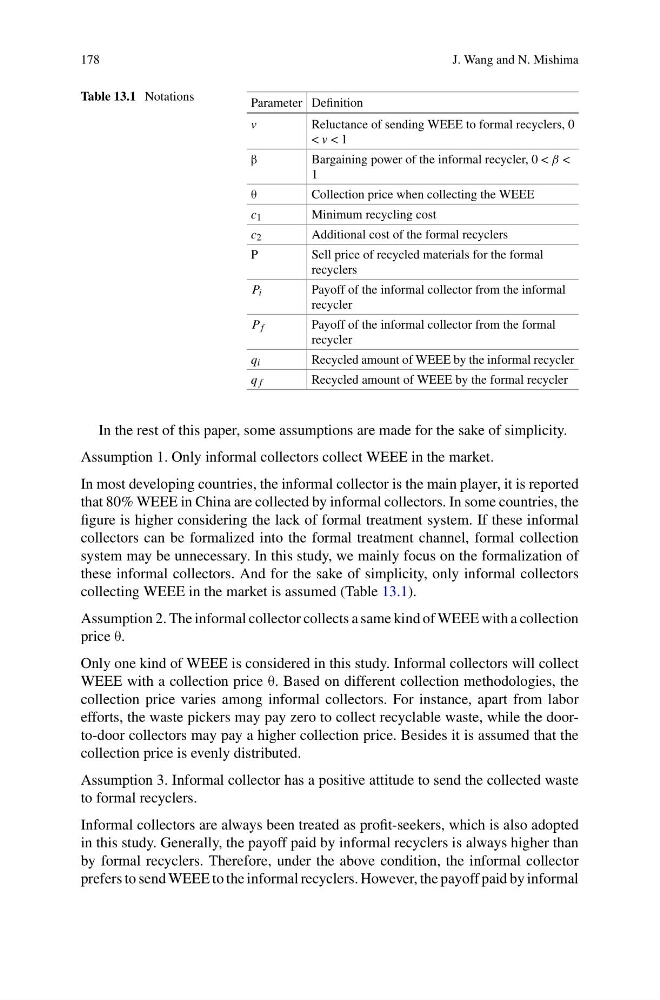
Table 13.1 Notations
Parameter Definition
v
Reluctance of sending WEEE to formal recyclers, 0
< v < 1
β
Bargaining power of the informal recycler, 0 < β <
1
θ
Collection price when collecting the WEEE
c 1
Minimum recycling cost
c 2
Additional cost of the formal recyclers
P
Sell price of recycled materials for the formal
recyclers
P i
Payoff of the informal collector from the informal
recycler
P f
Payoff of the informal collector from the formal
recycler
q i
Recycled amount of WEEE by the informal recycler
q f
Recycled amount of WEEE by the formal recycler
In the rest of this paper, some assumptions are made for the sake of simplicity.
Assumption 1. Only informal collectors collect WEEE in the market.
In most developing countries, the informal collector is the main player, it is reported
that 80% WEEE in China are collected by informal collectors. In some countries, the
figure is higher considering the lack of formal treatment system. If these informal
collectors can be formalized into the formal treatment channel, formal collection
system may be unnecessary. In this study, we mainly focus on the formalization of
these informal collectors. And for the sake of simplicity, only informal collectors
collecting WEEE in the market is assumed (Table 13.1).
Assumption 2. The informal collector collects a same kind of WEEE with a collection
price θ.
Only one kind of WEEE is considered in this study. Informal collectors will collect
WEEE with a collection price θ. Based on different collection methodologies, the
collection price varies among informal collectors. For instance, apart from labor
efforts, the waste pickers may pay zero to collect recyclable waste, while the doorto-door collectors may pay a higher collection price. Besides it is assumed that the
collection price is evenly distributed.
Assumption 3. Informal collector has a positive attitude to send the collected waste
to formal recyclers.
Informal collectors are always been treated as profit-seekers, which is also adopted
in this study. Generally, the payoff paid by informal recyclers is always higher than
by formal recyclers. Therefore, under the above condition, the informal collector
prefers to send WEEE to the informal recyclers. However, the payoff paid by informal
J. Wang and N. Mishima
Table 13.1 Notations
Parameter Definition
v
Reluctance of sending WEEE to formal recyclers, 0
< v < 1
β
Bargaining power of the informal recycler, 0 < β <
1
θ
Collection price when collecting the WEEE
c 1
Minimum recycling cost
c 2
Additional cost of the formal recyclers
P
Sell price of recycled materials for the formal
recyclers
P i
Payoff of the informal collector from the informal
recycler
P f
Payoff of the informal collector from the formal
recycler
q i
Recycled amount of WEEE by the informal recycler
q f
Recycled amount of WEEE by the formal recycler
In the rest of this paper, some assumptions are made for the sake of simplicity.
Assumption 1. Only informal collectors collect WEEE in the market.
In most developing countries, the informal collector is the main player, it is reported
that 80% WEEE in China are collected by informal collectors. In some countries, the
figure is higher considering the lack of formal treatment system. If these informal
collectors can be formalized into the formal treatment channel, formal collection
system may be unnecessary. In this study, we mainly focus on the formalization of
these informal collectors. And for the sake of simplicity, only informal collectors
collecting WEEE in the market is assumed (Table 13.1).
Assumption 2. The informal collector collects a same kind of WEEE with a collection
price θ.
Only one kind of WEEE is considered in this study. Informal collectors will collect
WEEE with a collection price θ. Based on different collection methodologies, the
collection price varies among informal collectors. For instance, apart from labor
efforts, the waste pickers may pay zero to collect recyclable waste, while the doorto-door collectors may pay a higher collection price. Besides it is assumed that the
collection price is evenly distributed.
Assumption 3. Informal collector has a positive attitude to send the collected waste
to formal recyclers.
Informal collectors are always been treated as profit-seekers, which is also adopted
in this study. Generally, the payoff paid by informal recyclers is always higher than
by formal recyclers. Therefore, under the above condition, the informal collector
prefers to send WEEE to the informal recyclers. However, the payoff paid by informal