

13 Study of Formalization of Informal Collectors …
179
recyclers is highly based on the WEEE quantity and quality, which are uncertain and
influenced by the up-front, such as the attitude and behavior of consumers. Hence, the
revenue of informal collectors is uncertain and risky if they choose to send WEEE to
informal recyclers. In contrast, if the informal collector agreed to be formalized and
sends WEEE to formal recyclers, even though the direct payoff paid to each WEEE
is less, the risk of revenue can be reduced. For instance, the formal recycler can
provide a minimum salary to informal collectors once they choose to be formalized.
This undoubtedly can reduce the income risk and uncertainty.
Assume the reluctance of sending WEEE to formal recyclers as v, which v is a
discounted rate of the collection price θ. Given the payoff from formal and informal
recyclers as P f and P i , the utility of informal collectors can be denoted as U f (θ) =
P f − vθ for sending WEEE to formal recyclers, and U i(θ) = P i − θ for sending
WEEE to informal recyclers.
Undoubtedly, the informal collector will choose to send WEEE to formal
recyclers only the utility satisfies
θ |U f (θ) ≥ U i(θ) , U f (θ) ≥ 0,
P f − θ
≥ 0
,
while choosing to send WEEE to informal recyclers when the utility satisfies
θ |U i(θ) ≥ U f (θ) , U i(θ) ≥ 0
.
Accordingly, when P f >
P i
2−v
, the informal collector who offers collection price
among [
P i −P f
1−v
, P f ] will choose send WEEE to formal recyclers, while the informal
collector who offers collection price among [0,
P i −P f
1−v
] choose informal recyclers as
their destination. When v P i < P f ≤
P i
2−v
, and P f ≤ v P i , the informal collector
will never consider formal recycler as the destination while the informal collector
offers collection price among [0,
P i −P f
1−v
] and [0, P i ] will choose informal recyclers
respectively.
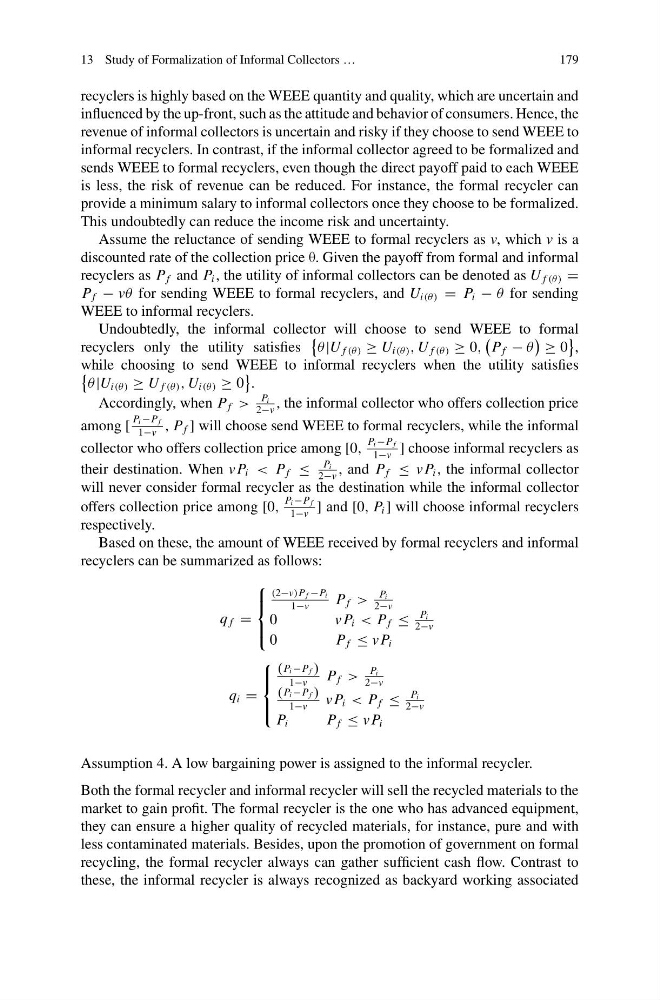
Based on these, the amount of WEEE received by formal recyclers and informal
recyclers can be summarized as follows:
q f =
⎧
⎪ ⎨
⎪ ⎩
(2−v)P f −P i
1−v
P f >
P i
2−v
0
v P i < P f ≤
P i
2−v
0
P f ≤ v P i
q i =
⎧
⎪ ⎨
⎪ ⎩
(Pi−Pf )
1−v
P f >
P i
2−v
(Pi−Pf )
1−v
v P i < P f ≤
P i
2−v
P i
P f ≤ v P i
Assumption 4. A low bargaining power is assigned to the informal recycler.
Both the formal recycler and informal recycler will sell the recycled materials to the
market to gain profit. The formal recycler is the one who has advanced equipment,
they can ensure a higher quality of recycled materials, for instance, pure and with
less contaminated materials. Besides, upon the promotion of government on formal
recycling, the formal recycler always can gather sufficient cash flow. Contrast to
these, the informal recycler is always recognized as backyard working associated
179
recyclers is highly based on the WEEE quantity and quality, which are uncertain and
influenced by the up-front, such as the attitude and behavior of consumers. Hence, the
revenue of informal collectors is uncertain and risky if they choose to send WEEE to
informal recyclers. In contrast, if the informal collector agreed to be formalized and
sends WEEE to formal recyclers, even though the direct payoff paid to each WEEE
is less, the risk of revenue can be reduced. For instance, the formal recycler can
provide a minimum salary to informal collectors once they choose to be formalized.
This undoubtedly can reduce the income risk and uncertainty.
Assume the reluctance of sending WEEE to formal recyclers as v, which v is a
discounted rate of the collection price θ. Given the payoff from formal and informal
recyclers as P f and P i , the utility of informal collectors can be denoted as U f (θ) =
P f − vθ for sending WEEE to formal recyclers, and U i(θ) = P i − θ for sending
WEEE to informal recyclers.
Undoubtedly, the informal collector will choose to send WEEE to formal
recyclers only the utility satisfies
θ |U f (θ) ≥ U i(θ) , U f (θ) ≥ 0,
P f − θ
≥ 0
,
while choosing to send WEEE to informal recyclers when the utility satisfies
θ |U i(θ) ≥ U f (θ) , U i(θ) ≥ 0
.
Accordingly, when P f >
P i
2−v
, the informal collector who offers collection price
among [
P i −P f
1−v
, P f ] will choose send WEEE to formal recyclers, while the informal
collector who offers collection price among [0,
P i −P f
1−v
] choose informal recyclers as
their destination. When v P i < P f ≤
P i
2−v
, and P f ≤ v P i , the informal collector
will never consider formal recycler as the destination while the informal collector
offers collection price among [0,
P i −P f
1−v
] and [0, P i ] will choose informal recyclers
respectively.
Based on these, the amount of WEEE received by formal recyclers and informal
recyclers can be summarized as follows:
q f =
⎧
⎪ ⎨
⎪ ⎩
(2−v)P f −P i
1−v
P f >
P i
2−v
0
v P i < P f ≤
P i
2−v
0
P f ≤ v P i
q i =
⎧
⎪ ⎨
⎪ ⎩
(Pi−Pf )
1−v
P f >
P i
2−v
(Pi−Pf )
1−v
v P i < P f ≤
P i
2−v
P i
P f ≤ v P i
Assumption 4. A low bargaining power is assigned to the informal recycler.
Both the formal recycler and informal recycler will sell the recycled materials to the
market to gain profit. The formal recycler is the one who has advanced equipment,
they can ensure a higher quality of recycled materials, for instance, pure and with
less contaminated materials. Besides, upon the promotion of government on formal
recycling, the formal recycler always can gather sufficient cash flow. Contrast to
these, the informal recycler is always recognized as backyard working associated