

13 Study of Formalization of Informal Collectors …
177
system (instead of either ignoring or prohibiting their participation) is beneficial for
economical, environmental and social sustainability (Besiou et al. 2012).
To analyze the possibility of incorporating informal collectors into formal channel,
reveal underlying influence factors on the formalization process, at the meantime,
provide efficient countermeasures for a better formalization extent, this study is
undertaken. Based on game theory, a dual-channel collection and recycling activities
model is established, in which the formal and informal recycling activities are divided.
In this dual-channel model, the informal collector has two choices, either sending
WEEE to the formal recycler or to the informal recycler. The authors also introduce
the bargaining power of the informal recycler to represent the bargaining power of
selling the recycled materials to the market. Considering the formal recycler as the
Stackelberg leader in this game model, we discuss the formalization possibility of
informal collection activities and analyze the influence on formalization extent in
following sections.
This paper is organized as follows: the model assumptions and notations are
introduced and presented in Sect. 13.2. The detailed game model and results are
described in Sect. 13.3. Finally, Sect. 13.4 comes up with the conclusion.
13.2 Model Assumptions and Notations
The goal of this paper is to evaluate the possibility and extent of prompting informal
collector to send WEEE to formal recycler so as to reduce the adverse environmental
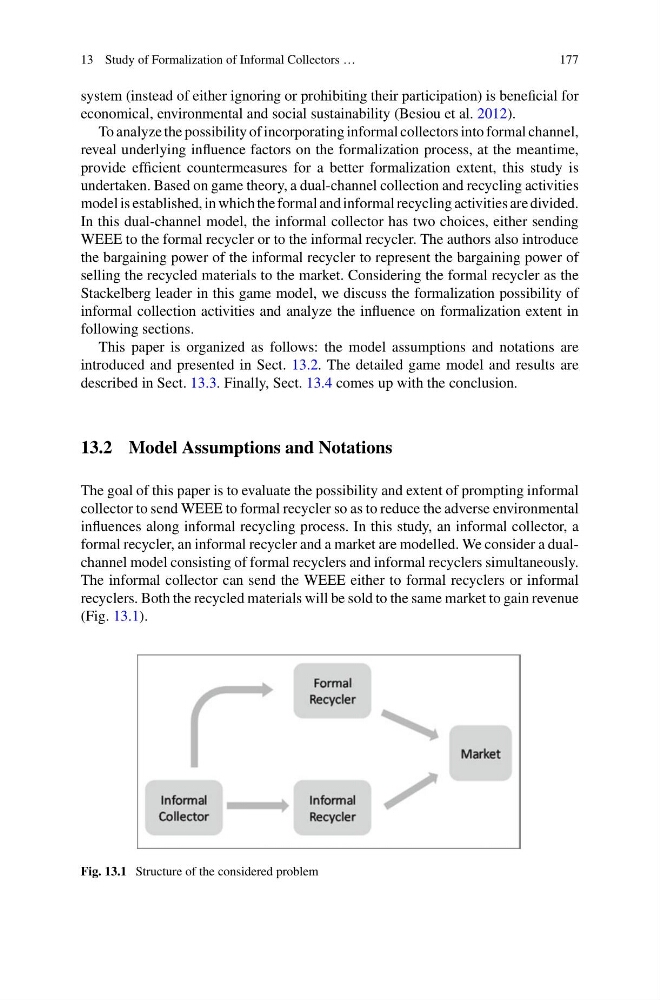
influences along informal recycling process. In this study, an informal collector, a
formal recycler, an informal recycler and a market are modelled. We consider a dualchannel model consisting of formal recyclers and informal recyclers simultaneously.
The informal collector can send the WEEE either to formal recyclers or informal
recyclers. Both the recycled materials will be sold to the same market to gain revenue
(Fig. 13.1).
Fig. 13.1 Structure of the considered problem
177
system (instead of either ignoring or prohibiting their participation) is beneficial for
economical, environmental and social sustainability (Besiou et al. 2012).
To analyze the possibility of incorporating informal collectors into formal channel,
reveal underlying influence factors on the formalization process, at the meantime,
provide efficient countermeasures for a better formalization extent, this study is
undertaken. Based on game theory, a dual-channel collection and recycling activities
model is established, in which the formal and informal recycling activities are divided.
In this dual-channel model, the informal collector has two choices, either sending
WEEE to the formal recycler or to the informal recycler. The authors also introduce
the bargaining power of the informal recycler to represent the bargaining power of
selling the recycled materials to the market. Considering the formal recycler as the
Stackelberg leader in this game model, we discuss the formalization possibility of
informal collection activities and analyze the influence on formalization extent in
following sections.
This paper is organized as follows: the model assumptions and notations are
introduced and presented in Sect. 13.2. The detailed game model and results are
described in Sect. 13.3. Finally, Sect. 13.4 comes up with the conclusion.
13.2 Model Assumptions and Notations
The goal of this paper is to evaluate the possibility and extent of prompting informal
collector to send WEEE to formal recycler so as to reduce the adverse environmental
influences along informal recycling process. In this study, an informal collector, a
formal recycler, an informal recycler and a market are modelled. We consider a dualchannel model consisting of formal recyclers and informal recyclers simultaneously.
The informal collector can send the WEEE either to formal recyclers or informal
recyclers. Both the recycled materials will be sold to the same market to gain revenue
(Fig. 13.1).
Fig. 13.1 Structure of the considered problem