

9 Eco-innovation by Integrating Emerging Technologies with ARIZ Method
127
9.5.1 Part 1: Formulation of System Conflicts
Step 1.1 Formulate Primary Function:
Primary function of electrical motorcycle is no exhaust emissions in the driving
area. Therefore, it can reduces air pollution and environmental impacts.
Step 1.2 Identify Major Components (MCs) of system:
The MCs of the system are battery swapping station and electrical motorcycle.
The MCs of the surrounding environment are air in the driving area of electrical
motorcycle, driving road, and solar light.
Step 1.3 Choose components of system conflicts and associate them with useful and
harmful actions:
Table 9.2 matches conflicting components with real components. It lists only the
real MCs that are related to each conflict and matches them with the conflicting
components.
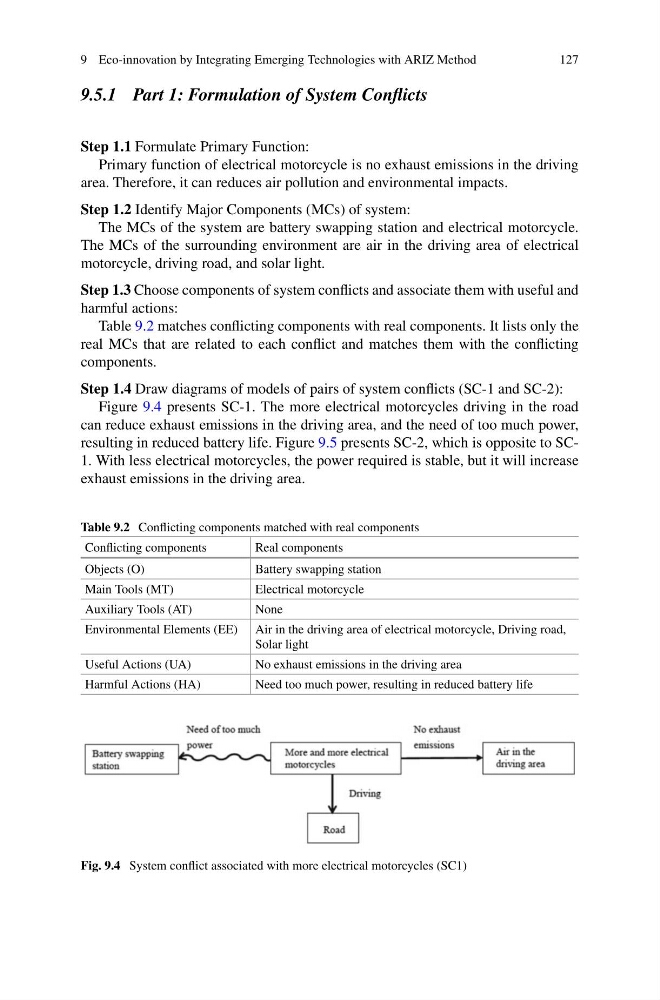
Step 1.4 Draw diagrams of models of pairs of system conflicts (SC-1 and SC-2):
Figure 9.4 presents SC-1. The more electrical motorcycles driving in the road
can reduce exhaust emissions in the driving area, and the need of too much power,
resulting in reduced battery life. Figure 9.5 presents SC-2, which is opposite to SC1. With less electrical motorcycles, the power required is stable, but it will increase
exhaust emissions in the driving area.
Table 9.2 Conflicting components matched with real components
Conflicting components
Real components
Objects (O)
Battery swapping station
Main Tools (MT)
Electrical motorcycle
Auxiliary Tools (AT)
None
Environmental Elements (EE) Air in the driving area of electrical motorcycle, Driving road,
Solar light
Useful Actions (UA)
No exhaust emissions in the driving area
Harmful Actions (HA)
Need too much power, resulting in reduced battery life
Fig. 9.4 System conflict associated with more electrical motorcycles (SC1)
127
9.5.1 Part 1: Formulation of System Conflicts
Step 1.1 Formulate Primary Function:
Primary function of electrical motorcycle is no exhaust emissions in the driving
area. Therefore, it can reduces air pollution and environmental impacts.
Step 1.2 Identify Major Components (MCs) of system:
The MCs of the system are battery swapping station and electrical motorcycle.
The MCs of the surrounding environment are air in the driving area of electrical
motorcycle, driving road, and solar light.
Step 1.3 Choose components of system conflicts and associate them with useful and
harmful actions:
Table 9.2 matches conflicting components with real components. It lists only the
real MCs that are related to each conflict and matches them with the conflicting
components.
Step 1.4 Draw diagrams of models of pairs of system conflicts (SC-1 and SC-2):
Figure 9.4 presents SC-1. The more electrical motorcycles driving in the road
can reduce exhaust emissions in the driving area, and the need of too much power,
resulting in reduced battery life. Figure 9.5 presents SC-2, which is opposite to SC1. With less electrical motorcycles, the power required is stable, but it will increase
exhaust emissions in the driving area.
Table 9.2 Conflicting components matched with real components
Conflicting components
Real components
Objects (O)
Battery swapping station
Main Tools (MT)
Electrical motorcycle
Auxiliary Tools (AT)
None
Environmental Elements (EE) Air in the driving area of electrical motorcycle, Driving road,
Solar light
Useful Actions (UA)
No exhaust emissions in the driving area
Harmful Actions (HA)
Need too much power, resulting in reduced battery life
Fig. 9.4 System conflict associated with more electrical motorcycles (SC1)