

122
J. L. Chen and C.-Y. Chou
is one of most important method in TRIZ theory. The goal of ARIZ is to analyze
the engineering problems through a series of logical steps and processes, so that
problems can be gradually simplified to be solved. There are many versions of ARIZ
including ARIZ-56, ARIZ-59, ARIZ-61, ARIZ-68, ARIZ-71, ARIZ-77, ARIZ-82,
ARIZ-85, ARIZ-85C and so on (Zlotin and Zusman 1999; Savransky 2000). In the
version of ARIZ-85C, the whole framework is complete but has too much parts and
steps which is more compliticated than other versions. Thus, Fey and Rivin (2006)
developed ARIZ-85C (Fey) that simplifies the processes of ARIZ-85C. ARIZ method
after several years of use becoming more and more complete and systematic.
9.3.2 ARIZ-85C (Fey) Version
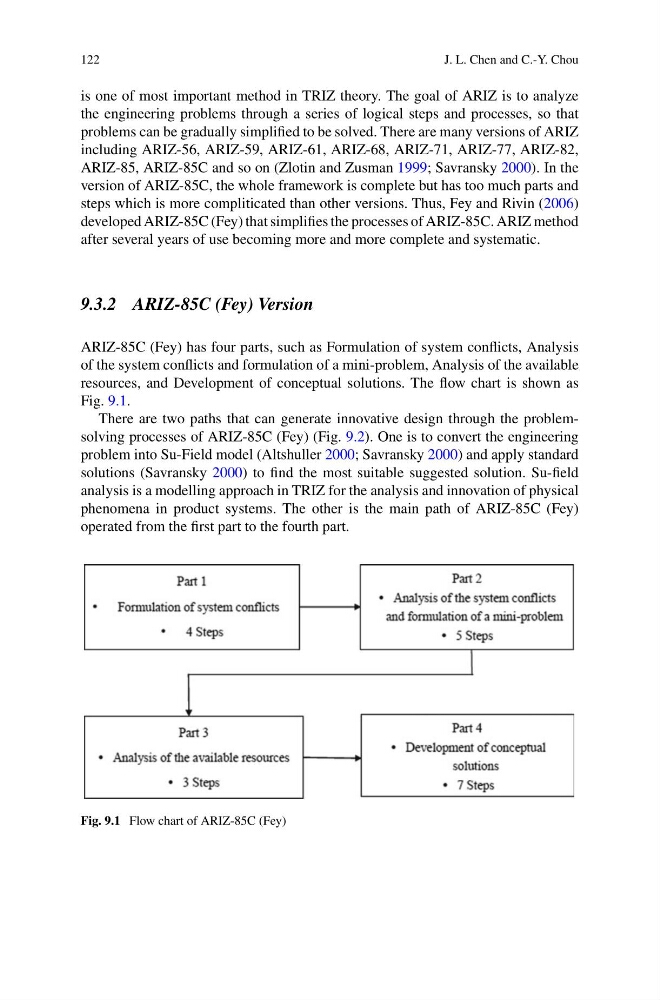
ARIZ-85C (Fey) has four parts, such as Formulation of system conflicts, Analysis
of the system conflicts and formulation of a mini-problem, Analysis of the available
resources, and Development of conceptual solutions. The flow chart is shown as
Fig. 9.1.
There are two paths that can generate innovative design through the problemsolving processes of ARIZ-85C (Fey) (Fig. 9.2). One is to convert the engineering
problem into Su-Field model (Altshuller 2000; Savransky 2000) and apply standard
solutions (Savransky 2000) to find the most suitable suggested solution. Su-field
analysis is a modelling approach in TRIZ for the analysis and innovation of physical
phenomena in product systems. The other is the main path of ARIZ-85C (Fey)
operated from the first part to the fourth part.
Fig. 9.1 Flow chart of ARIZ-85C (Fey)
J. L. Chen and C.-Y. Chou
is one of most important method in TRIZ theory. The goal of ARIZ is to analyze
the engineering problems through a series of logical steps and processes, so that
problems can be gradually simplified to be solved. There are many versions of ARIZ
including ARIZ-56, ARIZ-59, ARIZ-61, ARIZ-68, ARIZ-71, ARIZ-77, ARIZ-82,
ARIZ-85, ARIZ-85C and so on (Zlotin and Zusman 1999; Savransky 2000). In the
version of ARIZ-85C, the whole framework is complete but has too much parts and
steps which is more compliticated than other versions. Thus, Fey and Rivin (2006)
developed ARIZ-85C (Fey) that simplifies the processes of ARIZ-85C. ARIZ method
after several years of use becoming more and more complete and systematic.
9.3.2 ARIZ-85C (Fey) Version
ARIZ-85C (Fey) has four parts, such as Formulation of system conflicts, Analysis
of the system conflicts and formulation of a mini-problem, Analysis of the available
resources, and Development of conceptual solutions. The flow chart is shown as
Fig. 9.1.
There are two paths that can generate innovative design through the problemsolving processes of ARIZ-85C (Fey) (Fig. 9.2). One is to convert the engineering
problem into Su-Field model (Altshuller 2000; Savransky 2000) and apply standard
solutions (Savransky 2000) to find the most suitable suggested solution. Su-field
analysis is a modelling approach in TRIZ for the analysis and innovation of physical
phenomena in product systems. The other is the main path of ARIZ-85C (Fey)
operated from the first part to the fourth part.
Fig. 9.1 Flow chart of ARIZ-85C (Fey)