

8 Designing for Vehicle Recyclability from the Perspectives of Material …
113
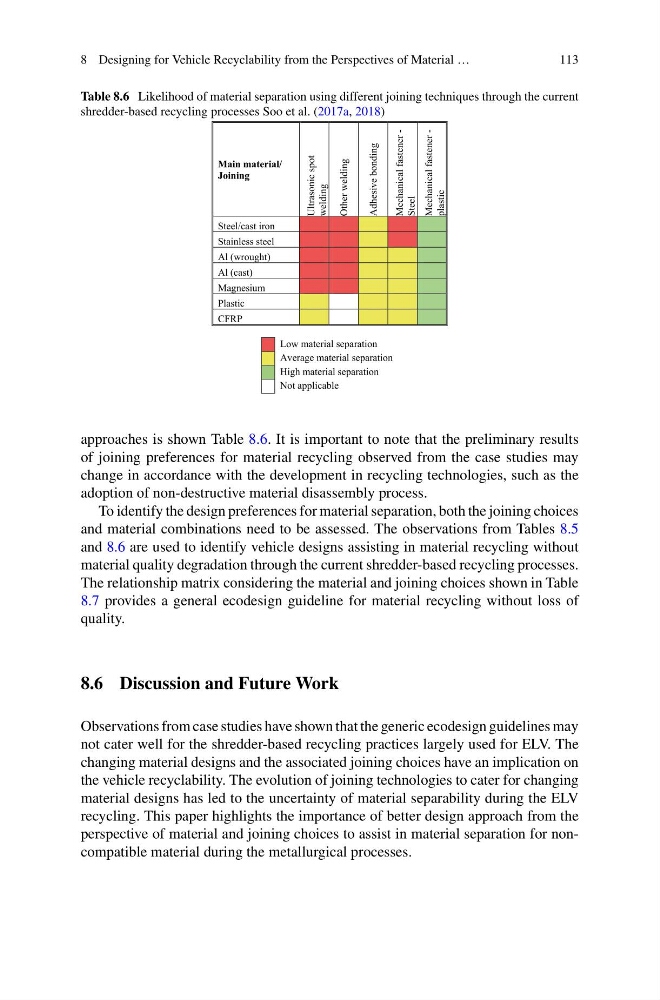
Table 8.6 Likelihood of material separation using different joining techniques through the current
shredder-based recycling processes Soo et al. (2017a, 2018)
Main material/
Joining
Ultrasonic spot
welding
Other welding
Adhesive bonding
Mechanical fastener -
Steel
Mechanical fastener -
plastic
Steel/cast iron
Stainless steel
Al (wrought)
Al (cast)
Magnesium
Plastic
CFRP
Low material separation
Average material separation
High material separation
Not applicable
approaches is shown Table 8.6. It is important to note that the preliminary results
of joining preferences for material recycling observed from the case studies may
change in accordance with the development in recycling technologies, such as the
adoption of non-destructive material disassembly process.
To identify the design preferences for material separation, both the joining choices
and material combinations need to be assessed. The observations from Tables 8.5
and 8.6 are used to identify vehicle designs assisting in material recycling without
material quality degradation through the current shredder-based recycling processes.
The relationship matrix considering the material and joining choices shown in Table
8.7 provides a general ecodesign guideline for material recycling without loss of
quality.
8.6 Discussion and Future Work
Observations from case studies have shown that the generic ecodesign guidelines may
not cater well for the shredder-based recycling practices largely used for ELV. The
changing material designs and the associated joining choices have an implication on
the vehicle recyclability. The evolution of joining technologies to cater for changing
material designs has led to the uncertainty of material separability during the ELV
recycling. This paper highlights the importance of better design approach from the
perspective of material and joining choices to assist in material separation for noncompatible material during the metallurgical processes.
113
Table 8.6 Likelihood of material separation using different joining techniques through the current
shredder-based recycling processes Soo et al. (2017a, 2018)
Main material/
Joining
Ultrasonic spot
welding
Other welding
Adhesive bonding
Mechanical fastener -
Steel
Mechanical fastener -
plastic
Steel/cast iron
Stainless steel
Al (wrought)
Al (cast)
Magnesium
Plastic
CFRP
Low material separation
Average material separation
High material separation
Not applicable
approaches is shown Table 8.6. It is important to note that the preliminary results
of joining preferences for material recycling observed from the case studies may
change in accordance with the development in recycling technologies, such as the
adoption of non-destructive material disassembly process.
To identify the design preferences for material separation, both the joining choices
and material combinations need to be assessed. The observations from Tables 8.5
and 8.6 are used to identify vehicle designs assisting in material recycling without
material quality degradation through the current shredder-based recycling processes.
The relationship matrix considering the material and joining choices shown in Table
8.7 provides a general ecodesign guideline for material recycling without loss of
quality.
8.6 Discussion and Future Work
Observations from case studies have shown that the generic ecodesign guidelines may
not cater well for the shredder-based recycling practices largely used for ELV. The
changing material designs and the associated joining choices have an implication on
the vehicle recyclability. The evolution of joining technologies to cater for changing
material designs has led to the uncertainty of material separability during the ELV
recycling. This paper highlights the importance of better design approach from the
perspective of material and joining choices to assist in material separation for noncompatible material during the metallurgical processes.