

112
V. K. Soo et al.
Table 8.4 Joining types causing impurities in the Al output stream and the observed characteristics
Unliberated joint type
Joint characteristics
Steel fasteners
• Partial liberation for threaded fasteners
• Fasteners with protrusion (e.g. socket screw) assist in liberation
• Corroded steel fasteners cannot be easily liberated
Steel rivets, steel clips, pins • Smooth surface ease liberation if shredded into smaller particle
sizes
Adhesive bonding
• Lap joint or sandwich layer joint design cannot be easily
liberated
• Material combination with larger differences in material
densities assist in liberation
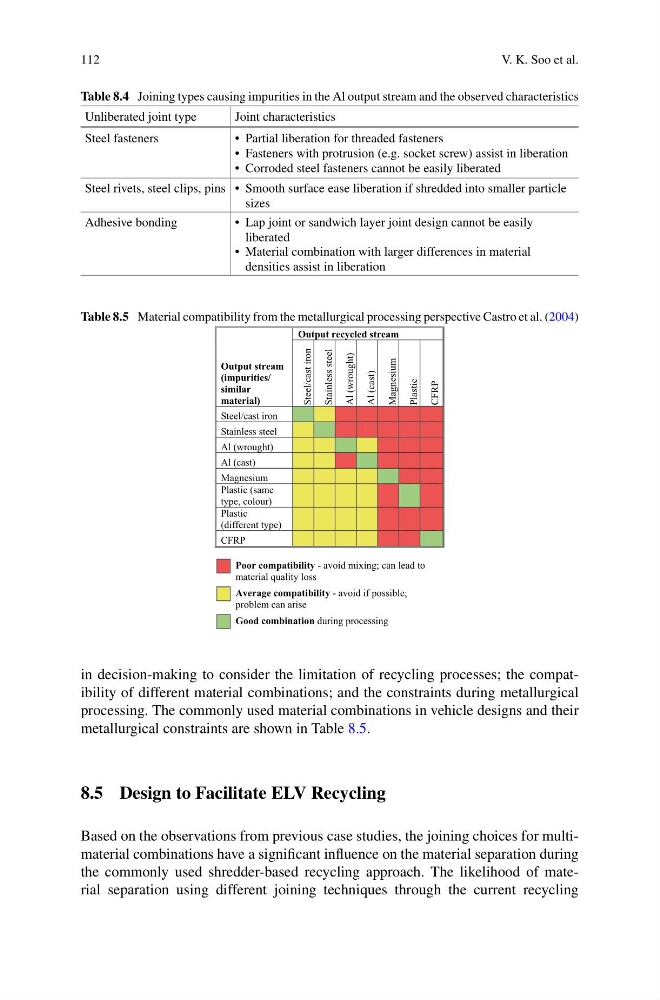
Table 8.5 Material compatibility from the metallurgical processing perspective Castro et al. (2004)
Output stream
(impurities/
similar
material)
Output recycled stream
Steel/cast iron
Stainless steel
Al (wrought)
Al (cast)
Magnesium
Plastic
CFRP
Steel/cast iron
Stainless steel
Al (wrought)
Al (cast)
Magnesium
Plastic (same
type, colour)
Plastic
(different type)
CFRP
Poor compatibility - avoid mixing; can lead to
material quality loss
Average compatibility - avoid if possible;
problem can arise
Good combination during processing
in decision-making to consider the limitation of recycling processes; the compatibility of different material combinations; and the constraints during metallurgical
processing. The commonly used material combinations in vehicle designs and their
metallurgical constraints are shown in Table 8.5.
8.5 Design to Facilitate ELV Recycling
Based on the observations from previous case studies, the joining choices for multimaterial combinations have a significant influence on the material separation during
the commonly used shredder-based recycling approach. The likelihood of material separation using different joining techniques through the current recycling
V. K. Soo et al.
Table 8.4 Joining types causing impurities in the Al output stream and the observed characteristics
Unliberated joint type
Joint characteristics
Steel fasteners
• Partial liberation for threaded fasteners
• Fasteners with protrusion (e.g. socket screw) assist in liberation
• Corroded steel fasteners cannot be easily liberated
Steel rivets, steel clips, pins • Smooth surface ease liberation if shredded into smaller particle
sizes
Adhesive bonding
• Lap joint or sandwich layer joint design cannot be easily
liberated
• Material combination with larger differences in material
densities assist in liberation
Table 8.5 Material compatibility from the metallurgical processing perspective Castro et al. (2004)
Output stream
(impurities/
similar
material)
Output recycled stream
Steel/cast iron
Stainless steel
Al (wrought)
Al (cast)
Magnesium
Plastic
CFRP
Steel/cast iron
Stainless steel
Al (wrought)
Al (cast)
Magnesium
Plastic (same
type, colour)
Plastic
(different type)
CFRP
Poor compatibility - avoid mixing; can lead to
material quality loss
Average compatibility - avoid if possible;
problem can arise
Good combination during processing
in decision-making to consider the limitation of recycling processes; the compatibility of different material combinations; and the constraints during metallurgical
processing. The commonly used material combinations in vehicle designs and their
metallurgical constraints are shown in Table 8.5.
8.5 Design to Facilitate ELV Recycling
Based on the observations from previous case studies, the joining choices for multimaterial combinations have a significant influence on the material separation during
the commonly used shredder-based recycling approach. The likelihood of material separation using different joining techniques through the current recycling