

231
maximise a x
n
j
i j
¦
1
(2)
Subjected to;
¦
d
}
t
}
n
j
ij j
i
j
a x b i
m
x
j
n
1
1
0
1
, .,
, .,
(3)
where;
x j = decision variable where the stakeholder holds control;
a i = numerical parameter whose related and have reflect relative contribution;
¦
n
j
i j
a x
1
= objective function;
¦
d
n
j
ij j
i
a x b
1
= function constrain which expresses the value of x j are limited towards
the environment of the decision-maker; and,
x j ≥ 0 = non-negative constrain that requires x j to not take a negative value.
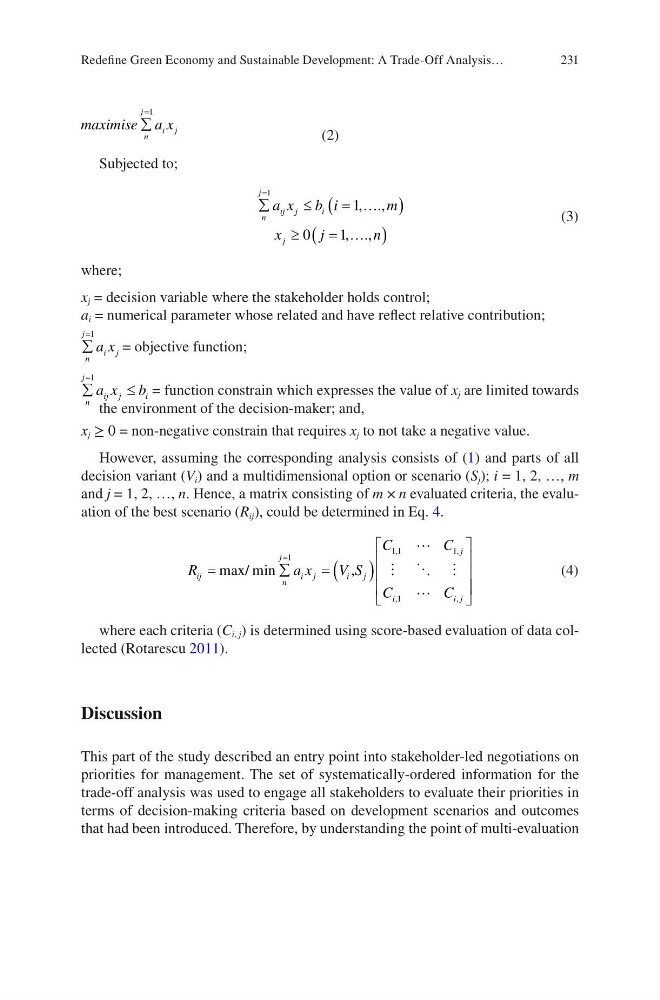
However, assuming the corresponding analysis consists of (1) and parts of all
decision variant (V i ) and a multidimensional option or scenario (S j ); i = 1, 2, …, m
and j = 1, 2, …, n. Hence, a matrix consisting of m × n evaluated criteria, the evaluation of the best scenario (R ij ), could be determined in Eq. 4.
R
a x
V S
C
C
C
C
ij
n
j
i j
i
j
j
i
i j
¦
ª
¬
«
«
«
º
¼
»
»
max/ min
,
,
,
,
1
1 1
1
1
,
» »
(4)
where each criteria (C i, j ) is determined using score-based evaluation of data collected (Rotarescu 2011).
Discussion
This part of the study described an entry point into stakeholder-led negotiations on
priorities for management. The set of systematically-ordered information for the
trade-off analysis was used to engage all stakeholders to evaluate their priorities in
terms of decision-making criteria based on development scenarios and outcomes
that had been introduced. Therefore, by understanding the point of multi-evaluation
Redefine Green Economy and Sustainable Development: A Trade-Off Analysis…
maximise a x
n
j
i j
¦
1
(2)
Subjected to;
¦
d
}
t
}
n
j
ij j
i
j
a x b i
m
x
j
n
1
1
0
1
, .,
, .,
(3)
where;
x j = decision variable where the stakeholder holds control;
a i = numerical parameter whose related and have reflect relative contribution;
¦
n
j
i j
a x
1
= objective function;
¦
d
n
j
ij j
i
a x b
1
= function constrain which expresses the value of x j are limited towards
the environment of the decision-maker; and,
x j ≥ 0 = non-negative constrain that requires x j to not take a negative value.
However, assuming the corresponding analysis consists of (1) and parts of all
decision variant (V i ) and a multidimensional option or scenario (S j ); i = 1, 2, …, m
and j = 1, 2, …, n. Hence, a matrix consisting of m × n evaluated criteria, the evaluation of the best scenario (R ij ), could be determined in Eq. 4.
R
a x
V S
C
C
C
C
ij
n
j
i j
i
j
j
i
i j
¦
ª
¬
«
«
«
º
¼
»
»
max/ min
,
,
,
,
1
1 1
1
1
,
» »
(4)
where each criteria (C i, j ) is determined using score-based evaluation of data collected (Rotarescu 2011).
Discussion
This part of the study described an entry point into stakeholder-led negotiations on
priorities for management. The set of systematically-ordered information for the
trade-off analysis was used to engage all stakeholders to evaluate their priorities in
terms of decision-making criteria based on development scenarios and outcomes
that had been introduced. Therefore, by understanding the point of multi-evaluation
Redefine Green Economy and Sustainable Development: A Trade-Off Analysis…