

230
Methods
Trade-off analysis measured the weighing of respondents’ preferences for various
product features (McCullough 1998; Francois et al. 1991; Luce 1959). In these
cases, respondents were asked to consider alternatives and state a likelihood of purchase or preference for each alternative (Lola et al. 2019). This method was suitable
only for simple decision analysis. In order to simulate multiple criteria, the corresponding situation required the involvement of several decision tools.
Conditional Logit Model
Conditional Logit is a common estimator for choice modelling (Train 2003;
McFadden 1973). In trade-off, Conditional Logit was used to empirically determine
the preferences of subject n, towards J alternative (consider J as an alternative set of
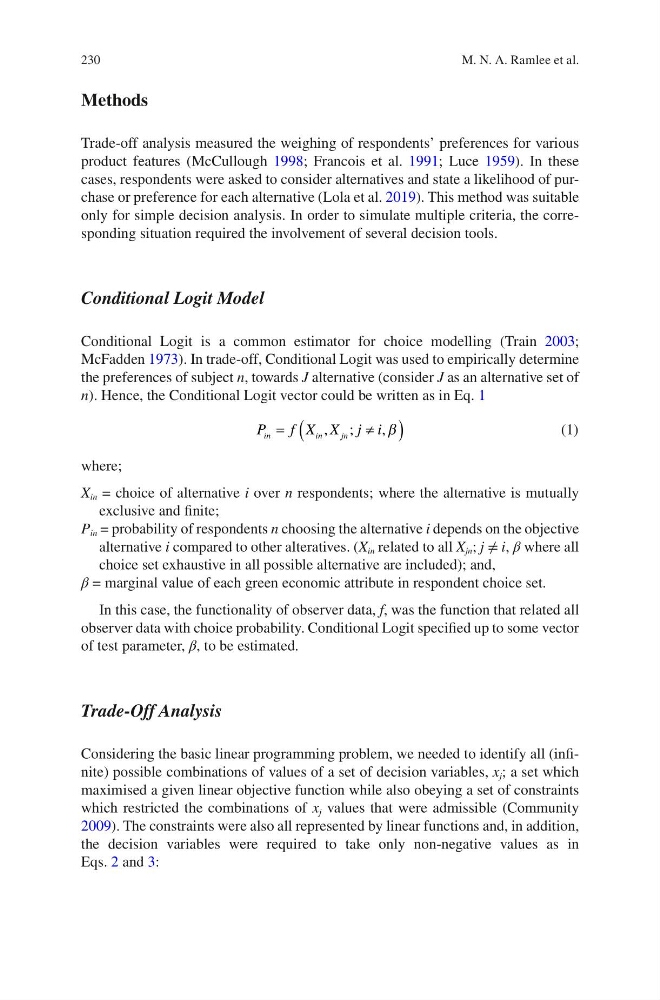
n). Hence, the Conditional Logit vector could be written as in Eq. 1
P
f X X j i
in
in
jn
z
, ;
, E
(1)
where;
X in = choice of alternative i over n respondents; where the alternative is mutually
exclusive and finite;
P in = probability of respondents n choosing the alternative i depends on the objective
alternative i compared to other alteratives. (X in related to all X jn ; j ≠ i, β where all
choice set exhaustive in all possible alternative are included); and,
β = marginal value of each green economic attribute in respondent choice set.
In this case, the functionality of observer data, f, was the function that related all
observer data with choice probability. Conditional Logit specified up to some vector
of test parameter, β, to be estimated.
Trade-Off Analysis
Considering the basic linear programming problem, we needed to identify all (infinite) possible combinations of values of a set of decision variables, x j ; a set which
maximised a given linear objective function while also obeying a set of constraints
which restricted the combinations of x j values that were admissible (Community
2009). The constraints were also all represented by linear functions and, in addition,
the decision variables were required to take only non-negative values as in
Eqs. 2 and 3:
M. N. A. Ramlee et al.
Methods
Trade-off analysis measured the weighing of respondents’ preferences for various
product features (McCullough 1998; Francois et al. 1991; Luce 1959). In these
cases, respondents were asked to consider alternatives and state a likelihood of purchase or preference for each alternative (Lola et al. 2019). This method was suitable
only for simple decision analysis. In order to simulate multiple criteria, the corresponding situation required the involvement of several decision tools.
Conditional Logit Model
Conditional Logit is a common estimator for choice modelling (Train 2003;
McFadden 1973). In trade-off, Conditional Logit was used to empirically determine
the preferences of subject n, towards J alternative (consider J as an alternative set of
n). Hence, the Conditional Logit vector could be written as in Eq. 1
P
f X X j i
in
in
jn
z
, ;
, E
(1)
where;
X in = choice of alternative i over n respondents; where the alternative is mutually
exclusive and finite;
P in = probability of respondents n choosing the alternative i depends on the objective
alternative i compared to other alteratives. (X in related to all X jn ; j ≠ i, β where all
choice set exhaustive in all possible alternative are included); and,
β = marginal value of each green economic attribute in respondent choice set.
In this case, the functionality of observer data, f, was the function that related all
observer data with choice probability. Conditional Logit specified up to some vector
of test parameter, β, to be estimated.
Trade-Off Analysis
Considering the basic linear programming problem, we needed to identify all (infinite) possible combinations of values of a set of decision variables, x j ; a set which
maximised a given linear objective function while also obeying a set of constraints
which restricted the combinations of x j values that were admissible (Community
2009). The constraints were also all represented by linear functions and, in addition,
the decision variables were required to take only non-negative values as in
Eqs. 2 and 3:
M. N. A. Ramlee et al.