

229
understand the type of tourism that is most likely to succeed in the development
region (Suess and Mody 2016). Therefore, there is a need to explore the potential
trade off that includes different perspectives of development to satisfy the above
dilemma. Since residents, stakeholders and others are involved in the development
region, Suess and Mody (2016) suggested the involvement of all participants to
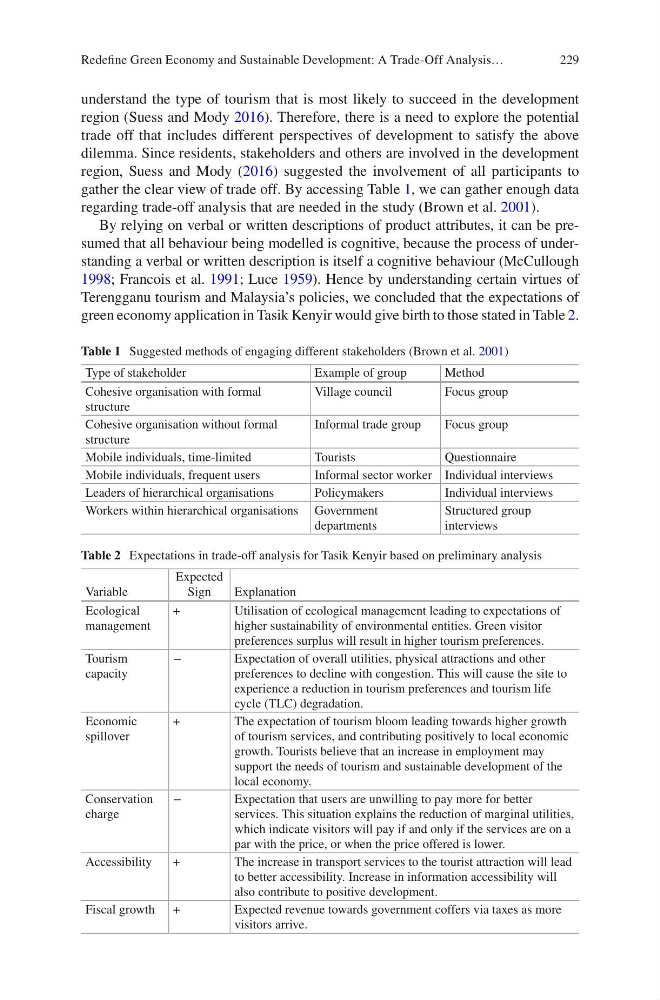
gather the clear view of trade off. By accessing Table 1, we can gather enough data
regarding trade-off analysis that are needed in the study (Brown et al. 2001).
By relying on verbal or written descriptions of product attributes, it can be presumed that all behaviour being modelled is cognitive, because the process of understanding a verbal or written description is itself a cognitive behaviour (McCullough
1998; Francois et al. 1991; Luce 1959). Hence by understanding certain virtues of
Terengganu tourism and Malaysia’s policies, we concluded that the expectations of
green economy application in Tasik Kenyir would give birth to those stated in Table 2.
Table 1 Suggested methods of engaging different stakeholders (Brown et al. 2001)
Type of stakeholder
Example of group
Method
Cohesive organisation with formal
structure
Village council
Focus group
Cohesive organisation without formal
structure
Informal trade group
Focus group
Mobile individuals, time-limited
Tourists
Questionnaire
Mobile individuals, frequent users
Informal sector worker Individual interviews
Leaders of hierarchical organisations
Policymakers
Individual interviews
Workers within hierarchical organisations Government
departments
Structured group
interviews
Table 2 Expectations in trade-off analysis for Tasik Kenyir based on preliminary analysis
Variable
Expected
Sign
Explanation
Ecological
management
+
Utilisation of ecological management leading to expectations of
higher sustainability of environmental entities. Green visitor
preferences surplus will result in higher tourism preferences.
Tourism
capacity
−
Expectation of overall utilities, physical attractions and other
preferences to decline with congestion. This will cause the site to
experience a reduction in tourism preferences and tourism life
cycle (TLC) degradation.
Economic
spillover
+
The expectation of tourism bloom leading towards higher growth
of tourism services, and contributing positively to local economic
growth. Tourists believe that an increase in employment may
support the needs of tourism and sustainable development of the
local economy.
Conservation
charge
−
Expectation that users are unwilling to pay more for better
services. This situation explains the reduction of marginal utilities,
which indicate visitors will pay if and only if the services are on a
par with the price, or when the price offered is lower.
Accessibility
+
The increase in transport services to the tourist attraction will lead
to better accessibility. Increase in information accessibility will
also contribute to positive development.
Fiscal growth +
Expected revenue towards government coffers via taxes as more
visitors arrive.
Redefine Green Economy and Sustainable Development: A Trade-Off Analysis…
understand the type of tourism that is most likely to succeed in the development
region (Suess and Mody 2016). Therefore, there is a need to explore the potential
trade off that includes different perspectives of development to satisfy the above
dilemma. Since residents, stakeholders and others are involved in the development
region, Suess and Mody (2016) suggested the involvement of all participants to
gather the clear view of trade off. By accessing Table 1, we can gather enough data
regarding trade-off analysis that are needed in the study (Brown et al. 2001).
By relying on verbal or written descriptions of product attributes, it can be presumed that all behaviour being modelled is cognitive, because the process of understanding a verbal or written description is itself a cognitive behaviour (McCullough
1998; Francois et al. 1991; Luce 1959). Hence by understanding certain virtues of
Terengganu tourism and Malaysia’s policies, we concluded that the expectations of
green economy application in Tasik Kenyir would give birth to those stated in Table 2.
Table 1 Suggested methods of engaging different stakeholders (Brown et al. 2001)
Type of stakeholder
Example of group
Method
Cohesive organisation with formal
structure
Village council
Focus group
Cohesive organisation without formal
structure
Informal trade group
Focus group
Mobile individuals, time-limited
Tourists
Questionnaire
Mobile individuals, frequent users
Informal sector worker Individual interviews
Leaders of hierarchical organisations
Policymakers
Individual interviews
Workers within hierarchical organisations Government
departments
Structured group
interviews
Table 2 Expectations in trade-off analysis for Tasik Kenyir based on preliminary analysis
Variable
Expected
Sign
Explanation
Ecological
management
+
Utilisation of ecological management leading to expectations of
higher sustainability of environmental entities. Green visitor
preferences surplus will result in higher tourism preferences.
Tourism
capacity
−
Expectation of overall utilities, physical attractions and other
preferences to decline with congestion. This will cause the site to
experience a reduction in tourism preferences and tourism life
cycle (TLC) degradation.
Economic
spillover
+
The expectation of tourism bloom leading towards higher growth
of tourism services, and contributing positively to local economic
growth. Tourists believe that an increase in employment may
support the needs of tourism and sustainable development of the
local economy.
Conservation
charge
−
Expectation that users are unwilling to pay more for better
services. This situation explains the reduction of marginal utilities,
which indicate visitors will pay if and only if the services are on a
par with the price, or when the price offered is lower.
Accessibility
+
The increase in transport services to the tourist attraction will lead
to better accessibility. Increase in information accessibility will
also contribute to positive development.
Fiscal growth +
Expected revenue towards government coffers via taxes as more
visitors arrive.
Redefine Green Economy and Sustainable Development: A Trade-Off Analysis…