

232
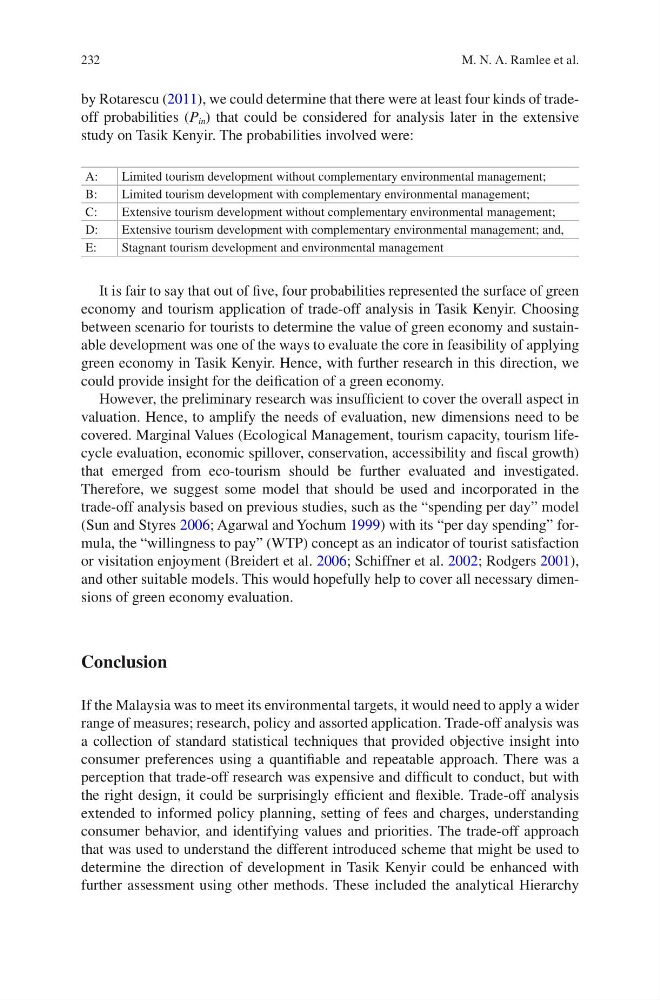
by Rotarescu (2011), we could determine that there were at least four kinds of tradeoff probabilities (P in ) that could be considered for analysis later in the extensive
study on Tasik Kenyir. The probabilities involved were:
A:
Limited tourism development without complementary environmental management;
B:
Limited tourism development with complementary environmental management;
C:
Extensive tourism development without complementary environmental management;
D:
Extensive tourism development with complementary environmental management; and,
E:
Stagnant tourism development and environmental management
It is fair to say that out of five, four probabilities represented the surface of green
economy and tourism application of trade-off analysis in Tasik Kenyir. Choosing
between scenario for tourists to determine the value of green economy and sustainable development was one of the ways to evaluate the core in feasibility of applying
green economy in Tasik Kenyir. Hence, with further research in this direction, we
could provide insight for the deification of a green economy.
However, the preliminary research was insufficient to cover the overall aspect in
valuation. Hence, to amplify the needs of evaluation, new dimensions need to be
covered. Marginal Values (Ecological Management, tourism capacity, tourism lifecycle evaluation, economic spillover, conservation, accessibility and fiscal growth)
that emerged from eco-tourism should be further evaluated and investigated.
Therefore, we suggest some model that should be used and incorporated in the
trade-off analysis based on previous studies, such as the “spending per day” model
(Sun and Styres 2006; Agarwal and Yochum 1999) with its “per day spending” formula, the “willingness to pay” (WTP) concept as an indicator of tourist satisfaction
or visitation enjoyment (Breidert et al. 2006; Schiffner et al. 2002; Rodgers 2001),
and other suitable models. This would hopefully help to cover all necessary dimensions of green economy evaluation.
Conclusion
If the Malaysia was to meet its environmental targets, it would need to apply a wider
range of measures; research, policy and assorted application. Trade-off analysis was
a collection of standard statistical techniques that provided objective insight into
consumer preferences using a quantifiable and repeatable approach. There was a
perception that trade-off research was expensive and difficult to conduct, but with
the right design, it could be surprisingly efficient and flexible. Trade-off analysis
extended to informed policy planning, setting of fees and charges, understanding
consumer behavior, and identifying values and priorities. The trade-off approach
that was used to understand the different introduced scheme that might be used to
determine the direction of development in Tasik Kenyir could be enhanced with
further assessment using other methods. These included the analytical Hierarchy
M. N. A. Ramlee et al.
by Rotarescu (2011), we could determine that there were at least four kinds of tradeoff probabilities (P in ) that could be considered for analysis later in the extensive
study on Tasik Kenyir. The probabilities involved were:
A:
Limited tourism development without complementary environmental management;
B:
Limited tourism development with complementary environmental management;
C:
Extensive tourism development without complementary environmental management;
D:
Extensive tourism development with complementary environmental management; and,
E:
Stagnant tourism development and environmental management
It is fair to say that out of five, four probabilities represented the surface of green
economy and tourism application of trade-off analysis in Tasik Kenyir. Choosing
between scenario for tourists to determine the value of green economy and sustainable development was one of the ways to evaluate the core in feasibility of applying
green economy in Tasik Kenyir. Hence, with further research in this direction, we
could provide insight for the deification of a green economy.
However, the preliminary research was insufficient to cover the overall aspect in
valuation. Hence, to amplify the needs of evaluation, new dimensions need to be
covered. Marginal Values (Ecological Management, tourism capacity, tourism lifecycle evaluation, economic spillover, conservation, accessibility and fiscal growth)
that emerged from eco-tourism should be further evaluated and investigated.
Therefore, we suggest some model that should be used and incorporated in the
trade-off analysis based on previous studies, such as the “spending per day” model
(Sun and Styres 2006; Agarwal and Yochum 1999) with its “per day spending” formula, the “willingness to pay” (WTP) concept as an indicator of tourist satisfaction
or visitation enjoyment (Breidert et al. 2006; Schiffner et al. 2002; Rodgers 2001),
and other suitable models. This would hopefully help to cover all necessary dimensions of green economy evaluation.
Conclusion
If the Malaysia was to meet its environmental targets, it would need to apply a wider
range of measures; research, policy and assorted application. Trade-off analysis was
a collection of standard statistical techniques that provided objective insight into
consumer preferences using a quantifiable and repeatable approach. There was a
perception that trade-off research was expensive and difficult to conduct, but with
the right design, it could be surprisingly efficient and flexible. Trade-off analysis
extended to informed policy planning, setting of fees and charges, understanding
consumer behavior, and identifying values and priorities. The trade-off approach
that was used to understand the different introduced scheme that might be used to
determine the direction of development in Tasik Kenyir could be enhanced with
further assessment using other methods. These included the analytical Hierarchy
M. N. A. Ramlee et al.