

194
sustainability of the village population might come into question. In 2014 and 2015,
there were four and five young deaths compared with only 10 and 12 births,
respectively.
A good healthcare system should be able to reduce childhood deaths, but this
was not reflected in the village, which only had a small population of 510. However,
the data indicated a 5-year trend only, and further studies should include a longer
period as population dynamics could rise and decline over decades.
In order to control sexually-transmitted diseases like HIV/AIDS and syphilis
among the Orang Asli, family planning and sexual health awareness would be effective tools. Preventing unwanted pregnancies might help improve the socio-economic
condition of Orang Asli families as they would not be burdened by the cost of raising many children.
Generally, the Orang Asli did not care about the size of their families. They did
not consider that a huge family would cause inequality among members. Having
more children than they could support would lower their standard of living and
make them poorer. However, family planning had been introduced to the Orang Asli
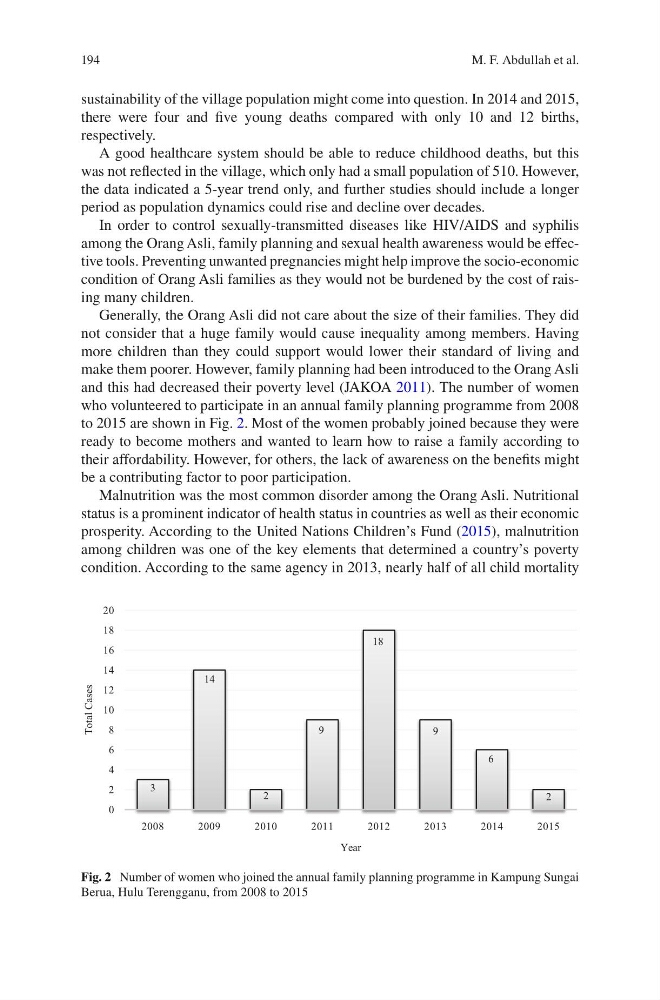
and this had decreased their poverty level (JAKOA 2011). The number of women
who volunteered to participate in an annual family planning programme from 2008
to 2015 are shown in Fig. 2. Most of the women probably joined because they were
ready to become mothers and wanted to learn how to raise a family according to
their affordability. However, for others, the lack of awareness on the benefits might
be a contributing factor to poor participation.
Malnutrition was the most common disorder among the Orang Asli. Nutritional
status is a prominent indicator of health status in countries as well as their economic
prosperity. According to the United Nations Children’s Fund (2015), malnutrition
among children was one of the key elements that determined a country’s poverty
condition. According to the same agency in 2013, nearly half of all child mortality
3
14
2
9
18
9
6
2
0
2
4
6
8
10
12
14
16
18
20
2008
2009
2010
2011
2012
2013
2014
2015
Total Cases
Year
Fig. 2 Number of women who joined the annual family planning programme in Kampung Sungai
Berua, Hulu Terengganu, from 2008 to 2015
M. F. Abdullah et al.
sustainability of the village population might come into question. In 2014 and 2015,
there were four and five young deaths compared with only 10 and 12 births,
respectively.
A good healthcare system should be able to reduce childhood deaths, but this
was not reflected in the village, which only had a small population of 510. However,
the data indicated a 5-year trend only, and further studies should include a longer
period as population dynamics could rise and decline over decades.
In order to control sexually-transmitted diseases like HIV/AIDS and syphilis
among the Orang Asli, family planning and sexual health awareness would be effective tools. Preventing unwanted pregnancies might help improve the socio-economic
condition of Orang Asli families as they would not be burdened by the cost of raising many children.
Generally, the Orang Asli did not care about the size of their families. They did
not consider that a huge family would cause inequality among members. Having
more children than they could support would lower their standard of living and
make them poorer. However, family planning had been introduced to the Orang Asli
and this had decreased their poverty level (JAKOA 2011). The number of women
who volunteered to participate in an annual family planning programme from 2008
to 2015 are shown in Fig. 2. Most of the women probably joined because they were
ready to become mothers and wanted to learn how to raise a family according to
their affordability. However, for others, the lack of awareness on the benefits might
be a contributing factor to poor participation.
Malnutrition was the most common disorder among the Orang Asli. Nutritional
status is a prominent indicator of health status in countries as well as their economic
prosperity. According to the United Nations Children’s Fund (2015), malnutrition
among children was one of the key elements that determined a country’s poverty
condition. According to the same agency in 2013, nearly half of all child mortality
3
14
2
9
18
9
6
2
0
2
4
6
8
10
12
14
16
18
20
2008
2009
2010
2011
2012
2013
2014
2015
Total Cases
Year
Fig. 2 Number of women who joined the annual family planning programme in Kampung Sungai
Berua, Hulu Terengganu, from 2008 to 2015
M. F. Abdullah et al.