

193
medical practices. The Orang Asli health data were obtained from the Sungai Berua
rural clinic and Hulu Terengganu district health office.
Results and Discussion
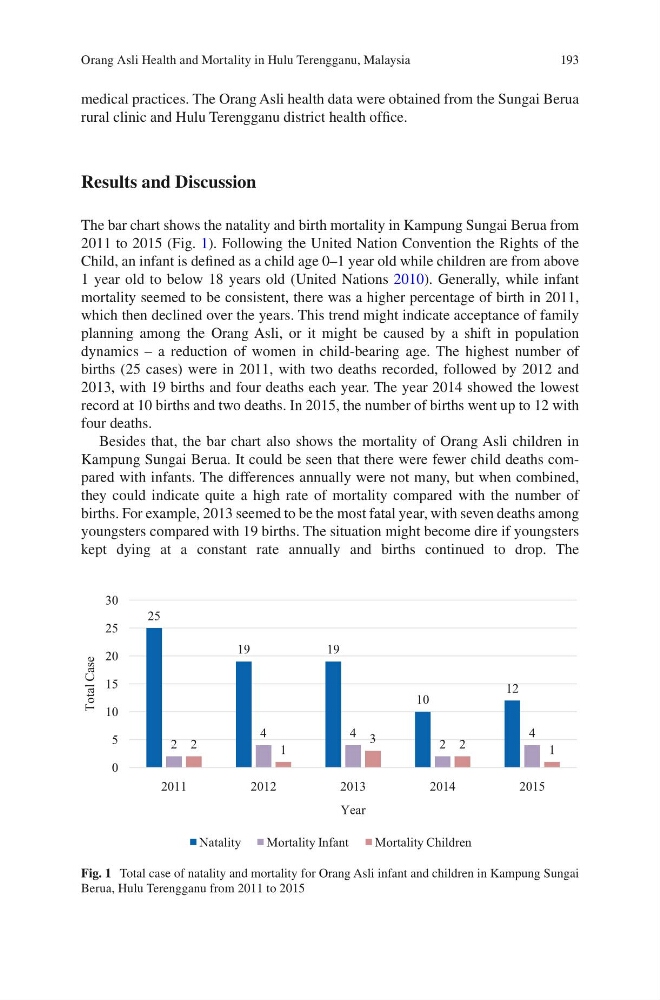
The bar chart shows the natality and birth mortality in Kampung Sungai Berua from
2011 to 2015 (Fig. 1). Following the United Nation Convention the Rights of the
Child, an infant is defined as a child age 0–1 year old while children are from above
1 year old to below 18 years old (United Nations 2010). Generally, while infant
mortality seemed to be consistent, there was a higher percentage of birth in 2011,
which then declined over the years. This trend might indicate acceptance of family
planning among the Orang Asli, or it might be caused by a shift in population
dynamics – a reduction of women in child-bearing age. The highest number of
births (25 cases) were in 2011, with two deaths recorded, followed by 2012 and
2013, with 19 births and four deaths each year. The year 2014 showed the lowest
record at 10 births and two deaths. In 2015, the number of births went up to 12 with
four deaths.
Besides that, the bar chart also shows the mortality of Orang Asli children in
Kampung Sungai Berua. It could be seen that there were fewer child deaths compared with infants. The differences annually were not many, but when combined,
they could indicate quite a high rate of mortality compared with the number of
births. For example, 2013 seemed to be the most fatal year, with seven deaths among
youngsters compared with 19 births. The situation might become dire if youngsters
kept dying at a constant rate annually and births continued to drop. The
25
19
19
10
12
2
4
4
2
4
2
1
3
2
1
0
5
10
15
20
25
30
2011
2012
2013
2014
2015
Total Case
Year
Natality
Mortality Infant
Mortality Children
Fig. 1 Total case of natality and mortality for Orang Asli infant and children in Kampung Sungai
Berua, Hulu Terengganu from 2011 to 2015
Orang Asli Health and Mortality in Hulu Terengganu, Malaysia
medical practices. The Orang Asli health data were obtained from the Sungai Berua
rural clinic and Hulu Terengganu district health office.
Results and Discussion
The bar chart shows the natality and birth mortality in Kampung Sungai Berua from
2011 to 2015 (Fig. 1). Following the United Nation Convention the Rights of the
Child, an infant is defined as a child age 0–1 year old while children are from above
1 year old to below 18 years old (United Nations 2010). Generally, while infant
mortality seemed to be consistent, there was a higher percentage of birth in 2011,
which then declined over the years. This trend might indicate acceptance of family
planning among the Orang Asli, or it might be caused by a shift in population
dynamics – a reduction of women in child-bearing age. The highest number of
births (25 cases) were in 2011, with two deaths recorded, followed by 2012 and
2013, with 19 births and four deaths each year. The year 2014 showed the lowest
record at 10 births and two deaths. In 2015, the number of births went up to 12 with
four deaths.
Besides that, the bar chart also shows the mortality of Orang Asli children in
Kampung Sungai Berua. It could be seen that there were fewer child deaths compared with infants. The differences annually were not many, but when combined,
they could indicate quite a high rate of mortality compared with the number of
births. For example, 2013 seemed to be the most fatal year, with seven deaths among
youngsters compared with 19 births. The situation might become dire if youngsters
kept dying at a constant rate annually and births continued to drop. The
25
19
19
10
12
2
4
4
2
4
2
1
3
2
1
0
5
10
15
20
25
30
2011
2012
2013
2014
2015
Total Case
Year
Natality
Mortality Infant
Mortality Children
Fig. 1 Total case of natality and mortality for Orang Asli infant and children in Kampung Sungai
Berua, Hulu Terengganu from 2011 to 2015
Orang Asli Health and Mortality in Hulu Terengganu, Malaysia