

192
programmes, such as health camps, mobile clinics, dentistry services and air doctors, to ensure that the Orang Asli received healthcare services on a par with other
communities (JAKOA 2011).
The government continues to respond to the needs of the Orang Asli. While
progress has been slow, nevertheless, it is being realised. Cases of vector-borne
diseases are declining among the Orang Asli in Hulu Terengganu. According to
JAKOA (2011), the Orang Asli who live in the forest normally suffer from malaria,
tuberculosis, leprosy, skin problems and worm infection. According to the district
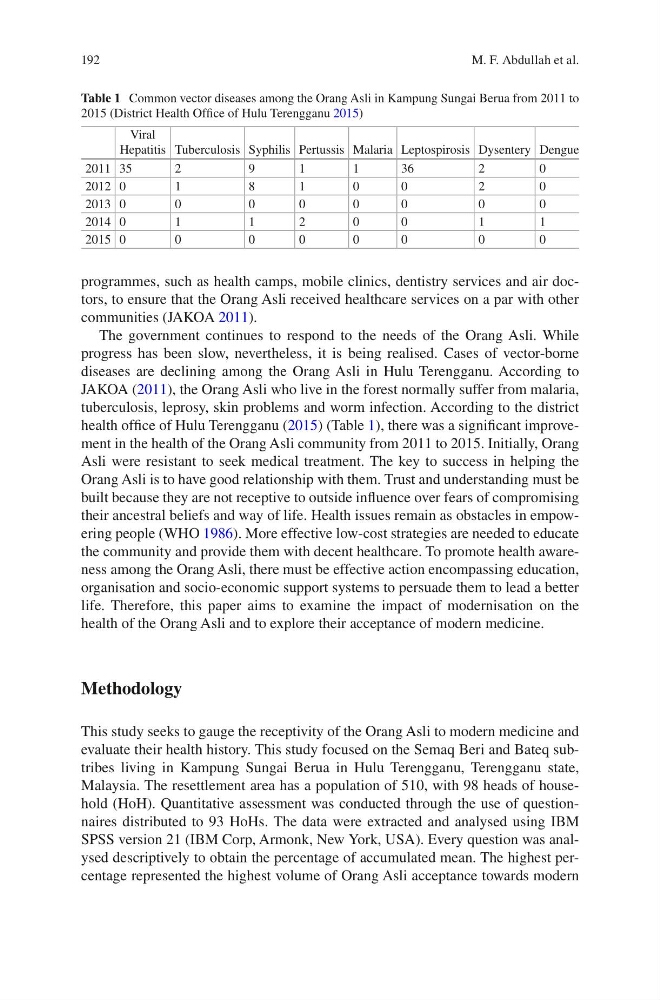
health office of Hulu Terengganu (2015) (Table 1), there was a significant improvement in the health of the Orang Asli community from 2011 to 2015. Initially, Orang
Asli were resistant to seek medical treatment. The key to success in helping the
Orang Asli is to have good relationship with them. Trust and understanding must be
built because they are not receptive to outside influence over fears of compromising
their ancestral beliefs and way of life. Health issues remain as obstacles in empowering people (WHO 1986). More effective low-cost strategies are needed to educate
the community and provide them with decent healthcare. To promote health awareness among the Orang Asli, there must be effective action encompassing education,
organisation and socio-economic support systems to persuade them to lead a better
life. Therefore, this paper aims to examine the impact of modernisation on the
health of the Orang Asli and to explore their acceptance of modern medicine.
Methodology
This study seeks to gauge the receptivity of the Orang Asli to modern medicine and
evaluate their health history. This study focused on the Semaq Beri and Bateq subtribes living in Kampung Sungai Berua in Hulu Terengganu, Terengganu state,
Malaysia. The resettlement area has a population of 510, with 98 heads of household (HoH). Quantitative assessment was conducted through the use of questionnaires distributed to 93 HoHs. The data were extracted and analysed using IBM
SPSS version 21 (IBM Corp, Armonk, New York, USA). Every question was analysed descriptively to obtain the percentage of accumulated mean. The highest percentage represented the highest volume of Orang Asli acceptance towards modern
Table 1 Common vector diseases among the Orang Asli in Kampung Sungai Berua from 2011 to
2015 (District Health Office of Hulu Terengganu 2015)
Viral
Hepatitis Tuberculosis Syphilis Pertussis Malaria Leptospirosis Dysentery Dengue
2011 35
2
9
1
1
36
2
0
2012 0
1
8
1
0
0
2
0
2013 0
0
0
0
0
0
0
0
2014 0
1
1
2
0
0
1
1
2015 0
0
0
0
0
0
0
0
M. F. Abdullah et al.
programmes, such as health camps, mobile clinics, dentistry services and air doctors, to ensure that the Orang Asli received healthcare services on a par with other
communities (JAKOA 2011).
The government continues to respond to the needs of the Orang Asli. While
progress has been slow, nevertheless, it is being realised. Cases of vector-borne
diseases are declining among the Orang Asli in Hulu Terengganu. According to
JAKOA (2011), the Orang Asli who live in the forest normally suffer from malaria,
tuberculosis, leprosy, skin problems and worm infection. According to the district
health office of Hulu Terengganu (2015) (Table 1), there was a significant improvement in the health of the Orang Asli community from 2011 to 2015. Initially, Orang
Asli were resistant to seek medical treatment. The key to success in helping the
Orang Asli is to have good relationship with them. Trust and understanding must be
built because they are not receptive to outside influence over fears of compromising
their ancestral beliefs and way of life. Health issues remain as obstacles in empowering people (WHO 1986). More effective low-cost strategies are needed to educate
the community and provide them with decent healthcare. To promote health awareness among the Orang Asli, there must be effective action encompassing education,
organisation and socio-economic support systems to persuade them to lead a better
life. Therefore, this paper aims to examine the impact of modernisation on the
health of the Orang Asli and to explore their acceptance of modern medicine.
Methodology
This study seeks to gauge the receptivity of the Orang Asli to modern medicine and
evaluate their health history. This study focused on the Semaq Beri and Bateq subtribes living in Kampung Sungai Berua in Hulu Terengganu, Terengganu state,
Malaysia. The resettlement area has a population of 510, with 98 heads of household (HoH). Quantitative assessment was conducted through the use of questionnaires distributed to 93 HoHs. The data were extracted and analysed using IBM
SPSS version 21 (IBM Corp, Armonk, New York, USA). Every question was analysed descriptively to obtain the percentage of accumulated mean. The highest percentage represented the highest volume of Orang Asli acceptance towards modern
Table 1 Common vector diseases among the Orang Asli in Kampung Sungai Berua from 2011 to
2015 (District Health Office of Hulu Terengganu 2015)
Viral
Hepatitis Tuberculosis Syphilis Pertussis Malaria Leptospirosis Dysentery Dengue
2011 35
2
9
1
1
36
2
0
2012 0
1
8
1
0
0
2
0
2013 0
0
0
0
0
0
0
0
2014 0
1
1
2
0
0
1
1
2015 0
0
0
0
0
0
0
0
M. F. Abdullah et al.