

195
under age 5 could be attributed to under-nutrition. This was because malnourished
children were at risk of dying from common infections. The condition would slow
down the body’s metabolism and suppress the immune system. Malnourished children were more likely to suffer infections because of this immune deficiency
(Rayhan & Khan, 2006). The number of malnutrition cases among the Orang Asli
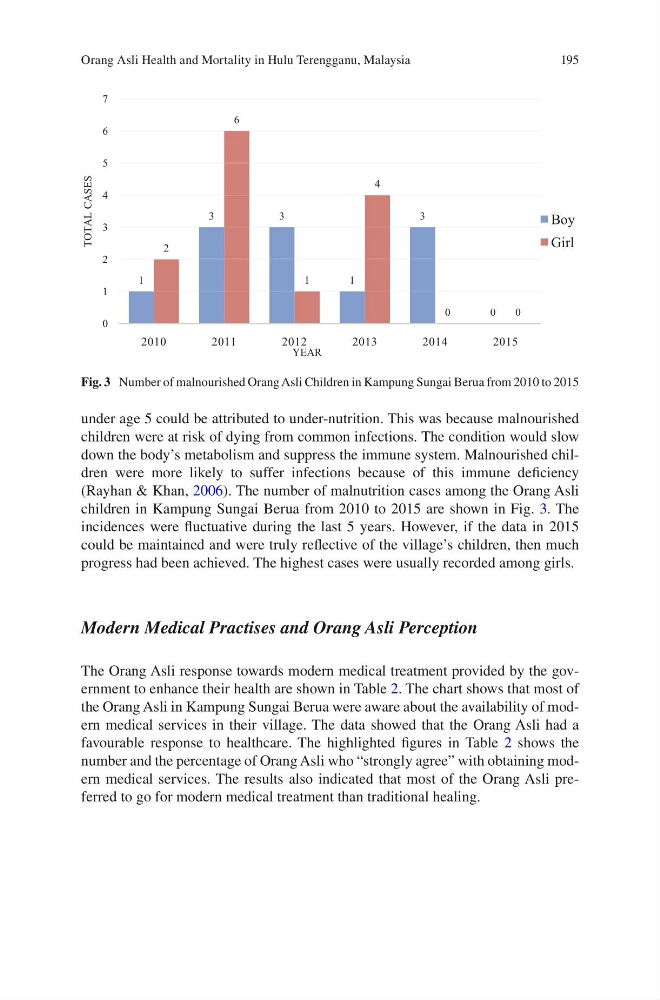
children in Kampung Sungai Berua from 2010 to 2015 are shown in Fig. 3. The
incidences were fluctuative during the last 5 years. However, if the data in 2015
could be maintained and were truly reflective of the village’s children, then much
progress had been achieved. The highest cases were usually recorded among girls.
Modern Medical Practises and Orang Asli Perception
The Orang Asli response towards modern medical treatment provided by the government to enhance their health are shown in Table 2. The chart shows that most of
the Orang Asli in Kampung Sungai Berua were aware about the availability of modern medical services in their village. The data showed that the Orang Asli had a
favourable response to healthcare. The highlighted figures in Table 2 shows the
number and the percentage of Orang Asli who “strongly agree” with obtaining modern medical services. The results also indicated that most of the Orang Asli preferred to go for modern medical treatment than traditional healing.
1
3
3
1
3
0
2
6
1
4
0
0
0
1
2
3
4
5
6
7
2010
2011
2012
2013
2014
2015
TOTAL CASES
YEAR
Boy
Girl
Fig. 3 Number of malnourished Orang Asli Children in Kampung Sungai Berua from 2010 to 2015
Orang Asli Health and Mortality in Hulu Terengganu, Malaysia
under age 5 could be attributed to under-nutrition. This was because malnourished
children were at risk of dying from common infections. The condition would slow
down the body’s metabolism and suppress the immune system. Malnourished children were more likely to suffer infections because of this immune deficiency
(Rayhan & Khan, 2006). The number of malnutrition cases among the Orang Asli
children in Kampung Sungai Berua from 2010 to 2015 are shown in Fig. 3. The
incidences were fluctuative during the last 5 years. However, if the data in 2015
could be maintained and were truly reflective of the village’s children, then much
progress had been achieved. The highest cases were usually recorded among girls.
Modern Medical Practises and Orang Asli Perception
The Orang Asli response towards modern medical treatment provided by the government to enhance their health are shown in Table 2. The chart shows that most of
the Orang Asli in Kampung Sungai Berua were aware about the availability of modern medical services in their village. The data showed that the Orang Asli had a
favourable response to healthcare. The highlighted figures in Table 2 shows the
number and the percentage of Orang Asli who “strongly agree” with obtaining modern medical services. The results also indicated that most of the Orang Asli preferred to go for modern medical treatment than traditional healing.
1
3
3
1
3
0
2
6
1
4
0
0
0
1
2
3
4
5
6
7
2010
2011
2012
2013
2014
2015
TOTAL CASES
YEAR
Boy
Girl
Fig. 3 Number of malnourished Orang Asli Children in Kampung Sungai Berua from 2010 to 2015
Orang Asli Health and Mortality in Hulu Terengganu, Malaysia