

597
nology; it is named in specific manner and is practicing successfully (Pamies et al.
2017). Scientists are working to alter growth or detection of defective trait or disease
gene by using microorganisms, plants and animal cell, system or processes to make
products for their use (Nazir et al. 2017). In modern times, several applications from
recombinant DNA technology to tissue culture technology are involved in the production of different products and services (Bandyopadhyay et al. 2017). For having
better crop variety and more predictable results, molecular improvements offer
much better promising results (Perez et al. 2017). The scientists who are interested
in improving disease resistance in any crop plant often face problems in the quest of
adequate resistance in available germplasm (Montenegro de Wit 2017). There are
many chances that the desired trait is virtually nonexistent in the species gene pool
(Alexander and Woeste 2017). The genetic engineering presents the solution in the
form of transferring a specific desire gene from a donor to the recipient in a more
controlled manner because in this technology the donor has not been sexually compatible. Various ailments are being treated by different proteins (Table 26.2). The
new technology allows us to approach directly to the DNA molecule for information
(Rasekh et al. 2017). Sequence alignment of DNA and genetic engineering provides
us information about working of detailed section of DNA (Bothmer et al. 2017). The
word biotechnology represents alliance or relationship between environmental science and knowledge. Principally, biotechnology is a recently exposed scheme of
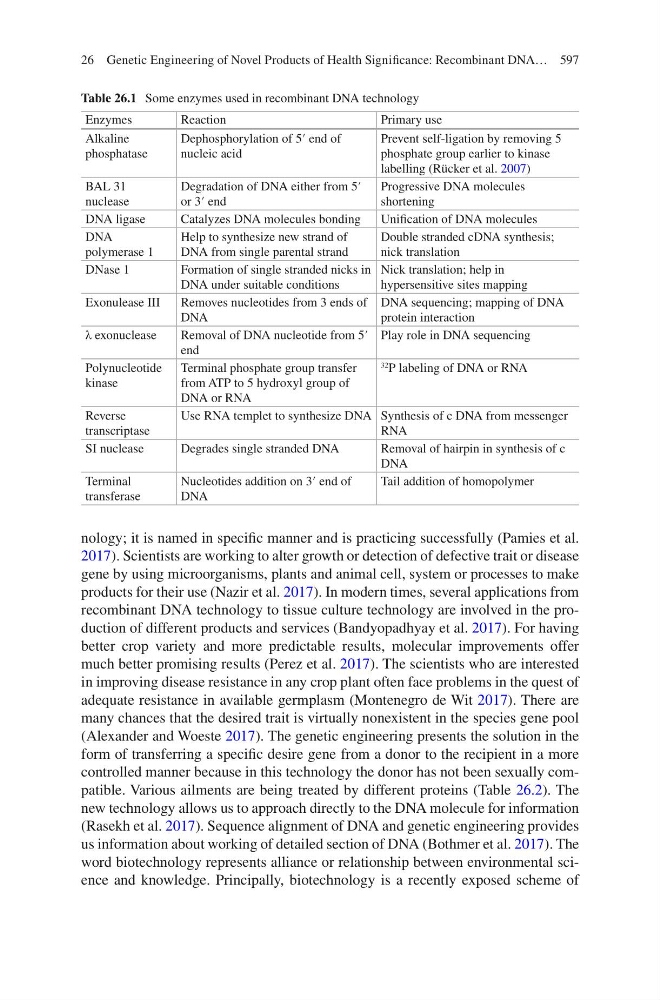
Table 26.1 Some enzymes used in recombinant DNA technology
Enzymes
Reaction
Primary use
Alkaline
phosphatase
Dephosphorylation of 5′ end of
nucleic acid
Prevent self-ligation by removing 5
phosphate group earlier to kinase
labelling (Rücker et al. 2007)
BAL 31
nuclease
Degradation of DNA either from 5′
or 3′ end
Progressive DNA molecules
shortening
DNA ligase
Catalyzes DNA molecules bonding
Unification of DNA molecules
DNA
polymerase 1
Help to synthesize new strand of
DNA from single parental strand
Double stranded cDNA synthesis;
nick translation
DNase 1
Formation of single stranded nicks in
DNA under suitable conditions
Nick translation; help in
hypersensitive sites mapping
Exonulease III
Removes nucleotides from 3 ends of
DNA
DNA sequencing; mapping of DNA
protein interaction
λ exonuclease
Removal of DNA nucleotide from 5′
end
Play role in DNA sequencing
Polynucleotide
kinase
Terminal phosphate group transfer
from ATP to 5 hydroxyl group of
DNA or RNA
32 P labeling of DNA or RNA
Reverse
transcriptase
Use RNA templet to synthesize DNA Synthesis of c DNA from messenger
RNA
SI nuclease
Degrades single stranded DNA
Removal of hairpin in synthesis of c
DNA
Terminal
transferase
Nucleotides addition on 3′ end of
DNA
Tail addition of homopolymer
26 Genetic Engineering of Novel Products of Health Significance: Recombinant DNA…