

48
Hemicelluloses are water-soluble polysaccharides of low degree of polymerization (100–200). While cellulose is made of a linear chain of glucose homopolymer,
hemicelluloses are branched heteropolymers made of many different sugars such as
glucose, mannose, galactose, xylose, and arabinose. Sugar ratio changes from plant
to plant (Kamhi et al. 2013).
4.3.3 Glucomanan
These are fibrous polysaccharides with molecular formula C 24 H 42 O 21 that has a high
molecular weight (average: 1,000,000 Daltons) and can absorb up to 50 times its
weight in water, making it one of the most sticky dietary fibers (Tester and
Al-Ghazzewi 2013). Glucomanan is a fermentable dietary fiber that is usually
extracted from the tuber of the elephant yam (Amorphophallus konjac or
Amorphophallus rivieri). It consists of a polysaccharide chain of β-D-glucose and
β-D-mannose with acetyl groups attached in a molar ratio of 5:8. This ratio varies
among different species with β-1–4 linkages (Tester and Al-Ghazzewi 2013). The
basic polymeric repeating unit has the pattern: GGMMGMMMMMGGM, with
branching through β-(1 → 3)- and β-(1 → 6)-glucosyl linkages (Fig. 4.6). Acetate
groups occur on C-6 in every 9–19 units of the main chain. The fact that the human
salivary and pancreatic amylase cannot split β-1, 4 linkages, glucomannan passes
relatively unchanged into the colon, where it is highly fermented by resident colonic
bacteria (Tester and Al-Ghazzewi 2013).
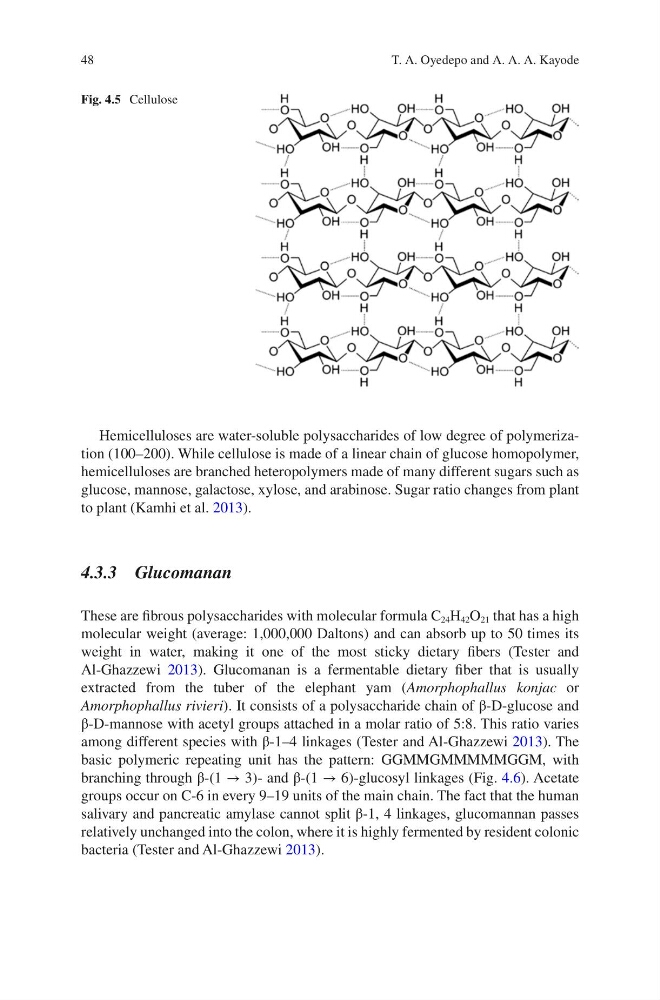
Fig. 4.5 Cellulose
T. A. Oyedepo and A. A. A. Kayode
Hemicelluloses are water-soluble polysaccharides of low degree of polymerization (100–200). While cellulose is made of a linear chain of glucose homopolymer,
hemicelluloses are branched heteropolymers made of many different sugars such as
glucose, mannose, galactose, xylose, and arabinose. Sugar ratio changes from plant
to plant (Kamhi et al. 2013).
4.3.3 Glucomanan
These are fibrous polysaccharides with molecular formula C 24 H 42 O 21 that has a high
molecular weight (average: 1,000,000 Daltons) and can absorb up to 50 times its
weight in water, making it one of the most sticky dietary fibers (Tester and
Al-Ghazzewi 2013). Glucomanan is a fermentable dietary fiber that is usually
extracted from the tuber of the elephant yam (Amorphophallus konjac or
Amorphophallus rivieri). It consists of a polysaccharide chain of β-D-glucose and
β-D-mannose with acetyl groups attached in a molar ratio of 5:8. This ratio varies
among different species with β-1–4 linkages (Tester and Al-Ghazzewi 2013). The
basic polymeric repeating unit has the pattern: GGMMGMMMMMGGM, with
branching through β-(1 → 3)- and β-(1 → 6)-glucosyl linkages (Fig. 4.6). Acetate
groups occur on C-6 in every 9–19 units of the main chain. The fact that the human
salivary and pancreatic amylase cannot split β-1, 4 linkages, glucomannan passes
relatively unchanged into the colon, where it is highly fermented by resident colonic
bacteria (Tester and Al-Ghazzewi 2013).
Fig. 4.5 Cellulose
T. A. Oyedepo and A. A. A. Kayode