

49
4.3.4 Pectins
Pectins are natural plant carbohydrates which are complicated in terms of their
chemical composition as well as their physico-chemical structure. It is a heteropolysaccharide which is often present in the primary cell walls of terrestrial plants. It is
a polymer with a core of alternating α-1,4-linked D-galacturonic acid and α-1,2- Lrhamnose units, including a variety of neutral sugars such as arabinose, galactose,
and a few units of other sugars. The amount, structure and chemical composition of
pectin may be different among various plants. They may also differ within a plant
over time, just as they may differ in various parts of a plant (Kamhi et al. 2013).
Pectins are soluble in alkaline water. They provide flexibility to plants and play a
role in plant growth. They equally play important roles in the cell wall structure,
cell–cell adhesion, cell development, morphogenesis, defense, signaling, cell
expansion, wall porosity, binding of ions, growth factors and enzymes, pollen tube
growth, seed hydration, leaf abscission, and fruit development (Kamhi et al. 2013).
Many bioactive pectic polysaccharides have been isolated from plants. They contain some defined structural units: homogalacturonans (HG), rhamnogalacturonan I
(RGI), and substituted galacturonans such as rhamnogalacturonan II (RGII) (Ho
et al. 2016). The familiar components of pectin with anti-cancer potentials are HG
and RGI. The most predominant region of pectin is HG (Fig. 4.7), composed principally of a homopolymer of (1 → 4)-linked α-D-galacturonic acid (GalA) partially
methylated at C-6 (Ho et al. 2016).
The degree of methylation (DE) refers to the ratio between methylated and nonmethylated GalA. Pectin with high DE has 50% or more methyl ester groups on the
HG backbone and are known as HM pectin while pectin with low DE (LM pectin)
have fewer than 50% methyl ester groups on the HG backbone. The methyl-ester
content is particularly important in pectin research as it strongly determines the
physical properties of pectin. The GalA residues at O-2 and O-3 may also be partially esterified with acetic acid in certain plant species such as sugar beet (Jiang
et al. 2016). Similarly, the ratio between acetylated and non- acetylated GalA is
referred to as the degree of acetylation (DAc).
H
CH 2 OH
CH 2 OH
CH 2 OH
6
CH 2 OCOCH 3
H
H
H
OH
OH
H
Glucose
Glucose with
acetate group
on carbon 6
Mannose
Mannose
H H
OH
OH
H
H H
O
O
H
H
OH
H
H
HO H
O
O
O
H
H
OH
H
H
HO H
O
O
O
1
2
3
4
5
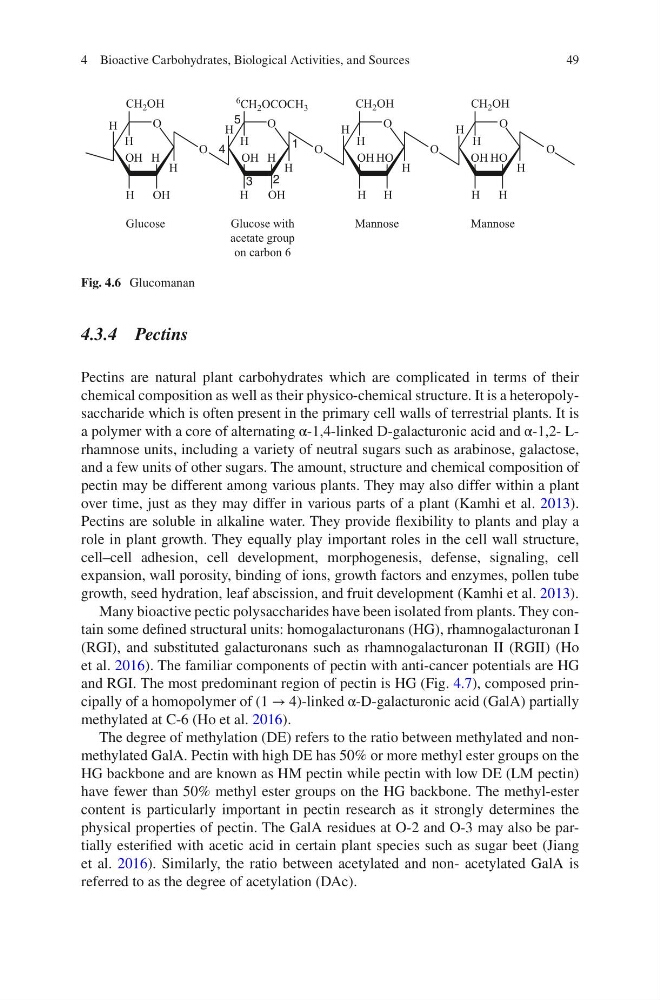
Fig. 4.6 Glucomanan
4 Bioactive Carbohydrates, Biological Activities, and Sources
4.3.4 Pectins
Pectins are natural plant carbohydrates which are complicated in terms of their
chemical composition as well as their physico-chemical structure. It is a heteropolysaccharide which is often present in the primary cell walls of terrestrial plants. It is
a polymer with a core of alternating α-1,4-linked D-galacturonic acid and α-1,2- Lrhamnose units, including a variety of neutral sugars such as arabinose, galactose,
and a few units of other sugars. The amount, structure and chemical composition of
pectin may be different among various plants. They may also differ within a plant
over time, just as they may differ in various parts of a plant (Kamhi et al. 2013).
Pectins are soluble in alkaline water. They provide flexibility to plants and play a
role in plant growth. They equally play important roles in the cell wall structure,
cell–cell adhesion, cell development, morphogenesis, defense, signaling, cell
expansion, wall porosity, binding of ions, growth factors and enzymes, pollen tube
growth, seed hydration, leaf abscission, and fruit development (Kamhi et al. 2013).
Many bioactive pectic polysaccharides have been isolated from plants. They contain some defined structural units: homogalacturonans (HG), rhamnogalacturonan I
(RGI), and substituted galacturonans such as rhamnogalacturonan II (RGII) (Ho
et al. 2016). The familiar components of pectin with anti-cancer potentials are HG
and RGI. The most predominant region of pectin is HG (Fig. 4.7), composed principally of a homopolymer of (1 → 4)-linked α-D-galacturonic acid (GalA) partially
methylated at C-6 (Ho et al. 2016).
The degree of methylation (DE) refers to the ratio between methylated and nonmethylated GalA. Pectin with high DE has 50% or more methyl ester groups on the
HG backbone and are known as HM pectin while pectin with low DE (LM pectin)
have fewer than 50% methyl ester groups on the HG backbone. The methyl-ester
content is particularly important in pectin research as it strongly determines the
physical properties of pectin. The GalA residues at O-2 and O-3 may also be partially esterified with acetic acid in certain plant species such as sugar beet (Jiang
et al. 2016). Similarly, the ratio between acetylated and non- acetylated GalA is
referred to as the degree of acetylation (DAc).
H
CH 2 OH
CH 2 OH
CH 2 OH
6
CH 2 OCOCH 3
H
H
H
OH
OH
H
Glucose
Glucose with
acetate group
on carbon 6
Mannose
Mannose
H H
OH
OH
H
H H
O
O
H
H
OH
H
H
HO H
O
O
O
H
H
OH
H
H
HO H
O
O
O
1
2
3
4
5
Fig. 4.6 Glucomanan
4 Bioactive Carbohydrates, Biological Activities, and Sources