

47
ate or low molecular weight β-glucans (e.g. glucan phosphate) possess biological
activity in vivo, but their cellular effects are less clear. Very short β-glucans
i.e. <5000–10,000 molecular weight (e.g. laminarin) are generally considered
inactive (El Khoury et al. 2011).
4.3.2 Cellulose and Hemicelluloses
Cellulose is the most abundant organic chemical on earth because it is the main
component of plant skeleton (Credou and Berthelot 2014). Apart from plants that
are the dominant cellulose suppliers, algae, bacteria, and fungi also produce cellulose. Thus, millions of tons are biosynthesized annually, thereby leading cellulose
to be considered an almost inexhaustible polymeric raw material (Klemm et al.
2011). The conventional sources of cellulose are wood pulp and cotton linters
(Kamhi et al. 2013). Cellulose obtained from seed hairs of the cotton plant occurs in
almost pure form. In contrast, cell wall of woody plants provides a composite material mainly made of cellulose, hemicelluloses, and lignin. It may also contain pectin,
extractives such as waxes, or even proteins (Kamhi et al. 2013). The sources and
potential health benefits of bioactive carbohydrates from higher plants were presented in Table 4.2.
Cellulose consists of several hundreds of β – (1 → 4) linked D-glucose units in a
linear chain. A good number of these polysaccharide chains are arranged in parallel
arrays to form cellulose microfibrils. Each of the polysaccharide chains in the
microfibrils is bound together by hydrogen bonds (Fig. 4.5) which makes the microfibrils to be exceedingly tough and inflexible. Furthermore, the microfibrils are
bundled together to form macrofibrils (Synytsya and Novák 2013). This tensile
strength of the cellulose makes it a very useful organic molecule because it does not
bind with water nor change form in the digestive tract (Onofrei and Filimon 2016).
Cellulose in the form of its dietary fiber plays a very important role in human
nutrition as they are crucial for healthy digestion and health of the human gut.
Dietary cellulose is thought not to be digested in the stomach and small intestine
since about 85% can be recovered in ileostomy contents from subjects fed diets
containing usually eaten foods. However, in the large intestine, it is fermented by
gut microflora leading to the production of short-chain fatty acids, methane, hydrogen and carbon dioxide (Chen et al. 2011).
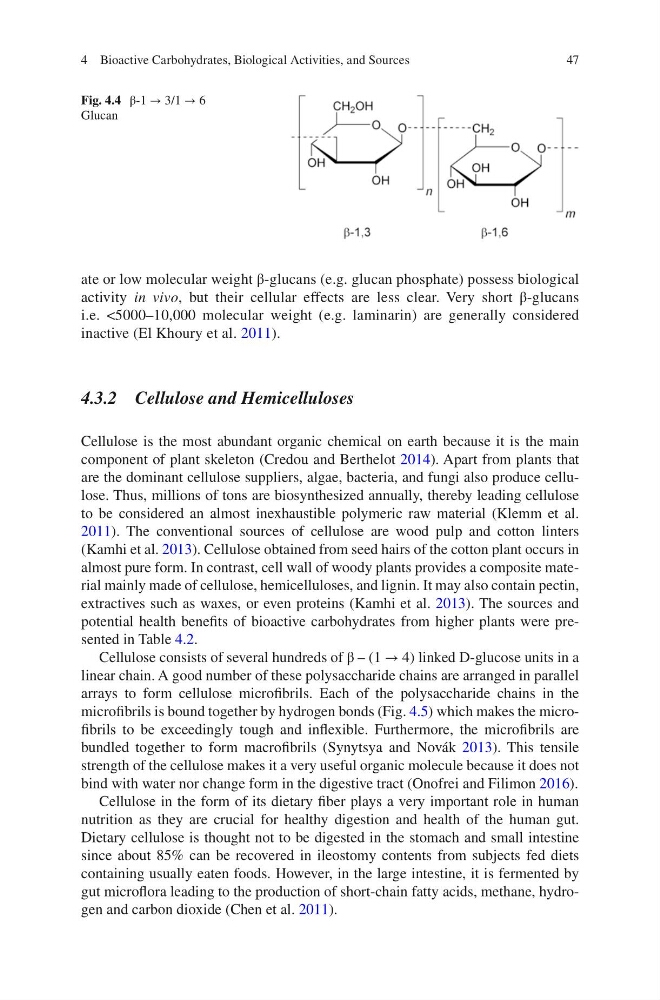
Fig. 4.4 β-1 → 3/1 → 6
Glucan
4 Bioactive Carbohydrates, Biological Activities, and Sources
ate or low molecular weight β-glucans (e.g. glucan phosphate) possess biological
activity in vivo, but their cellular effects are less clear. Very short β-glucans
i.e. <5000–10,000 molecular weight (e.g. laminarin) are generally considered
inactive (El Khoury et al. 2011).
4.3.2 Cellulose and Hemicelluloses
Cellulose is the most abundant organic chemical on earth because it is the main
component of plant skeleton (Credou and Berthelot 2014). Apart from plants that
are the dominant cellulose suppliers, algae, bacteria, and fungi also produce cellulose. Thus, millions of tons are biosynthesized annually, thereby leading cellulose
to be considered an almost inexhaustible polymeric raw material (Klemm et al.
2011). The conventional sources of cellulose are wood pulp and cotton linters
(Kamhi et al. 2013). Cellulose obtained from seed hairs of the cotton plant occurs in
almost pure form. In contrast, cell wall of woody plants provides a composite material mainly made of cellulose, hemicelluloses, and lignin. It may also contain pectin,
extractives such as waxes, or even proteins (Kamhi et al. 2013). The sources and
potential health benefits of bioactive carbohydrates from higher plants were presented in Table 4.2.
Cellulose consists of several hundreds of β – (1 → 4) linked D-glucose units in a
linear chain. A good number of these polysaccharide chains are arranged in parallel
arrays to form cellulose microfibrils. Each of the polysaccharide chains in the
microfibrils is bound together by hydrogen bonds (Fig. 4.5) which makes the microfibrils to be exceedingly tough and inflexible. Furthermore, the microfibrils are
bundled together to form macrofibrils (Synytsya and Novák 2013). This tensile
strength of the cellulose makes it a very useful organic molecule because it does not
bind with water nor change form in the digestive tract (Onofrei and Filimon 2016).
Cellulose in the form of its dietary fiber plays a very important role in human
nutrition as they are crucial for healthy digestion and health of the human gut.
Dietary cellulose is thought not to be digested in the stomach and small intestine
since about 85% can be recovered in ileostomy contents from subjects fed diets
containing usually eaten foods. However, in the large intestine, it is fermented by
gut microflora leading to the production of short-chain fatty acids, methane, hydrogen and carbon dioxide (Chen et al. 2011).
Fig. 4.4 β-1 → 3/1 → 6
Glucan
4 Bioactive Carbohydrates, Biological Activities, and Sources