

46
gives stability to β-glucan and reduces its ability to form aggregates, hence, the
solubility of β-glucan is greatly affected by such a trend (Ahmad et al. 2012; Sikora
et al. 2013). Other names for β-Glucans include β- Glycans, β-1, 3-glucan, and β-1,
3/1, 6-glycan (Synytsya and Novák 2013).
The effectiveness of β- glucan against various diseases and disorders have been
established in various studies. Some of these scientific reported the tendency of βglucan to reduce the onset of colorectal cancer (Xu et al. 2013), increase stool bulk
and provide assistance against constipation (Ahmad et al. 2012), reduce glycemic
index, flatten postprandial blood glucose levels and insulin rises, prevent insulin
resistance, reduce serum cholesterol levels, produce short-chain fatty acids (Wang
et al. 2013), prevent coronary heart disease, prevent hepatic damage (Karaduman
et al. 2010), and promote the growth of beneficial gut microflora (Ahmad et al.
2012; El Khoury et al. 2011).
Additionally, it is important to note that β-Glucans obtained from different
sources do have variations in their structure. The physicochemical properties of
β-glucans, therefore, have a direct relationship with the characteristics of their primary structure. This includes- molecular weight, linkage type, degree of branching,
and conformation (Synytsya and Novák 2013). The most common forms of
β-glucans are those comprising D-glucose units with β-1 → 3 links. β-glucan found
in yeast and mushrooms contains 1 → 3-glucan linkages and occasionally 1 → 6
linkages. Meanwhile, the β-glucans from grains (i.e., oats and barley) contains
1 → 3 and 1 → 4 linkages (Synytsya and Novák 2013). Mushrooms form α (1 → 3)
or β (1 → 3) or (1 → 6) linkages but it can also form heteroglycans containing other
sugars like arabinose, mannose, fucose, galactose, xylose, etc. They can also bind to
protein residues as it is found in PSP (polysaccharide–protein) complexes. The
yeast-derived β-1 → 3/1 → 6 glucan supposedly has greater biological activity than
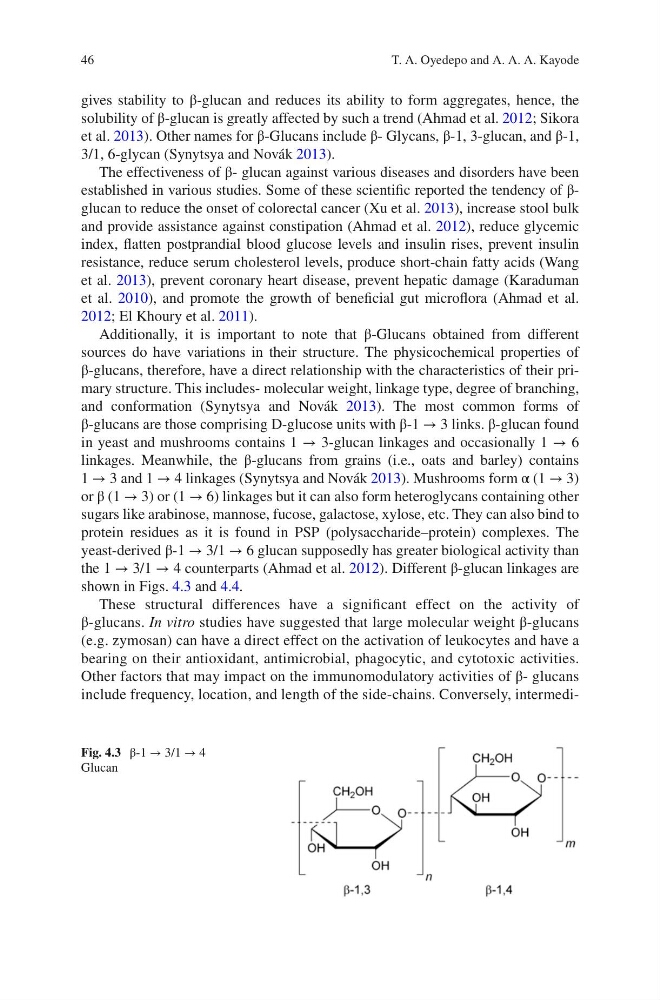
the 1 → 3/1 → 4 counterparts (Ahmad et al. 2012). Different β-glucan linkages are
shown in Figs. 4.3 and 4.4.
These structural differences have a significant effect on the activity of
β-glucans. In vitro studies have suggested that large molecular weight β-glucans
(e.g. zymosan) can have a direct effect on the activation of leukocytes and have a
bearing on their antioxidant, antimicrobial, phagocytic, and cytotoxic activities.
Other factors that may impact on the immunomodulatory activities of β- glucans
include frequency, location, and length of the side-chains. Conversely, intermediFig. 4.3 β-1 → 3/1 → 4
Glucan
T. A. Oyedepo and A. A. A. Kayode
gives stability to β-glucan and reduces its ability to form aggregates, hence, the
solubility of β-glucan is greatly affected by such a trend (Ahmad et al. 2012; Sikora
et al. 2013). Other names for β-Glucans include β- Glycans, β-1, 3-glucan, and β-1,
3/1, 6-glycan (Synytsya and Novák 2013).
The effectiveness of β- glucan against various diseases and disorders have been
established in various studies. Some of these scientific reported the tendency of βglucan to reduce the onset of colorectal cancer (Xu et al. 2013), increase stool bulk
and provide assistance against constipation (Ahmad et al. 2012), reduce glycemic
index, flatten postprandial blood glucose levels and insulin rises, prevent insulin
resistance, reduce serum cholesterol levels, produce short-chain fatty acids (Wang
et al. 2013), prevent coronary heart disease, prevent hepatic damage (Karaduman
et al. 2010), and promote the growth of beneficial gut microflora (Ahmad et al.
2012; El Khoury et al. 2011).
Additionally, it is important to note that β-Glucans obtained from different
sources do have variations in their structure. The physicochemical properties of
β-glucans, therefore, have a direct relationship with the characteristics of their primary structure. This includes- molecular weight, linkage type, degree of branching,
and conformation (Synytsya and Novák 2013). The most common forms of
β-glucans are those comprising D-glucose units with β-1 → 3 links. β-glucan found
in yeast and mushrooms contains 1 → 3-glucan linkages and occasionally 1 → 6
linkages. Meanwhile, the β-glucans from grains (i.e., oats and barley) contains
1 → 3 and 1 → 4 linkages (Synytsya and Novák 2013). Mushrooms form α (1 → 3)
or β (1 → 3) or (1 → 6) linkages but it can also form heteroglycans containing other
sugars like arabinose, mannose, fucose, galactose, xylose, etc. They can also bind to
protein residues as it is found in PSP (polysaccharide–protein) complexes. The
yeast-derived β-1 → 3/1 → 6 glucan supposedly has greater biological activity than
the 1 → 3/1 → 4 counterparts (Ahmad et al. 2012). Different β-glucan linkages are
shown in Figs. 4.3 and 4.4.
These structural differences have a significant effect on the activity of
β-glucans. In vitro studies have suggested that large molecular weight β-glucans
(e.g. zymosan) can have a direct effect on the activation of leukocytes and have a
bearing on their antioxidant, antimicrobial, phagocytic, and cytotoxic activities.
Other factors that may impact on the immunomodulatory activities of β- glucans
include frequency, location, and length of the side-chains. Conversely, intermediFig. 4.3 β-1 → 3/1 → 4
Glucan
T. A. Oyedepo and A. A. A. Kayode