

418
required for photosynthesis of plants, like β-carotene, violaxanthin, and neoxanthin
while secondary carotenoids do not possess photosynthetic activities and are
localized in plants fruits or flowers, which include antheraxanthin, capsanthin,
capsorubin, zeaxanthin, α-carotene, and β-cryptoxanthin (Lichtenhaler 1987).
20.3 Distributions of Carotenoids
Carotenoids are pigments, which occur widely in nature. They are hydrophobic,
lipophilic and insoluble in water. They are however, soluble in organic solvents
including chloroform, alcohol and acetone (Thane and Reddy 1997). Their soluble
nature has enhanced their occurrence in different natural sources. They are found in
both photosynthetic and non-photosynthetic organisms distributed in a broad class
of plants, algae, bacteria and fungi (Delgado-Vargas et al. 2000). Natural sources of
carotenoids include vegetables and colored fruits (Ambrósio et al. 2006). Lycopene
are mostly found in tomatoes and its products (juices, ketchup, sauces and soups)
(Tavares and Rodriguez-Amaya 1994). í µí»½-carotenes are most abundant in food
sources expressing higher activities of provitamin A (Mezzomo and Ferreira 2016).
β-carotene are abundant in Canarium odontophyllum Miq (Prasad et al. 2011). β
carotene and α-carotene are also found in apricots, cantaloupe, carrots, pumpkin
and sweet potato. β-carotene, phytofluene and phytoene are found in watermelon,
grapefruit as well as in tomatoes (Paiva and Russell 1999). Lutein are abundant in
mangoes, oranges, papaya, peaches, prunes, spinach and squash (Paiva and Russell
1999). β-cryptoxanthin are found in citrus fruits, papaya and peach (Sugiura et al.
2002). Zeaxanthin, the dihydroxylated form of β-carotene is found in corn and varieties of vegetables (Nishino et al. 2002). Zeaxanthin are found in corn, alfalfa, wolfberry and marigold flowers (Nelis and DeLeenheer 1991; Chang et al. 2010).
Table 20.1 summaries some plant sources of carotenoids.
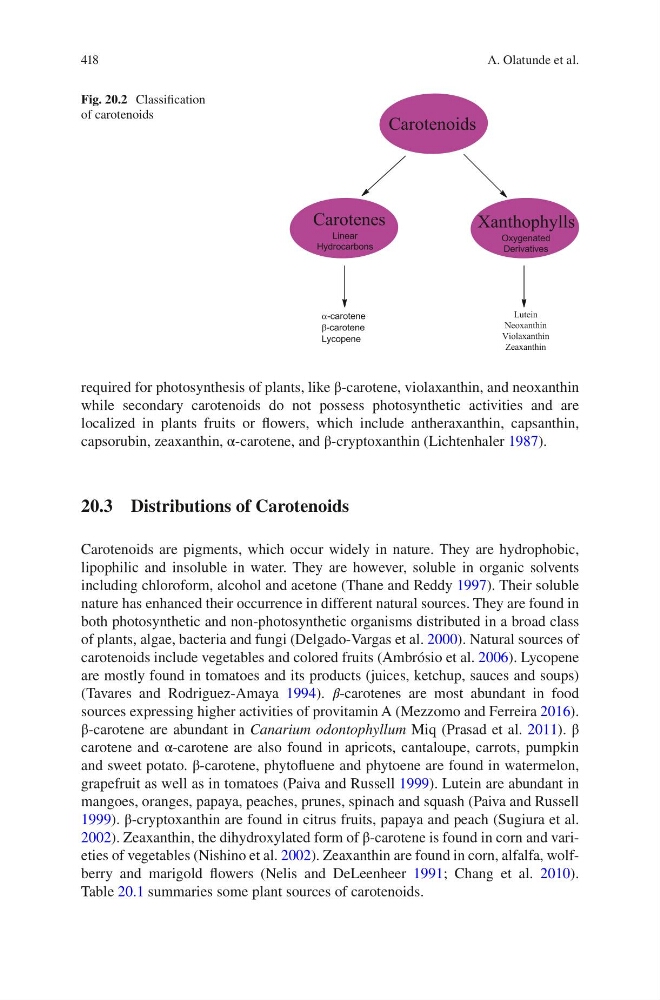
Fig. 20.2 Classification
of carotenoids
A. Olatunde et al.
required for photosynthesis of plants, like β-carotene, violaxanthin, and neoxanthin
while secondary carotenoids do not possess photosynthetic activities and are
localized in plants fruits or flowers, which include antheraxanthin, capsanthin,
capsorubin, zeaxanthin, α-carotene, and β-cryptoxanthin (Lichtenhaler 1987).
20.3 Distributions of Carotenoids
Carotenoids are pigments, which occur widely in nature. They are hydrophobic,
lipophilic and insoluble in water. They are however, soluble in organic solvents
including chloroform, alcohol and acetone (Thane and Reddy 1997). Their soluble
nature has enhanced their occurrence in different natural sources. They are found in
both photosynthetic and non-photosynthetic organisms distributed in a broad class
of plants, algae, bacteria and fungi (Delgado-Vargas et al. 2000). Natural sources of
carotenoids include vegetables and colored fruits (Ambrósio et al. 2006). Lycopene
are mostly found in tomatoes and its products (juices, ketchup, sauces and soups)
(Tavares and Rodriguez-Amaya 1994). í µí»½-carotenes are most abundant in food
sources expressing higher activities of provitamin A (Mezzomo and Ferreira 2016).
β-carotene are abundant in Canarium odontophyllum Miq (Prasad et al. 2011). β
carotene and α-carotene are also found in apricots, cantaloupe, carrots, pumpkin
and sweet potato. β-carotene, phytofluene and phytoene are found in watermelon,
grapefruit as well as in tomatoes (Paiva and Russell 1999). Lutein are abundant in
mangoes, oranges, papaya, peaches, prunes, spinach and squash (Paiva and Russell
1999). β-cryptoxanthin are found in citrus fruits, papaya and peach (Sugiura et al.
2002). Zeaxanthin, the dihydroxylated form of β-carotene is found in corn and varieties of vegetables (Nishino et al. 2002). Zeaxanthin are found in corn, alfalfa, wolfberry and marigold flowers (Nelis and DeLeenheer 1991; Chang et al. 2010).
Table 20.1 summaries some plant sources of carotenoids.
Fig. 20.2 Classification
of carotenoids
A. Olatunde et al.