

417
tetrahydrofuran, ethyl acetate) and regarded as non-saponifiable fats (Pradas-Baena
et al. 2015; Uthayakumaran and Wrigley 2017). Carotenoids are the most widespread pigment in nature and they have received commendable level of attention
because of their provitamin and antioxidant functions (Zakynthinos and Varzakas
2016). Majority of these poly-isoprenoid hydrocarbons like the carotene are utilized
for the synthesis of vitamin A in the body. But other carotenoids like lutein and
lycopene exhibit no activity of vitamin A (Wolak and Paran 2013). The major source
of this bioactive compounds in the plasma of humans are vegetables and fruits
(Heber and Lu 2002). Lycopene is extensively found in pink guava, pink grapefruit,
tomatoes, papaya and watermelon while lutein is mostly found in persimmons,
maize and leafy vegetables like kale, spinach and broccoli (Nagarajan et al. 2017).
They are mainly used as feeds, cosmetics and natural colorant for food as well as
important for photosynthesis and plant growth (Olson 1987; Zakynthinos and
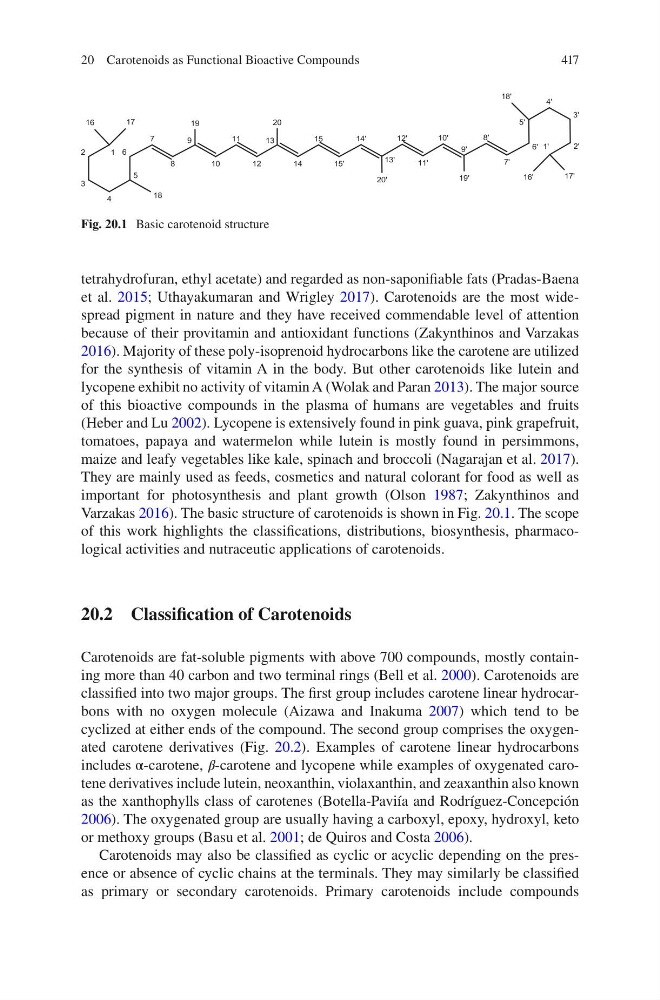
Varzakas 2016). The basic structure of carotenoids is shown in Fig. 20.1. The scope
of this work highlights the classifications, distributions, biosynthesis, pharmacological activities and nutraceutic applications of carotenoids.
20.2 Classification of Carotenoids
Carotenoids are fat-soluble pigments with above 700 compounds, mostly containing more than 40 carbon and two terminal rings (Bell et al. 2000). Carotenoids are
classified into two major groups. The first group includes carotene linear hydrocarbons with no oxygen molecule (Aizawa and Inakuma 2007) which tend to be
cyclized at either ends of the compound. The second group comprises the oxygenated carotene derivatives (Fig. 20.2). Examples of carotene linear hydrocarbons
includes α-carotene, í µí»½-carotene and lycopene while examples of oxygenated carotene derivatives include lutein, neoxanthin, violaxanthin, and zeaxanthin also known
as the xanthophylls class of carotenes (Botella-Paviía and Rodríguez-Concepción
2006). The oxygenated group are usually having a carboxyl, epoxy, hydroxyl, keto
or methoxy groups (Basu et al. 2001; de Quiros and Costa 2006).
Carotenoids may also be classified as cyclic or acyclic depending on the presence or absence of cyclic chains at the terminals. They may similarly be classified
as primary or secondary carotenoids. Primary carotenoids include compounds
Fig. 20.1 Basic carotenoid structure
20 Carotenoids as Functional Bioactive Compounds
tetrahydrofuran, ethyl acetate) and regarded as non-saponifiable fats (Pradas-Baena
et al. 2015; Uthayakumaran and Wrigley 2017). Carotenoids are the most widespread pigment in nature and they have received commendable level of attention
because of their provitamin and antioxidant functions (Zakynthinos and Varzakas
2016). Majority of these poly-isoprenoid hydrocarbons like the carotene are utilized
for the synthesis of vitamin A in the body. But other carotenoids like lutein and
lycopene exhibit no activity of vitamin A (Wolak and Paran 2013). The major source
of this bioactive compounds in the plasma of humans are vegetables and fruits
(Heber and Lu 2002). Lycopene is extensively found in pink guava, pink grapefruit,
tomatoes, papaya and watermelon while lutein is mostly found in persimmons,
maize and leafy vegetables like kale, spinach and broccoli (Nagarajan et al. 2017).
They are mainly used as feeds, cosmetics and natural colorant for food as well as
important for photosynthesis and plant growth (Olson 1987; Zakynthinos and
Varzakas 2016). The basic structure of carotenoids is shown in Fig. 20.1. The scope
of this work highlights the classifications, distributions, biosynthesis, pharmacological activities and nutraceutic applications of carotenoids.
20.2 Classification of Carotenoids
Carotenoids are fat-soluble pigments with above 700 compounds, mostly containing more than 40 carbon and two terminal rings (Bell et al. 2000). Carotenoids are
classified into two major groups. The first group includes carotene linear hydrocarbons with no oxygen molecule (Aizawa and Inakuma 2007) which tend to be
cyclized at either ends of the compound. The second group comprises the oxygenated carotene derivatives (Fig. 20.2). Examples of carotene linear hydrocarbons
includes α-carotene, í µí»½-carotene and lycopene while examples of oxygenated carotene derivatives include lutein, neoxanthin, violaxanthin, and zeaxanthin also known
as the xanthophylls class of carotenes (Botella-Paviía and Rodríguez-Concepción
2006). The oxygenated group are usually having a carboxyl, epoxy, hydroxyl, keto
or methoxy groups (Basu et al. 2001; de Quiros and Costa 2006).
Carotenoids may also be classified as cyclic or acyclic depending on the presence or absence of cyclic chains at the terminals. They may similarly be classified
as primary or secondary carotenoids. Primary carotenoids include compounds
Fig. 20.1 Basic carotenoid structure
20 Carotenoids as Functional Bioactive Compounds