

419
Carotenoids also occur in some microorganisms having the ability to produce
them but not in animals, which obtain them through their various sources from the
diet (de Quirós and Costa 2006). Astaxanthin are synthesize in large quantities by
Chlorella vulgaris, Phaffia rhodozyma and Haematococcus pluvialis (Yin et al.
2013; Kim et al. 2016). Some microorganisms are similarly capable of synthesizing
astaxanthin, canthaxanthin, lutein, lycopene, zeaxanthin, β-cryptoxanthin,
β-carotene (Bhosale 2004; Bhosale and Bernstein 2005). β-carotene and zeaxanthin
are produced by the microalgae Dunaliella salina and Flavobacterium sp. respectively (Masetto et al. 2001; Pisal and Lele 2005).
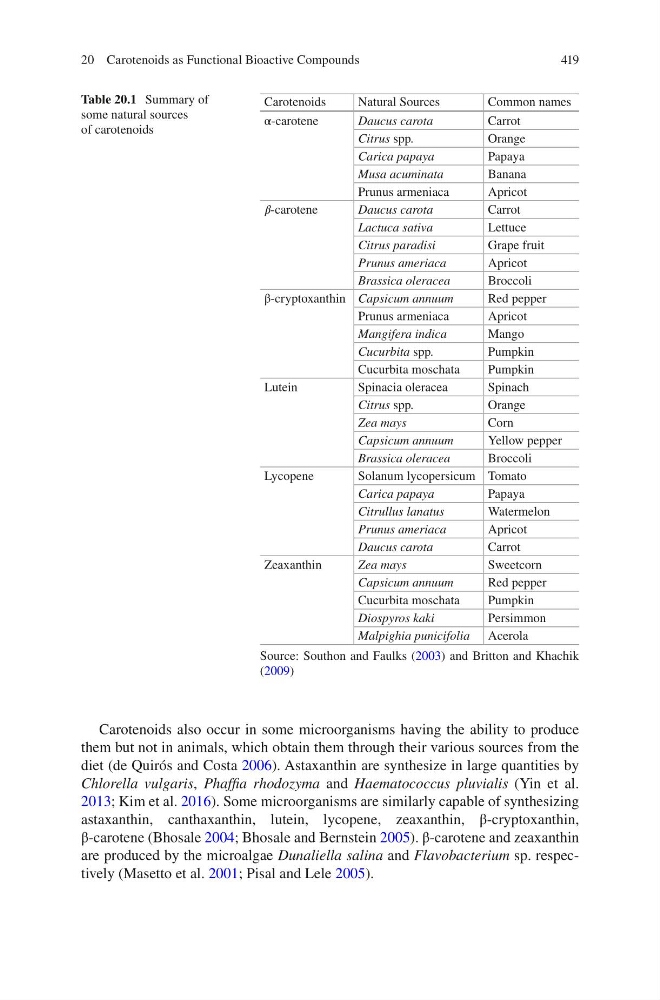
Table 20.1 Summary of
some natural sources
of carotenoids
Carotenoids
Natural Sources
Common names
α-carotene
Daucus carota
Carrot
Citrus spp.
Orange
Carica papaya
Papaya
Musa acuminata
Banana
Prunus armeniaca
Apricot
í µí»½-carotene
Daucus carota
Carrot
Lactuca sativa
Lettuce
Citrus paradisi
Grape fruit
Prunus ameriaca
Apricot
Brassica oleracea
Broccoli
β-cryptoxanthin Capsicum annuum
Red pepper
Prunus armeniaca
Apricot
Mangifera indica
Mango
Cucurbita spp.
Pumpkin
Cucurbita moschata
Pumpkin
Lutein
Spinacia oleracea
Spinach
Citrus spp.
Orange
Zea mays
Corn
Capsicum annuum
Yellow pepper
Brassica oleracea
Broccoli
Lycopene
Solanum lycopersicum Tomato
Carica papaya
Papaya
Citrullus lanatus
Watermelon
Prunus ameriaca
Apricot
Daucus carota
Carrot
Zeaxanthin
Zea mays
Sweetcorn
Capsicum annuum
Red pepper
Cucurbita moschata
Pumpkin
Diospyros kaki
Persimmon
Malpighia punicifolia Acerola
Source: Southon and Faulks (2003) and Britton and Khachik
(2009)
20 Carotenoids as Functional Bioactive Compounds
Carotenoids also occur in some microorganisms having the ability to produce
them but not in animals, which obtain them through their various sources from the
diet (de Quirós and Costa 2006). Astaxanthin are synthesize in large quantities by
Chlorella vulgaris, Phaffia rhodozyma and Haematococcus pluvialis (Yin et al.
2013; Kim et al. 2016). Some microorganisms are similarly capable of synthesizing
astaxanthin, canthaxanthin, lutein, lycopene, zeaxanthin, β-cryptoxanthin,
β-carotene (Bhosale 2004; Bhosale and Bernstein 2005). β-carotene and zeaxanthin
are produced by the microalgae Dunaliella salina and Flavobacterium sp. respectively (Masetto et al. 2001; Pisal and Lele 2005).
Table 20.1 Summary of
some natural sources
of carotenoids
Carotenoids
Natural Sources
Common names
α-carotene
Daucus carota
Carrot
Citrus spp.
Orange
Carica papaya
Papaya
Musa acuminata
Banana
Prunus armeniaca
Apricot
í µí»½-carotene
Daucus carota
Carrot
Lactuca sativa
Lettuce
Citrus paradisi
Grape fruit
Prunus ameriaca
Apricot
Brassica oleracea
Broccoli
β-cryptoxanthin Capsicum annuum
Red pepper
Prunus armeniaca
Apricot
Mangifera indica
Mango
Cucurbita spp.
Pumpkin
Cucurbita moschata
Pumpkin
Lutein
Spinacia oleracea
Spinach
Citrus spp.
Orange
Zea mays
Corn
Capsicum annuum
Yellow pepper
Brassica oleracea
Broccoli
Lycopene
Solanum lycopersicum Tomato
Carica papaya
Papaya
Citrullus lanatus
Watermelon
Prunus ameriaca
Apricot
Daucus carota
Carrot
Zeaxanthin
Zea mays
Sweetcorn
Capsicum annuum
Red pepper
Cucurbita moschata
Pumpkin
Diospyros kaki
Persimmon
Malpighia punicifolia Acerola
Source: Southon and Faulks (2003) and Britton and Khachik
(2009)
20 Carotenoids as Functional Bioactive Compounds